
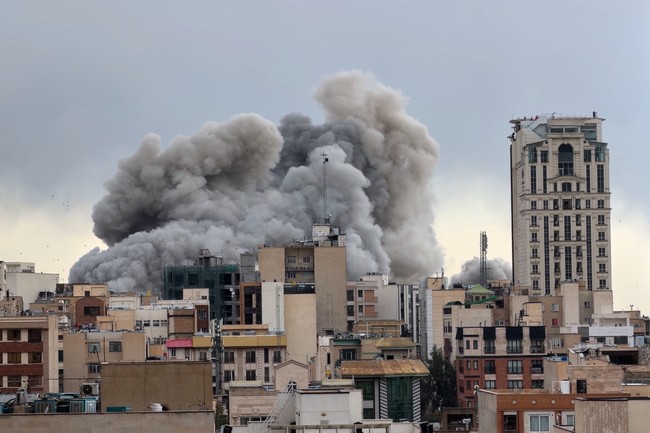
The United States has issued a direct warning to civilians inside Iran, saying the Iranian regime places military assets in populated neighborhoods and risks the lives of ordinary people; U.S. forces stress they take precautions to avoid civilian casualties while noting Iran’s tactics endanger its own citizens and others across the region.
The pattern is grim and familiar: militant groups and regimes have long put weapons and launch sites in the middle of civilian life, and Iran appears to be doing the same on a national scale. CENTCOM has in Iran to shelter in place because those targets are likely to be struck if they are used for military operations. That practice turns schools, hospitals, and apartment blocks into places where the population itself becomes a shield for combatants.
The U.S. warning, quoted below, lays out the core accusation plainly and without euphemism. It says the Iranian regime is using heavily populated civilian areas to launch attacks, and that using such locations for military purposes strips those sites of protected status under international law. The message urges civilians to stay at home to reduce risk, while also making clear that facilities co-opted for military use could be deemed legitimate targets.
The Iranian regime is using heavily populated civilian areas to conduct military operations, including launching one-way attack drones and ballistic missiles. This dangerous decision risks the lives of all civilians in Iran since locations used for military purposes lose protected status and could become legitimate military targets under international law.
Iranian forces are using crowded areas surrounded by civilians in cities such as Dezful, Esfahan and Shiraz to launch attack drones and ballistic missiles.
U.S. forces strongly urge civilians in Iran to stay at home. The Iranian regime is knowingly endangering innocent lives. Additionally, Iranian forces are jeopardizing the safety of innocent people throughout the Middle East by deliberately and indiscriminately targeting civilian airports, hotels, and residential neighborhoods.
The practical problem is how to get that warning to people inside Iran when communications are spotty or cut. The internet has been shut down in large parts of the country since early strikes struck Iranian infrastructure, and we have to wonder what channels remain open for life-saving broadcasts. Does CENTCOM have the means to reach people over local radio, hijack emergency notification systems, or use leaflet drops in places where phones and networks are down? Those are old-school but effective measures when modern networks fail.
Beyond the mechanics of warning distribution, the contrast drawn by U.S. officials is important for how the conflict is framed. U.S. and allied militaries regularly emphasize precautions to avoid civilian harm, investing time and intelligence to strike only legitimate military targets whenever possible. The warning repeats that theme and stresses a distinction in tactics: Iran locates launchers and command nodes inside civilian neighborhoods, while U.S. policy seeks to minimize civilian risk even if it cannot promise perfect safety.
The U.S. military takes every feasible precaution to minimize harm to civilians but cannot guarantee civilian safety in or near facilities used by the Iranian regime for military purposes. Unlike the Iranian regime, U.S. forces do not target or intentionally risk the safety of civilians.
That distinction doesn’t make the reality any easier for residents caught between regimes and retaliatory strikes. If a launcher is embedded in a dense neighborhood, opposing forces face a harrowing choice: leave the launcher in place and accept continued attacks, or strike and risk civilian casualties because the enemy chose that placement. Either way, innocent people suffer when military assets are shielded by the populace.
There is also a political dimension in how these messages are received inside Iran and abroad. When civilian areas are used for military purposes, the regime can later raise complaints about attacks, claiming humanitarian outrage while having created those very conditions. Observers note the pattern of hostile actors weaponizing civilian spaces as a way to complicate responses and to score propaganda points after strikes occur.
For planners and policymakers, warnings like this try to shift some immediate risk away from innocent people by urging sheltering in place, while also documenting the Iranian regime’s choices for an international record. These statements can serve both tactical and public affairs goals: reduce casualties now and build a case later that the regime knowingly placed civilians at risk. In a conflict where every move is scrutinized, recorded warnings matter.
Ultimately, the core fact remains: the Iranian leadership has placed military systems among civilians, and that decision creates grave danger for ordinary Iranians and others in the region. The U.S. message is blunt and meant to be practical—take shelter, avoid known military sites, and recognize that using civilian areas for combat operations changes how those places are viewed under the laws of armed conflict.
Events on the ground will decide how effective the warning is and how many lives are spared, but the strategic and moral line being drawn is clear: a government that endangers its own people by hiding military assets in civilian neighborhoods bears responsibility for the consequences that follow.


Add comment