
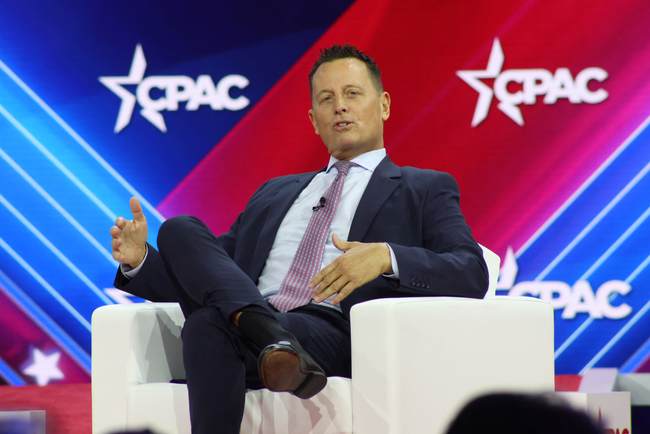
At CPAC 2026 Ric Grenell, former Ambassador to Germany, former DNI, and ex-Kennedy Center president, laid out his take on fixing cultural institutions, the role of tough diplomacy, and why trusting decisive leadership matters for threats from Iran, Cuba, and beyond. He described the Kennedy Center’s physical and financial failures, discussed programming and donor problems, and argued for a State Department filled with pragmatic diplomats who back credible threats. Grenell praised MAGA’s open debate, defended President Trump’s approach to hard choices, and warned Europe about the costs of neglecting defense and immigration. His remarks mixed sharp criticism of prior management with a Republican view that action beats words when it comes to national security and American culture.
Grenell opened with a clear account of the Kennedy Center’s condition and the work needed to make it functional again. He framed the problem as years of deferred maintenance and mismanagement that left the complex falling apart and costly to operate. He said the place required more than patchwork fixes: it needed a serious construction reset to restore both structure and reputation.
“Well, you know, one of the things about Washington is that they love to kick the can down the road. They don’t ever solve problems. And we’re so frustrated. You look at the border, you look at any issue. Washington D.C. doesn’t know how to fix problems. President Trump came in, and the then-Kennedy Center, which was financially a mess and structurally a mess.
“I actually think people should go to prison for the deferred maintenance on the Kennedy Center. When you look at what they said that they were gonna do, which was fix the Kennedy Center, they were getting federal dollars to maintain the building: they were not maintaining the building. After 10 years of all that, the place was literally falling apart. Lawsuits from the ceiling falling on cars. Every time there was rain, it poured in through the roof, the sewer system was backed up. Pipes would burst. I arrived, and we didn’t even have the fountains out front that were able to work because they were going down into the parking garage and flooding the parking garage. The marble was literally falling apart.
“President Trump, when I first came, he came over. And we took him to the bowels of the basement. And he saw it immediately. He said, ‘Wow, this place needs to be fixed.’ Some of our engineers were saying we should tear it down and start over. But President Trump said, we’re going to fix it. And we’ve tried to fix it as we’ve gone along. But the best thing to do is to shut it down, turn it into a construction site for two years, bring it back better than ever. We have to do that because of years of neglect, of people literally saying that they were gonna spend money on maintenance, and they didn’t. So, they were lying.”
Beyond the building, Grenell said programming drove away corporate sponsors and audiences. He argued that an arts institution needs broad appeal and reliable revenue to survive and that left-leaning niche programming had hollowed out the donor base. Restoring mainstream hits and technical upgrades would make the center financially viable and culturally relevant again.
“You also think about the programming which was so far left, that corporations had abandoned the place. So, the model of how we paid for the Arts was not working. And let me just say this: the New York Times, which I don’t quote very often, they’ve done two front-page stories about the Arts in America. One was that Broadway was dying. People weren’t buying tickets because the shows were just not the traditional Broadway shows that people wanted to go see. That was one. And two, The Met was 300 million in debt. So, this phenomenon of arts institutions not being able to pay their bills, and ticket sales plummeting. Shame on the media for suddenly holding the then-Kennedy Center to this standard that they didn’t hold the rest of the arts institutions across America to. And we actually stepped out and fixed the problem, and now we’re fixing the building. So, we will be able to say we fixed, financially and physically, the new Trump-Kennedy Center.”
He reviewed cost growth on projects like The Reach and criticized prior management for large overruns and additional borrowing. Grenell said these financial surprises demanded a more businesslike approach to programming and spending. For him, the goal was clear: run the Kennedy Center like a commonsense operation that can pay its bills without recurring debt.
“And then, lastly, I’ll just say the previous administration allowed there to be the building of this brand new section of the Trump-Kennedy Center called ‘The Reach,’ a modern section of that. They told people it would be 100 million dollars to build The Reach. We didn’t need to build it, but they went out and raised, and they said it would be 100 million. When all was said and done, they spent 280 million dollars, not a 100: 280 million dollars and took out a 30 million dollar loan.
“Now, the Washington Post, the New York Times who cover the Trump-Kennedy Center have never printed any of that, because they don’t understand finances. You’ve got these woke arts-culture reporters who all they want to talk about is the latest soprano that’s coming to the Center and how much money we might be paying for this, and how we’re cutting-edge programming. And what I was saying is you need somebody to run this organization more like a commonsense business person. So that when you’re all said and done, you’re paying for these performances without going into debt every single time. You can do it. You’ve just got to have common sense programming that corporations support.”
When the discussion moved to foreign policy, Grenell celebrated MAGA’s willingness to debate and the priority of trusting a president who gets unseen intelligence. He argued that unity rests on confidence in decisive leadership and the idea that leaders must pair diplomatic skill with credible threats. For Grenell, the State Department must be staffed with effective, tough diplomats ready to solve problems short of war.
“First of all, the one thing that I love about the MAGA movement is that we actually have opinions. We share our opinions. We’re proud to be transparent about those opinions, and we try to work through these issues. The Democrats really demand that people just fall in line. Well, we don’t do that. We have a messy debate that sometimes you see it play out. What we’re unified on, though, is trusting President Trump.”
Grenell emphasized negotiation backed by credible consequences as the most effective foreign policy tool. He described negotiations in which a president’s willingness to act, including tariffs or military options, gives diplomats leverage. In his view, a strong mix of offense and savvy diplomacy prevents endless cycles of reaction.
“What I would say is what we just saw from the last panel. They were talking about the need to confront our threats, right? And we all agree that we should confront our threats. But what I want to see, what I’ve advocated for for my career, is that when we confront a threat that we don’t just immediately assume that this goes to the Department of War, or the Pentagon, right? We have to be sophisticated enough to know that if you’re gonna to confront these conflicts and you’re gonna to problem solve them, then you better have a State Department filled with diplomats who are really tough.
“Because nothing is better when you do negotiations — and I’ve done tens of thousands of negotiations. And nothing is better than when you sit in a room, and you’re negotiating as diplomats across the table with a foreign diplomat, and you’re talking about solving a problem, nothing is better than to have the diplomat on the other side know that I’ve got a president of the United States, I’ve got a boss who doesn’t just have a threat: he has credible threat. And when President Trump says, I’m going to do something, and I don’t just mean military action, when President Trump says, if you don’t do X, we are going to increase tariffs. People know, countries know, he’s increasing tariffs. That is going to happen.
“And what I love about this president is that he doesn’t do the typical Washington thing of, you know, we’re going to talk to the Treasury Department or the Commerce Department and the Deputy Assistant of this and that is going to give us a white paper and we’re going to look and study issues. President Trump says Tuesday, if you haven’t moved, we are going to increase tariffs.
“They move, because they don’t want the tariffs increase. This is a difference between a threat, which is what Kamala said, ‘No, don’t.’ And a credible threat, which is President Trump saying, ‘You have until Tuesday.'”
On Iran and Cuba, Grenell defended the administration’s tougher posture, arguing past policies enabled hostile regimes and that decisive action can disrupt those networks. He said diplomacy backed by credible pressure can bring faster, cheaper solutions and prevent wars. He also warned Europe about the consequences of neglecting immigration and defense obligations, arguing NATO must be reinforced and partners held accountable.

Everybody can earn 250$h+ 1k$ daily… You can earn from $6000-$13600 a month or even more if you work as a full time job…It’s easy, just follow instructions on this page, read it carefully from start to finish….. It’s a flexible job but a good earning opportunity. Go to this site home tab for more detail thank you .
Join This Right Now ____________ PayAtHome1.Com