
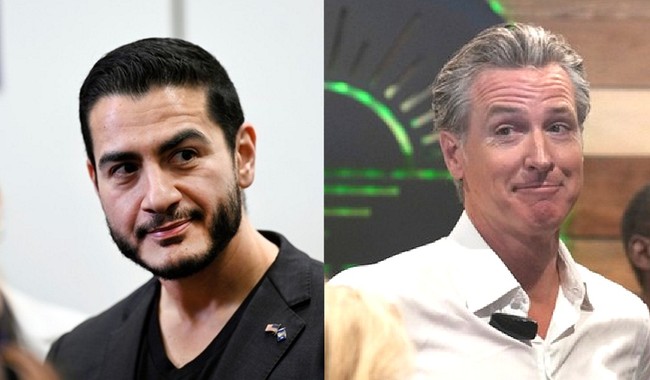
Gavin Newsom is campaigning beyond California while praising Michigan Senate hopeful Abdul El-Sayed, and this piece argues that Newsom’s support for El-Sayed signals alignment with radical left ideas that would be disastrous if replicated nationally.
I joined Gov. Gavin Newsom’s email list recently and quickly noticed a familiar pattern: PR tours and out-of-state grandstanding. The latest notice shows him jetting to Michigan to campaign with Democrats and meet Abdul El-Sayed, a candidate the piece portrays as extreme and divisive.
Newsom’s national ambitions often look like a convenience tour rather than governance for Californians left behind by high taxes and housing shortages. Critics see his travels to red states and media appearances as self-promotion while problems like affordability and energy costs remain unresolved at home.
El-Sayed’s rise has raised alarm bells for many who view his rhetoric as beyond mainstream Democratic politics. The argument laid out here is that backing someone with his record reflects priorities that favor ideology over practical solutions for working families.
From the standpoint of taxpayers and small business owners, the concern is straightforward: emulating California-style policies across other states would likely push out residents and businesses. Higher taxes, heavier regulation, and an emphasis on social and cultural battles over economic growth are central to that worry.
Newsom’s public praise of El-Sayed centers on the governor’s comment that El-Sayed “gets it,” which Newsom repeated when confirming he would meet the candidate. For critics, that line signals approval of a candidate whose style and positions are controversial and, in their view, harmful.
https://x.com/MCGOP_CA/status/2086150162901340507
Supporters of El-Sayed describe him as an energetic organizer who excites progressive voters and can flip tight races. Opponents say energy and enthusiasm do not substitute for sane fiscal policy or respect for pluralistic civic norms, and they fear the long-term governance consequences.
There’s also a broader political angle: Democrats want to hold and flip Senate seats, and big-name endorsements help fundraising and morale. From Newsom’s perspective, aiding a high-profile primary winner could be framed as defending the Senate and national priorities aligned with his vision.
Critics counter that prioritizing national ambitions and out-of-state campaigning while state-level issues fester is irresponsible. They argue governors owe their first loyalty to their own constituents, especially when economic and public-safety pressures demand attention at home.
Election strategists on both sides see the Michigan race as pivotal, and outside investment is already flowing into messaging and ground game. For conservatives and moderate voters alarmed by El-Sayed’s rhetoric, a Newsom endorsement crystallizes fears that a national political project seeks to expand California-style governance.
When political leaders back candidates with polarizing records, it forces voters to choose between a status quo of rising costs and cultural battles or a different path focused on economic growth and local accountability. That choice is central to the critique being made here.
If El-Sayed were to win and then pursue policies similar to those critics attribute to Newsom, the prediction is familiar: higher taxes, increased regulation, and deeper culture-war focus draining attention from practical problems. Opponents view that future as predictable and alarming.
Gavin Newsom has confirmed he will meet with radical Senate hopeful Abdul El-Sayed as he campaigns with Democrats in the battleground state of Michigan.
During a C-SPAN broadcast, a reporter asked the governor Sunday whether he intends to meet with El-Sayed, to which Newsom confirmed, “I’ll be meeting with him tomorrow.”
He continued: “The Senate is in play, and it will go through this state. Getting behind him is going to be important. That’s going to require not just the party here, but support outside of Michigan.”
For many voters outside the progressive bubble, endorsements mean more than words; they signal priorities and likely policy directions. That’s why Newsom’s meeting with El-Sayed is viewed not as benign networking but as an explicit alignment with a candidate the piece casts as radical.
Politics inevitably involves coalition-building, and Democrats see uniting behind a nominee as essential to winning competitive seats in 2026. Conservatives, meanwhile, are using Newsom’s involvement as an example of why nationalizing state-level policies should be resisted.
At the end of the day, the debate boils down to two competing visions: one that pushes progressive, California-style governance nationally, and another that prioritizes economic freedom, lower taxes, and local control. This article takes the latter view and sees Newsom’s actions as validating worst-case scenarios for many voters.


Add comment