
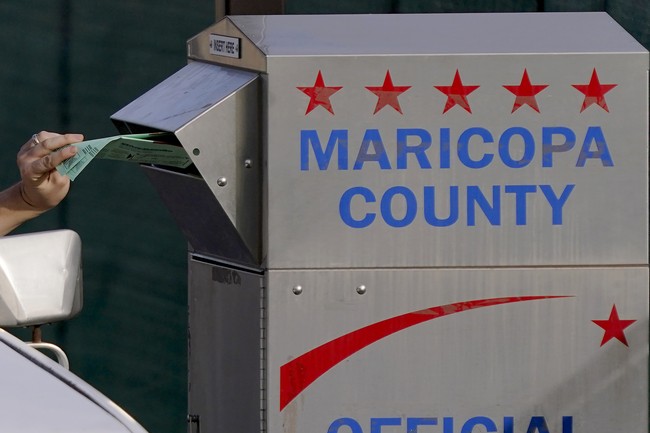
The Maricopa County Recorder’s office, led by Justin Heap, says it achieved a major operational milestone during the 2026 Arizona primary by completing signature verification for early ballots far faster than usual, after a year-and-a-half legal fight with the county Board of Supervisors over control of election systems and staff.
Maricopa County has long been known for slow vote counts, especially for early and mail-in ballots that historically represent a large share of the total. Voters in Arizona remember weeks-long waits for final numbers, and that history set the expectations for another drawn-out count this primary. Recorder Justin Heap ran in 2024 promising to speed up and secure election operations, and his efforts ran into institutional resistance that turned into a courtroom fight.
The county Board of Supervisors and the outgoing Recorder transferred substantial portions of the Recorder’s office—staff, IT systems, and duties—away from the incoming Recorder after the 2024 election. Heap challenged those moves, arguing they prevented him from delivering on campaign promises to streamline processes and restore accountability. The dispute eventually went to the Arizona Supreme Court, which issued a unanimous interim order roughly two weeks before the primary.
In her order, Chief Justice Ann A. Scott Timmer instituted a 12-point interim plan proposed by Heap’s attorney. Under the framework, voting locations and drop boxes will remain the same unless both Heap and the board decide on changes. Heap will gain access to the databases used to administer elections, and the existing vote tabulating equipment and procedures will be used.
The court’s decision restored crucial access and responsibilities to the Recorder’s office, letting Heap’s team work with election databases and maintain established tabulation systems. Heap described on a local Newsmaker program that the outgoing officials had effectively stripped him of staff and resources by agreement. He framed it as a last-minute effort to lock in control over voting processes against the will of voters who elected him.
After I won the primary, the outgoing Board and Recorder signed an agreement that transferred a third of my staff, my IT systems, and many of the duties assigned to the Recorder over to the control of the Board.
Heap and his staff then prepared for the logistical challenge of this primary, knowing that early ballots typically make up roughly 83% of the county’s total vote. That reality meant signature verification on those ballots is the critical bottleneck for timely, trustworthy reporting. Heap told reporters his office had caught up with signatures from early voting and was poised to handle ballots dropped off through Election Day.
On Election Day, Heap publicly committed to verifying ballot signatures quickly, promising voters the work would be done by mid-day Wednesday. The Recorder’s office reported receiving a final batch of “late-early” ballots in the early hours but pushed through verification with staff who started at 2:00 a.m. The result, according to the Recorder, was finishing signature verification well ahead of schedule and transferring verified ballots to the Board’s tabulation department.
ELECTION UPDATE: Despite receiving the final batch of late-early ballots at 2:40 a.m., my Office completed signature verification on all Election Day early ballots by 8:00 a.m. A huge thank you to the dedicated staff who came in at 2:00 a.m. to ensure we delivered the fast, accurate, and transparent results we promised Maricopa County voters. The verified ballots have now been transferred to the Board’s Election Department for tabulation.
The Recorder’s office released a longer statement celebrating what it called “an unprecedented milestone” for signature verification speed during a primary. The release attributed the improvement to enhanced processes, technology upgrades, and staff dedication, stressing the work was done without sacrificing security or accuracy. It also noted upcoming steps to notify voters about any signature issues and a deadline for curing affidavit problems.
The Maricopa County Recorder’s Office has completed signature verification, successfully processing and transmitting all signature-verified ballot affidavits dropped off on Election Day to the Maricopa County Board of Supervisors’ Elections Department for tabulation.
A tremendous thank you to our dedicated elections team, who began work at 2:00 a.m., this morning, and completed the signature verification process in less than 6 hours while upholding the highest standards of accuracy, security, and election integrity.
This achievement represents an unprecedented milestone for the Recorder’s Office and sets a new benchmark for the speed and efficiency of signature verification during a Primary Election. Through enhanced processes, technology improvements, and the dedication of our trained staff, ballot affidavits were verified in a matter of hours rather than days, without compromising the rigorous safeguards that protect every vote.
We are proud of the extraordinary work of our team and remain committed to delivering elections that are secure, transparent, accurate, and efficient for the voters of Maricopa County.
Our focus now shifts to curing ballot affidavits.
If you receive a call or notification about a signature issue, contact us at 602-506-1511 or visit BeBallotReady.Vote to confirm your identity and signature so your ballot can be counted.
Deadline: Sunday, July 26, at 5:00 p.m.
https://x.com/azjustinheap/status/2079957975792558530
Only voters who were contacted need to take action.
For voters who wanted faster, more accountable elections, this result will read like vindication of the priorities Heap made central to his campaign. The episode also highlights the friction that can arise when new leadership tries to change entrenched election practices. Whether this speed becomes the standard going forward will depend on cooperation between the Recorder’s office and the Board, along with continued investment in process and technology improvements.



Add comment