
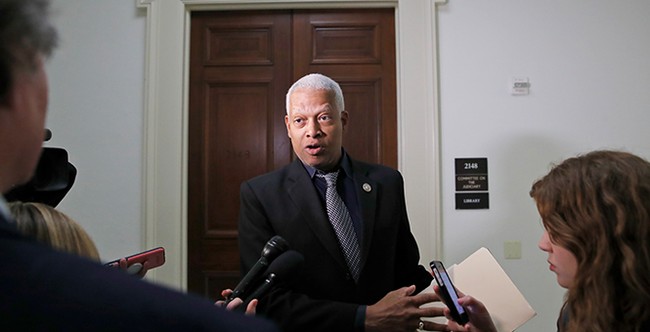
The piece examines Democratic Rep. Hank Johnson’s recent remark labeling the United States the “Great Satan” under President Trump, traces the context of a U.S. strike on a suspected narcotics boat, contrasts that criticism with the threats posed by cartels and hostile regimes, and argues from a conservative perspective that decisive American strength is necessary, not shameful.
Rep. Hank Johnson’s leap to the phrase “Great Satan” landed like a grenade in political conversation, mainly because that label originated as a slur from Tehran. He used it to describe America after a recent U.S. strike on a suspected drug-trafficking vessel, arguing the action showed the nation “can start killing people with impunity.” The line is meant to shock, and it did — but it also demands context before being accepted wholesale.
Johnson voiced his view on the “Dean Obeidallah Show” and said the U.S. has morphed into the “world’s No. 1 bully,” echoing a critique that paints force as illegitimate by default. That stance fits a strain of progressive thought that treats American leverage and enforcement as inherently tainted. From a conservative angle, however, the question is simple: does preventing drugs and saving lives count as bullying, or as responsibility?
The strike in question targeted vessels tied to cartels moving fentanyl and other deadly substances toward the United States. Administration briefings presented it as an interdiction aimed at protecting American communities, not as theater. Federal law enforcement reports show seizures in the region increased significantly, a fact that supporters say translates directly into fewer overdoses and less crime on U.S. streets.
Johnson framed the operation as imperial overreach and said, “America under the Trump regime is demonstrating that that moniker was entirely accurate.” He doubled down by calling the nation the “Great Satan,” a phrase with blood on its hands in many parts of the world. Using that phrase to describe the United States ignores the stark alternatives and the actors who actually target innocents with violence and cruelty.
If we follow Johnson’s logic to its end, we must compare the U.S. to regimes and groups that routinely murder dissidents, sponsor terrorism, and traffic in human misery. Iran, which popularized the “Great Satan” label, suppresses dissent and supports proxy groups that attack civilians. Latin American tyrannies and criminal cartels brutalize neighbors and profit from chaos, and their cruelty is not metaphorical; it is literal and ongoing.
Johnson’s critique also glosses over recent history. Strength and targeted action, even when uncomfortable, have been used by leaders from both parties. Presidents accused of being dovish have ordered strikes and covert actions. Criticism that singles out the current administration while ignoring prior uses of force reads like selective outrage, not principled consistency.
Some of Johnson’s past remarks have provoked ridicule and raised questions about judgment, which matters when lawmakers shape foreign policy discourse. That history makes his dramatic rhetoric easier to dismiss as grandstanding. Still, the underlying debate he taps into — whether America should act unilaterally and forcefully — is real and worth addressing without flinching.
From a conservative point of view, power is not an end in itself but a tool to protect citizens and deter malign actors. The cost of hesitating in the face of predators can be measured in lives lost and borders violated. Those outcomes are not abstract; they show up in communities hit hardest by addiction and crime, the very harms interdictions seek to reduce.
Arguments that portray interdiction and defense as inherently immoral ignore the agency of violent actors who exploit weakness. When the state refuses to act decisively, cartels and hostile regimes expand their reach. A posture of restraint that borders on passivity invites aggression, whereas targeted, lawful force can restore deterrence and disrupt criminal networks.
Labeling America’s defensive actions as evidence that we have become a global villain misreads both intent and effect. The debate should be about means and oversight — ensuring actions follow law and minimize harm — not about denying the legitimacy of protecting the nation. In the real world, the absence of will often means more suffering, not less.
Political theater aside, this episode reveals a broader trend in which powerful rhetoric replaces policy nuance. Calling the United States the “Great Satan” is rhetorically flashy, but it does little to address the logistics of interdiction, the international cooperation required, or the domestic impact of drug flows. Tough questions deserve serious answers, not epithets.
For Republicans, the takeaway is clear: defending American interests and citizens matters, and it is not shameful. Strong policy must be paired with lawful conduct and transparency, but strength itself must not be framed as sin. In a dangerous world, the choice between action and feigned virtue has consequences, and those consequences are counted in lives saved or lost.
I brand Democratic Rep. Hank Johnson an absolute traitor POS who needs to be kicked out of not only the legislature but out of AMERICA! Send him to Somalia or some other hellish nightmare nation like that, where he can find out what it’s like to fight for your life every day with no assurances that you will have another day or be protected from the thugs and killers that riddle the planet!
Because the great satan is a democrat!
Why as taxpayers do we continue to pay these American hating reps!!! If you hate America so much Hank give us our money back relinquish your pension and move on!!!