
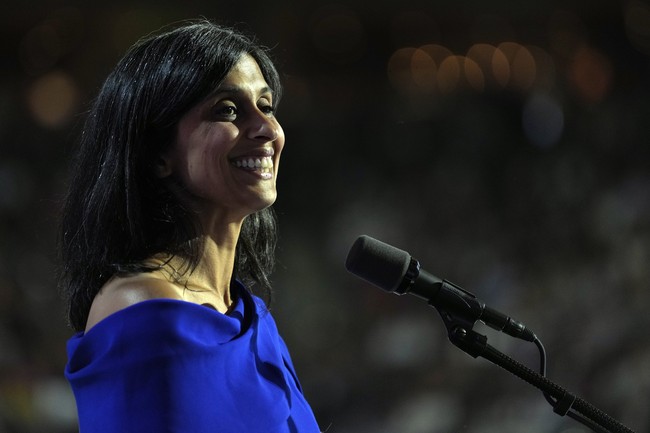
The Second Lady, Usha Vance, faced personal attacks from Michigan Senate candidate Abdul El-Sayed and handled them with restraint and dignity, refusing to trade barbs while highlighting that her marriage and family are what matter. This piece reports the incident, El-Sayed’s past comments about the Vance children, and Usha Vance’s measured public reply, contrasting her composure with his increasingly personal attacks.
The last thing Usha Vance needs is to be dragged into ugly political theater while caring for a newborn and three other children getting ready for school. She just had her youngest, Alec, about a month ago, and any parent knows the juggling act of infant care and school year prep is hard enough without political attacks. Yet she found herself responding to a campaign that chose to mock her family instead of debating policy.
Abdul El-Sayed has made a habit of going personal, and his most recent taunt crossed a line into mocking the Vance family in a way that feels calculated rather than candid. He sneered, “So we think JD is taking Usha with him back in time to meet Papaw, or no…” which played on the idea that the vice president’s ancestors would disapprove of his marriage to a woman of Indian descent. That kind of comment lands as mean spirited and petty, not as serious political discourse.
Rather than responding in kind, Mrs. Vance kept her reply simple and firm, underscoring what actually matters. In an interview set to air on Fox News she said she never met Papaw and laughed off the attack, and she insisted on the basic fact that the extended family is hers too. Her response, “They are my family,” is short, human, and impossible to weaponize without sounding crass.
The contrast between her composure and El-Sayed’s tactics is stark and telling about where each person is choosing to spend political capital. Usha Vance focused on family and on rising above the personal smear, while El-Sayed doubled down on nastiness that targets children and skin color. The optics are bad for someone trying to present himself as above the fray when he resorts to the kind of taunts people expect from a playground bully.
Usha Vance responds to Abdul El-Sayed’s dig about whether JD Vance would take her “back in time to meet Papaw.”
The second lady says she laughed off the far-left candidates comment about their personal lives, saying she’s always felt at home with her husband’s Ohio family.
https://x.com/AbdulElSayed/status/2091151440433623395
Vance said she never got to meet JD’s Mamaw and Papaw, but knows and loves the family they raised, and any expectations she had about Ohio were “blown up” by how welcoming people were.
“They are my family.”
Watch @RCamposDuffy full interview airing tomorrow morning only on @foxandfriends
Those quotes show a person who refuses to get dragged into escalations and instead centers what matters most to her: family and belonging. It is a humane and politically savvy posture because it denies the attacker the satisfaction of a reaction while making the attacker look small. Voters tend to respect steadiness and decency more than theatrics and cheap shots.
More worrying than the taunt itself is El-Sayed’s pattern of comments that fixate on the race and appearance of the Vance children. Earlier this year he asked whether Vice President Vance could reconcile having “brown kids who he thinks are less American than everyone else.” Comments like that are not critique of policy, they are an assault on family and identity that should have no place in serious political conversation. It suggests an unusual focus that crosses into the personal in a way that repels many voters.
El-Sayed has also shown a tendency to trade in insults that aim to humiliate rather than challenge ideas. He called JD Vance “the charisma of a doorknob” and compared his aura to “a toad,” a line of attack that reads as petty rather than principled. On other occasions he made odd personal inquiries on television that have left commentators questioning his judgment and temperament.
This is the backdrop against which Usha Vance’s calm reply lands. She did not escalate or retaliate, and she reminded the public of a simple fact about her life that any sane person would accept without commentary. That decency highlights a contrast Republicans can point to when discussing character and tone in public life, and it underlines the political payoff of refusing to play the same low game as an opponent.
At bottom, this episode is less about a single snide line and more about the choices candidates make about tone and targets. Mrs. Vance chose family and grace. Her opponent chose smear and spectacle, focusing on personal attributes rather than policy disputes. The choice tells voters something important about priorities and temperament in public office.
For many people watching, the second lady’s line, “They are my family,” will stick because it is real and unpretentious, and because it resists being turned into a political cudgel. That kind of candid response cuts through noise and reminds voters that some lines should not be crossed, no matter the pressure of a campaign season.



Add comment