
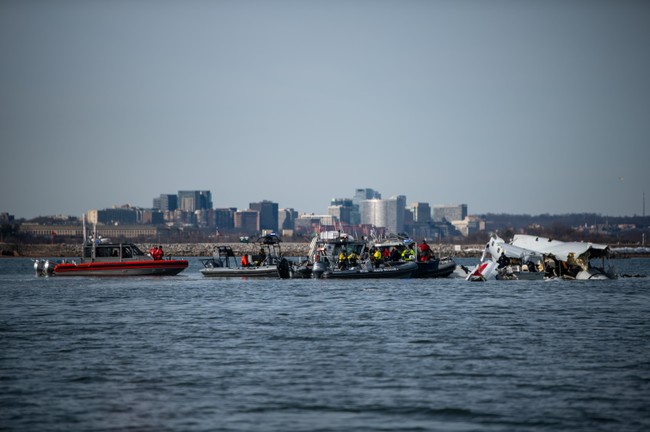
The government has formally admitted a failure of duty in the January 29, 2025 collision between a U.S. Army UH-60 Black Hawk and American Airlines Flight 5342 near Ronald Reagan Washington National Airport, a disaster that killed 67 people; the admission appears in a legal filing tied to the first lawsuit filed after the crash, and it highlights pilot vigilance, air traffic control procedures, and disputed altitudes as central issues in the unfolding investigations and litigation.
On January 29, 2025, a Black Hawk training flight and a commercial jet coming in from Wichita, Kansas collided while on approach to Ronald Reagan Washington National Airport, and both aircraft crashed into the Potomac River. The accident claimed 67 lives — 64 passengers and crew aboard the American Airlines flight and three Army personnel aboard the Black Hawk. That scale of loss has prompted intensive scrutiny from investigators, regulators, and now the courts as families seek answers and accountability.
Rachel Crafton, widow of passenger Casey Crafton, filed suit against the airline and the U.S. government, and in a filing the government conceded key failures tied to the collision. The government stated that both the Black Hawk crew and the crew of AE5342 failed to maintain vigilance to see and avoid one another, and that a local air traffic controller did not comply with specific air traffic control guidance. That admission is now part of the official record in litigation under the Federal Tort Claims Act.
… the United States admits that the [Black Hawk] and AE5342 pilots failed to maintain vigilance so as to see and avoid each other; the DCA local controller did not comply with ¶ 7-2-1(a)(2)(d) of FAA Order JO 7110.65AA, chg. 3, Air Traffic Control (Sept. 5, 2024); and because of the [Black Hawk] pilots’ failure to maintain vigilance so as to see and avoid AE5342, the United States is liable to a Plaintiff who is legally eligible to recover certain monetary damages, as permitted by the Federal Tort Claims Act (FTCA), 28 U.S.C. §§ 1346(b), 2671–80, in an amount yet to be determined and apportioned among other tortfeasors.
Investigators have focused heavily on altitude data in the hours after the crash, with preliminary numbers showing the passenger jet at 313 feet two seconds before impact while the Black Hawk was at 278 feet at the moment of collision. Those figures place the helicopter well above published guidance for that phase of flight, and they have sharpened questions about crew decisions and situational awareness. The apparent altitude discrepancy is one of the clearest technical threads tying together witness accounts, radar traces, and wreckage analysis.
Regulatory guidance for operations near Ronald Reagan Washington National Airport requires helicopters on certain approaches to remain at or below a 200-foot cap as they near the field. Preliminary findings indicate the Black Hawk was roughly 78 feet above that cap at the time of the impact, placing it perilously close to the arriving airliner. That difference, investigators say, materially increased collision risk in crowded terminal airspace where standard separation margins are already tight.
Beyond altitude, attention has turned to the military aircrew’s training flight profile, the applicable procedures for mixed military and civilian traffic in constrained airspace, and the role of the local air traffic controller who managed traffic at the time. The government’s admission points to a breakdown across multiple layers: pilot vigilance, air traffic control compliance, and the interaction between military training operations and commercial arrival paths. Those layers will be probed in discovery and by the National Transportation Safety Board.
Families of victims and their attorneys have reacted to the government filing as a significant development, saying it supports claims of negligence and responsibility by the Army crew and by controllers who oversee approaches to the airport. Legal filings now underway will examine how responsibility should be apportioned among parties, how federal liability under the FTCA applies in a mixed military-civilian accident, and what compensation may be appropriate for loss and damages. Those proceedings will move at a different pace than the safety investigation.
The NTSB has not yet issued a final determination on probable cause, and the agency’s comprehensive report is expected in early 2026. Meanwhile, public debate is centered on aviation safety practices near major metropolitan airports, the integration of military training flights into congested airspace, and whether procedural changes are needed to prevent another tragedy. Investigators will continue to parse flight data, voice recordings, and procedural compliance to build a full timeline of events leading up to the collision.
For now, the government’s own legal admission frames the accident as a failure of vigilance and procedure that resulted in catastrophic loss. That admission will influence litigation strategy, inform victims’ families’ claims, and shape regulatory conversations about how military and civilian operations can coexist safely in tightly constrained airspace around capital-area airports.

Add comment