
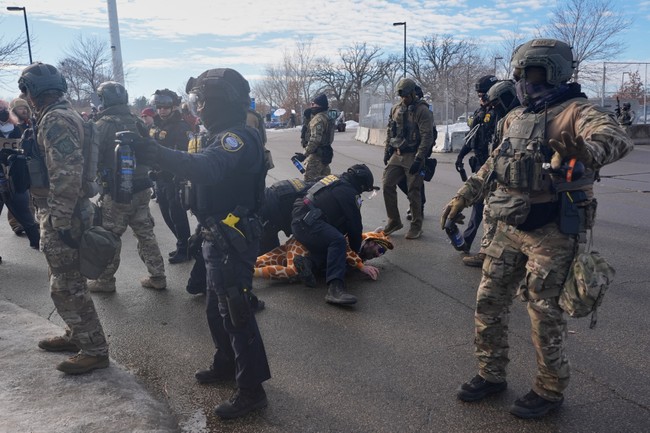
The piece examines recent lawsuits by Minnesota, Illinois, and Chicago challenging DHS and ICE operations, highlights CNN analyst Elie Honig’s blunt assessment that the suits are “political diatribes masquerading as lawsuits,” and explores constitutional issues such as the Supremacy Clause and precedent that make state efforts to bar federal enforcement unlikely to succeed.
Minnesota’s attorney general filed suit against the Department of Homeland Security over what he called the “unlawful deployment of thousands of armed, masked, and poorly trained federal agents” allegedly harming the state. Illinois and the City of Chicago followed with similar litigation aimed at curbing federal immigration enforcement inside their borders. These filings arrived amid ongoing anti-ICE protests and a high-profile confrontation that resulted in the death of a protester after an alleged attempt to run over an ICE agent.
Legal pushback from state officials frames the deployments as overreach, but experienced prosecutors and analysts see the filings differently. CNN’s Senior Legal Analyst Elie Honig, who served as both a federal and state prosecutor, reviewed the complaints and delivered a stark verdict about their legal prospects. Honig characterized the litigation in uncompromising terms: “political diatribes masquerading as lawsuits.”
I’ve read both the Minnesota and Illinois lawsuits. They’re really political diatribes masquerading as lawsuits.
<p class=”>There is no way a judge can say. ‘You, federal law enforcement agency, you are not allowed to execute federal law in a certain state or city.’
I think the most that the states could get out of this, if they get sympathetic judges, is a judge who’s going to ask questions of ICE, who’s gonna hold hearings, who is [going] to demand questions about how they’re training, how they are carrying out their policy.
You also could have judges that issue sort of symbolic orders along the lines of, ICE, you are not to violate the law, but that’s already the case. It’s already not allowed for ICE to violate the law.
So these lawsuits, which appear to be coordinated, they’re potentially powerful political statements, but I don’t give them much of a chance of achieving the legal thing that they’re asking for in the courts.
Honig’s critique highlights the core problem for the plaintiffs: the requests seek to prevent a federal agency from carrying out federal law enforcement, an outcome without clear precedent. Even if judges are sympathetic and ask probing questions about training and conduct, that is a far cry from issuing orders that effectively bar a federal agency from operating within a state. Courts traditionally resist measures that would disrupt federal priorities and operations.
The suits lean on political rhetoric as much as legal claims, contending that federal operations amount to an invasion of local communities. Honig rejected that framing as lacking legal force, noting that terms like “invasion” are rhetorically potent but do not translate into constitutional remedies. He observed that, “Even if every allegation made in both complaints is true, and we don’t know that, it doesn’t necessarily give them a constitutional legal remedy here.”
There is no legalese to that. I mean, it’s a powerful sort of rhetorical term. You heard a lot of things about an invasion and how horrible this is.
Even if every allegation made in both complaints is true, and we don’t know that, it doesn’t necessarily give them a constitutional legal remedy here.
And by the way, to be specific about why there’s a constitutional problem here, if a judge were to say to ICE, you can’t enforce the law in Minnesota or Illinois, it would violate the Supremacy Clause, which says the federal government gets to carry out federal priorities and the states cannot stop them.
The Supremacy Clause, located in Article VI, Clause 2 of the Constitution, makes federal law the supreme law of the land and binds state judges accordingly. Historically, the Supreme Court has struck down state measures that interfere with federal operations, dating back to McCulloch v. Maryland in 1819. Subsequent decisions reinforce that states cannot control or obstruct federal enforcement of national law.
Commentary from constitutional scholars echoes Honig’s view that preemption and supremacy doctrines pose major hurdles for the lawsuits. Cases like United States v. Washington and In re Neagle have clarified that states cannot criminally charge officials who are properly performing federal duties and that state laws conflicting with federal operations are subject to invalidation. Those precedents suggest judges will be cautious about granting the sweeping relief the states seek.
Given the constitutional framework and binding precedent, litigation that aims to prevent ICE from enforcing federal immigration laws inside particular states faces an uphill climb. Courts can investigate practices, compel information, and issue orders against unlawful conduct, but stripping a federal agency of authority within a state would clash with long-established doctrines. That tension helps explain why seasoned legal observers treat these suits as more political theater than viable legal strategy.


Add comment