
Short preface: This piece lays out how Senate Minority Leader Chuck Schumer reportedly stalled efforts to reopen the government, the pushback from moderate Democrats, the bipartisan deal that eventually moved forward, and the consequences for everyday Americans caught in the shutdown.
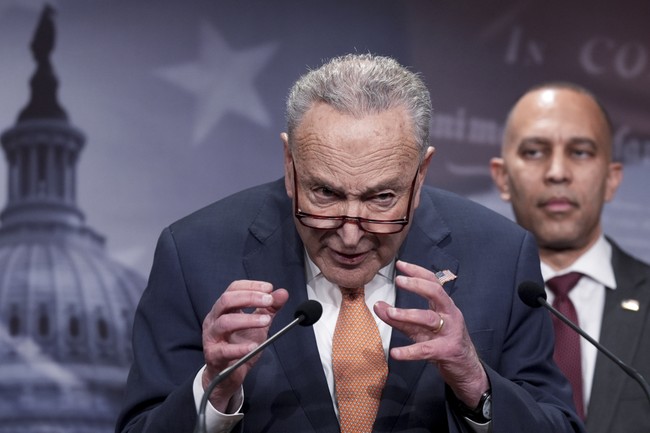
Senate Minority Leader Chuck Schumer (D-NY) reportedly had little interest in quickly reopening the government and instead worked to delay any resolution until at least November. Two weeks after the shutdown began on October 1, some moderate Democrats signaled they were ready to end the disruption, but Schumer persuaded them to hold off. The maneuvering centered on timing around Affordable Care Act open enrollment and other political leverage points. Republicans argued this was political theater that hurt Americans for partisan gain.
That dynamic was described in a recent report that said moderates were prepared to act but were dissuaded by Schumer. The report portrayed him as actively urging patience within his caucus, despite frustration among members who wanted the government reopened. For many voters, the shutdown produced tangible pain: delays at airports caused by staffing shortfalls and disruptions to critical benefits like SNAP. Republicans pointed to those effects as proof the Democrats prioritized politics over people.
The published account included this passage:
“Two weeks into the shutdown, a group of moderates told Schumer they were ready to vote to open the government, according to three sources familiar with the conversation.
It’s unclear if that group was big enough to end the shutdown. But Schumer persuaded the moderates to hold out until at least the beginning of November, when open enrollment for the Affordable Care Act began.
In mid-October, he made it clear to his entire caucus that he was likely to come out against the emerging bipartisan deal that a group of moderate senators were pushing. “
Sen. Jeanne Shaheen (D-NH) told reporters she and several colleagues had informed Schumer they intended to pursue a compromise to end the shutdown. She declined to comment on whether she felt Schumer actively worked against her package, keeping the private discussions private. Her public posture was cautious, while colleagues on both sides expressed impatience with continued brinkmanship. Republicans viewed those private discussions as proof a small faction sought practical solutions while leadership dug in.
Shaheen said, “We let him know what we were doing,” and when asked if she felt Schumer was working against her compromise package she “declined to comment.”
“I don’t really want to get into the private discussions we had,” she told reporters Monday afternoon.
As pressure mounted, a bipartisan agreement began to coalesce and some Democrats decided to abandon the leadership line. Eight senators ultimately signaled they would support a deal to reopen the government, trading votes for future action on ACA subsidies and addressing fallout from past federal personnel actions. Republicans framed that deal as necessary and reasonable, allowing critical services to resume and addressing specific policy disputes later through normal legislative channels.
One description of the deal’s terms noted:
“In exchange for their support of a bill to reopen the federal government, the eight Democrats were promised a future vote on continued government subsidies for the Affordable Care Act. Those subsidies have been at the heart of the Democrats’ overall objection to the clean continuing resolution [CR] passed through the House but stuck in the Senate since September.
Also a part of the deal is reversing mass firings from the federal government that were central to the [President Donald] Trump administration’s stated goals of shrinking the federal government—an effort spearheaded at the time by OMB Director Russ Vought. The new plan would retroactively eliminate those mass firings. The plan also pushes through a “minibus” of appropriations for the following three areas: Agriculture-FDA, Legislative Branch, and Military Construction-VA.”
With that vote set to move in the Senate, the path forward became procedural: a final vote on the amended continuing resolution, then the House vote, and ultimately the President’s signature to reopen the government. Republicans stressed that lawmakers on both sides should have avoided inflicting more harm on Americans while bargaining over unrelated policy demands. The shutdown underscored the real-world costs when leadership chooses leverage over solutions.
Editor’s Note: After more than 40 days of screwing Americans, a few Senate Dems have finally caved. The Schumer Shutdown was never about principle—just inflicting pain for political points.


Add comment