
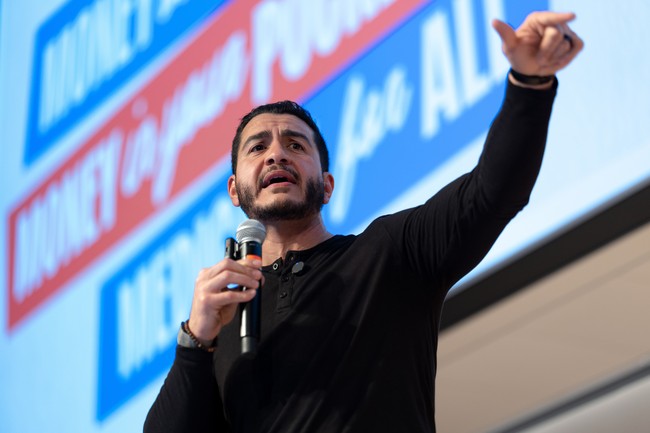
The Michigan Senate nominee Abdul El-Sayed is under renewed scrutiny after an old interview resurfaced in which he said he felt an “obligation” to follow sharia law, a line that raises questions for voters who expect American elected officials to prioritize the Constitution and secular governance.
El-Sayed won a crowded Democratic primary and has been cast by some defenders as a milestone for representation, but his past remarks invite serious examination from a conservative perspective. Voters are entitled to know whether a candidate’s stated personal obligations conflict with loyalty to American legal and civic norms. This piece lays out the key facts and context without speculation, focusing on El-Sayed’s own words and public record.
In a 2009 interview with a major newspaper, El-Sayed spoke candidly about arranging his finances to comply with religious law and described a broader sense of duty. That quote, now circulating widely, was delivered when he was a 24-year-old medical student and a Rhodes scholar buying a modest condominium. He said the choice involved more than money; it was tied to conscience and a lifelong commitment.
“Ultimately, the question is, when I die and I stand before God and go through everything I did in my life, I don’t want to say I did it the easy way instead of the Shariah-compliant way. Not because of fear but because of obligation,” said El-Sayed, who the Times identified at the time as a 24-year-old medical student and Rhodes scholar who had just taken out a “Sharia-compliant” mortgage to purchase a $123,000 condominium in Ann Arbor.
Those words are straightforward and remain unchanged here because the exact quote matters. Sharia refers to religious rules that cover worship and personal conduct and in some interpretations include strict criminal penalties and gender-based restrictions. Conservatives point out that public officials who embrace religious obligations in absolute terms must explain how they would prioritize the U.S. Constitution when conflicts arise.
El-Sayed and supporters often emphasize that his politics are secular and that his Muslim faith is a private matter that strengthens his values. Still, when a candidate uses language about an “obligation” to a system of religious law, it is reasonable for citizens to demand clarity about which law would guide policy decisions. That’s not an attack on religion; it’s about the separation of church and state and the responsibilities of public office.
Since his primary victory, El-Sayed has been portrayed by some outlets as a symbol of progress for Muslim political representation. He has also drawn criticism from conservatives for a pattern of statements and positions that they view as hostile to traditional American symbols and institutions. Observers note his past remarks about fireworks, the Second Amendment, and border policy as part of a broader ideological profile.
https://x.com/AndrewKerrNC/status/2087263305547079680
El-Sayed has pushed back on efforts to tie his faith to his public duties, and in different settings he has argued that discrimination and white supremacy explain many contemporary struggles. He said at a 2022 conference that the forces arrayed against various communities are related, listing historical wrongs and adding that attempts to ban sharia law are part of that history. Critics on the right see that framing as politicized and deflective.
From a Republican perspective, the core issue is simple: candidates running for national office must be transparent and unequivocal about their commitment to the Constitution and to laws enacted by representative institutions. Personal faith can inform values, but it should not create competing legal loyalties for someone who seeks power in a constitutional republic. Voters deserve answers, not equivocation.
El-Sayed’s quote about living in a “Shariah-compliant” way until he dies is not ambiguous, and it should prompt straightforward questions about how he would handle conflicts between religious obligations and constitutional duties. There is room in American politics for faith-driven leaders, but loyalty to the rule of law is non-negotiable for a senator with influence over federal policy.
Campaigns are often about shaping narratives, and El-Sayed’s backers emphasize inclusion and milestones for minority representation. Yet representation does not exempt candidates from scrutiny. When a public figure’s own words suggest a binding personal obligation to a religious legal framework, that raises legitimate concerns for those who believe secular governance and individual rights must come first.

Add comment