
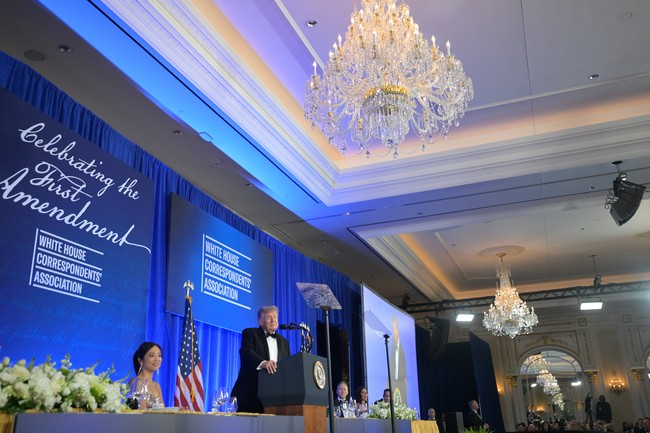
The rescheduled White House Correspondents’ Association Dinner brought President Donald Trump back into a roomful of legacy reporters, with a mix of pomp, pointed jokes, and predictable media outrage; this piece walks through the night, the reactions, and the flashpoints that made headlines afterward.
Friday night’s rescheduled WHCA dinner opened with formal ceremony and an upbeat presentation by the honor guard, setting a serious, almost ceremonial tone before the speeches began. The crowd was sharply dressed and clearly aware they were at an event meant to celebrate press freedom and the First Amendment. Expectations were split: some hoped for restraint, others braced for the kind of roast that has defined past Correspondents’ dinners. What arrived was a blend of traditional spectacle and sharp political theater.
https://x.com/diyarkurda/status/2080808079717761187
President Donald Trump entered amid ceremony, observed the anthem, and received the kind of pageantry that fits a head-of-state appearance. The optics were deliberate and followed by a speech that quickly moved from ceremonial to confrontational. Trump’s remarks targeted journalists in the room, which predictably provoked strong reactions from members of the press corps. The rest of the evening unfolded around that tension.
The awards portion of the night followed, a standard stretch of formal recognitions that often feels sleepy compared with more dramatic moments. After the violence that cut short the first dinner in April, any routine ceremony felt subdued or even oddly tranquil. The memory of the April shooting hung over the event and framed much of the security and media commentary. That contrast between threat and routine shaped how audiences perceived the night’s tone.
As reported by colleagues covering the event, Trump’s speech hit the targets he expected to hit and stung the people he intended to provoke. The audience reaction ranged from silence to visible discomfort; in other pockets there were laughs and applause. That mix turned coverage into an instant debate about whether he had dominated the room or whether journalists had seen through his routine. What mattered afterward was how outlets framed those moments.
Media outlets parsed soundbites and body language alike, with some analysts declaring the speech a media takedown and others insisting the president simply trolled a roomful of reporters. The immediate response from the pundit class was loud and split, feeding social and cable coverage for hours. Analysts on all sides dug into every joke and aside, searching for political impact and potential headlines. The result was a weekend of predictable hot takes.
Not everyone reacted as if the event were merely about jokes and roasts; some veteran figures and press freedom advocates voiced sharp concerns about the larger climate for journalism. Hundreds of former or retired journalists and multiple press freedom groups had already publicly asked the White House Correspondents’ Association to address recent attacks on the press. Those calls framed the rescheduled dinner as more than an evening of celebrity banter and pointed to real tensions between the administration and the press corps.
Hundreds of former or retired journalists and eight press freedom groups are asking the White House Correspondents’ Association to stand up to the Trump administration’s recent attacks on the media at its rescheduled dinner this week — a dinner President Donald Trump says he’ll attend.
The first dinner was cut short in April when a gunman, who prosecutors say was trying to assassinate Trump, opened fire at the Washington Hilton. The much smaller rescheduled dinner will take place Friday, with enhanced security precautions, at the capital’s Waldorf Astoria Hotel, formerly the Trump International Hotel.
The letter expands on a similar one issued in April, before the first dinner. It notes that since then, “the administration’s attacks on journalists and press freedom have become even more egregious.”
The letter, organized by former ABC News correspondent Lisa Stark and producer Ian Cameron, cites in particular the recent subpoenas by the Justice Department to New York Times journalists who reported on security concerns over the president’s Qatari-gifted Air Force One jet. Additional subpoenas of the journalists’ phone records have included even the mother of one reporter, and two spouses.
CNN and other networks moved into live fact-checking mode, dissecting remarks line by line as the president spoke, and that real-time analysis annoyed critics who see fact-checking as partisan performance. To others, it felt like standard media housekeeping—holding statements up to scrutiny as an audience consumes them. Either way, the spectacle of panels adjudicating one-liners amplified the sense that the dinner was both entertainment and political theater. That dynamic played out across social platforms and broadcast replays.
Some of the president’s jokes landed differently depending on who heard them, with a few lines earning genuine laughs while others drew gasps and outrage. One quip referencing a pop-culture figure earned immediate attention and social media reaction, and Trump capped his set with a final, provocative tease about running for an additional term in 2028. Those moments kept the conversation alive beyond the ballroom and guaranteed columns and segments over the weekend. For audiences, the night’s aftermath became the story.
Social posts and commentators reacted predictably: supporters praised the roast and the boldness, critics decried tone and implication. The back-and-forth ensured the dinner’s message was not confined to the hotel ballroom but replayed across feed timelines. That cycle—speech, reaction, analysis, repeat—has become standard for any high-profile political appearance in the digital era. The WHCA dinner followed that pattern in full.
Outside the ballroom, memes and hot takes multiplied as viewers clipped moments and interpreted them through political lenses. The mix of ceremony, security memories, and sharp political jabs made the rescheduled dinner a focal point for larger debates about press freedom, civility, and political theater. In short, the event gave both sides plenty to cite in support of their preferred narrative, ensuring the conversation would last well beyond the evening itself.
Add comment