
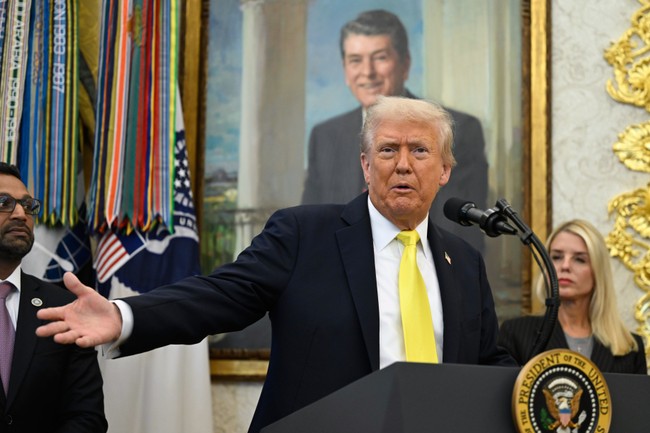
President Trump has taken a hard line against fentanyl by officially labeling illicit fentanyl and its primary precursor as a Weapon of Mass Destruction, a move meant to unlock new federal tools against cartels and foreign networks that flood American communities with this lethal drug.
The designation was made by executive order signed in the Oval Office, and it changes how the federal government can respond to trafficking, financing, and distribution of fentanyl. The administration says the shift is designed to coordinate law enforcement, national security resources, and financial controls to choke off the flow of this poison into the United States.
“Today I am taking one more step to protect Americans from the scourge of deadly fentanyl flooding into our country, “Trump said. “With this historic executive order…we are formally classifying fetanly as a Weapon of Mass Destruction.”
He added bluntly, “Which is what it is. No bomb does what this is doing,” and warned that the toll is staggering: “Two hundred to three hundred thousand people die every year, that we know of.” Those numbers underscore the administration’s urgency and also explain why the White House moved to reframe the threat in national security terms.
The executive order directs several major federal actions: prosecutors are ordered to pursue enhanced criminal charges and sentencing in fentanyl trafficking cases, while the State and Treasury departments are told to go after assets and financial institutions tied to the manufacture and distribution of illicit fentanyl and its precursors. The administration is linking criminal enforcement with diplomatic and financial pressure to disrupt supply chains and money flows that enrich cartels and enable trafficking.
The directive also asks Defense and Justice officials to evaluate whether enhanced national security resources are needed in an emergency involving a weapon of mass destruction, and it instructs the Defense and Homeland Security agencies to update chemical incident response plans to explicitly include the fentanyl threat. Homeland Security is told to use WMD and nonproliferation intelligence to identify smuggling networks.
- The Order directs the Attorney General to immediately pursue criminal charges, sentencing enhancements, and sentencing variances in fentanyl trafficking cases.
- The Order directs the Secretary of State and the Secretary of the Treasury to pursue appropriate actions against relevant assets and financial institutions for those involved in or supporting the manufacture, distribution, and sale of illicit fentanyl and its core precursor chemicals.
- The Order directs the Secretary of War and Attorney General to determine whether the Department of War should provide enhanced national security resources to the Department of Justice as necessary during an emergency situation involving a weapon of mass destruction.
- The Order directs the Secretary of War, in consultation with the Secretary of Homeland Security, to update their chemical incident response-related directives to include the fentanyl threat.
- The Order directs the Secretary of Homeland Security to identify fentanyl smuggling networks using WMD and nonproliferation related threat intelligence.
The White House framed the move as unleashing every available tool to combat cartels and foreign networks, arguing that fentanyl is now the leading cause of death among Americans aged 18 to 45. From the administration’s standpoint, treating fentanyl as a chemical weapon enables a multi-agency campaign that blends criminal law, national security doctrine, and global financial pressure.
This designation builds on other measures the president has taken since returning to office, including legislation that permanently classifies fentanyl-related substances under the most restrictive category of the Controlled Substances Act. That law was described by the administration as a decisive blow to traffickers and cartels, intended to remove legal loopholes and accelerate prosecutions.
The administration has also authorized military strikes against so-called narco-boats, arguing that stopping shipments at sea is essential to protect American communities from mass poisonings. It has labeled several transnational criminal organizations with highest-level designations to enable tougher action abroad and domestically against violent cartels and networks linked to drug trafficking.
Critics warn about overreach when criminal issues are folded into national security frameworks, but supporters say traditional approaches failed to stop the epidemic and that a tougher posture is long overdue. The White House is arguing that long-standing inaction allowed cartel power to grow, and only by treating fentanyl as a chemical weapon can the U.S. marshal the full suite of tools needed to break that power.
The policy shift signals a new phase in the drug fight: a campaign that blends criminal prosecution, sanctions, military interdiction, and intelligence sharing. For families who have lost loved ones, the administration presents this as a necessary escalation aimed at reducing deaths and dismantling the supply chains that have made fentanyl so deadly and pervasive.



Add comment