
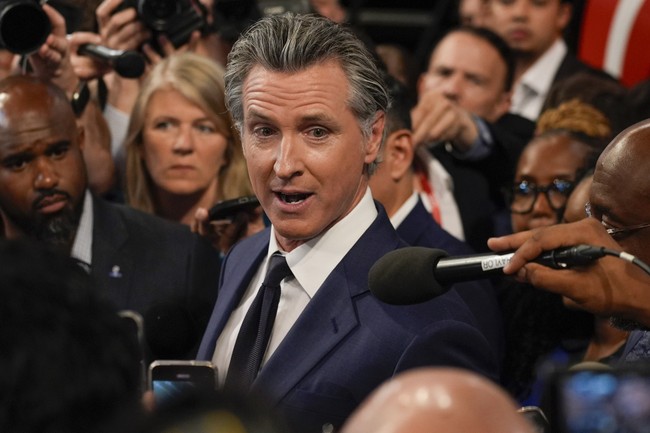
Gavin Newsom and the White House traded sharp public blows over California’s voting systems and Proposition 50, with assertions of widespread mail-in ballot fraud met by counterclaims about California’s lax voter safeguards and duplicate registrations. The clash unfolded across social posts and a White House press briefing, producing forceful statements from President Trump, Press Secretary Karoline Leavitt, and Governor Newsom that put election integrity squarely in the spotlight. This piece walks through what was said, the numbers cited, and why the debate matters for voters and for the 2026 political landscape.
The exchange began after President Trump posted about California’s Proposition 50 and the state’s voting system, arguing the process was rigged and promising ongoing legal scrutiny. That set off a back-and-forth in public forums and at a White House briefing, where the integrity of universal mail-in voting was the central battleground. Both sides leaned on statistics and past reports to make their points, turning routine criticism into a wider argument about who California’s system benefits.
Proposition 50 would change how California handles redistricting, and critics say it could let the state legislature redraw districts in ways that favor one party. Opponents argue that ending the independent redistricting commission risks breaking up competitive or traditionally opposition-held districts to gain seats. Supporters of the proposition claim the move restores accountability to elected officials, while detractors call it a blatant power grab with national consequences.
President Trump’s public message accused the California process of being “RIGGED” and flagged mail-in ballots as the main vulnerability, implying criminal and legal follow-up. His language was blunt and designed to drive attention to what he called systemic problems in how ballots are handled and verified. That charge forced the White House press team to elaborate during a briefing and to present their side in more detail.
The Unconstitutional Redistricting Vote in California is a GIANT SCAM in that the entire process, in particular the Voting itself, is RIGGED. All ‘Mail-In’ Ballots, where the Republicans in that State are “Shut Out,” is under very serious legal and criminal review. STAY TUNED!
At that briefing a reporter asked Press Secretary Karoline Leavitt what evidence supported the president’s claim, and she responded by framing an executive order effort to harden election procedures nationwide. Leavitt did not hedge when she said California’s universal mail-in system is “ripe for fraud” and called instances of irregular ballots a fact. She pressed the point that mail-in ballots open avenues for fraudulent voting that require federal oversight to prevent abuse.
Leavitt named concrete examples and numbers to back up the message, saying nearly 10 million mail-in ballots in 2024 were mailed and not returned, and citing duplicated registrations and low removal rates for deceased voters. She also referenced the 2005 bipartisan Carter-Baker Commission finding that absentee ballots pose the largest source of potential voter fraud. Those details were used to underline the administration’s argument that stronger, uniform safeguards are needed to secure federal elections.
Governor Newsom pushed back publicly, accusing the White House of politicizing the issue and claiming the critics were lying because they expect to lose. His tone was combative and aimed at delegitimizing the administration’s critiques. That prompted a rapid response from the White House that doubled down on the statistics and legal concerns to rebut his dismissal.
Leavitt’s reply to Newsom emphasized that California “doesn’t require voters to show photo ID before casting a ballot” and described the state’s rules as among the weakest nationwide for election security. She listed vulnerabilities such as universal mail-in balloting, duplicate registrations—2,178,551 duplicates reported in the 2024 cycle—and a small number of removals for deaths, figures presented to suggest systemic administration failures. Her message was pointed: these are not hypothetical risks but measurable flaws that deserve scrutiny.
The public fight mixed policy detail with sharp partisan language, and it landed squarely on practical effects voters could understand, like unreturned ballots and registration anomalies. Rather than a technical debate tucked away in government reports, both sides framed the issue as one of fairness and trust in the outcome of elections. For Republicans, the push is to highlight vulnerabilities and press for federal fixes; for Democrats, the counterargument is that these claims are politicized attacks meant to suppress votes.
This confrontation also underscores how state-level changes—like those proposed in Proposition 50—have ripple effects beyond California. Redistricting and ballot procedures influence who holds seats in Congress and who controls policy at the national level. That strategic consequence is exactly why this dispute drew such fast and fierce attention from political leaders and spokespeople on both sides.
The debate will continue in public forums, court filings, and likely in campaign messaging as parties use these numbers and narratives to shape voter perceptions. What voters should watch for are verifiable data, transparent audits, and clear reforms that address the cited problems without undermining legitimate access to the ballot. Ultimately, the clash over California’s election integrity is a preview of larger national fights over how America secures and counts its votes.
Editor’s Note: The Schumer Shutdown is here. Rather than put the American people first, Chuck Schumer and the radical Democrats forced a government shutdown for healthcare for illegals. They own this.



Add comment