
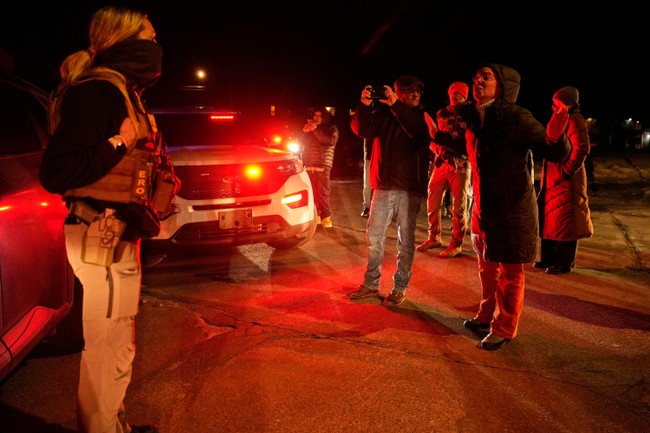
The protests aimed at disrupting federal immigration enforcement in Minneapolis look less like spontaneous civil unrest and more like a planned insurgency following Mao Zedong’s “People’s War” playbook, with organized political mobilization, staged escalation, and coordinated actions that seek to undermine federal authority.
What unfolded in Minneapolis was not merely passionate pushback against policy; it displayed the hallmarks of deliberate political mobilization. The movement used ideology and messaging to rally people, build cohesion, and justify confronting federal officers, which is precisely what revolutionary warfare theory predicts when politics directs military-type action.
The Cold War era produced a range of revolutionary doctrines, and Mao’s “People’s War” stands out for how it blends politics and irregular operations. That doctrine was adapted across continents, and its core idea — fuse political outreach with tactical harassment to wear down state authority — has shown up in many conflicts, from Algeria to Vietnam and even in urban insurgent experiments here at home.
At the heart of revolutionary warfare is a political campaign that seeks to replace legitimacy with parallel structures and narratives. That means propaganda, education, and institutions that chip away at the state’s moral authority. In Minneapolis we saw public messaging, secure communications, and organizational templates that pointed to more than ad hoc protest; these are the tools used to turn irritation into sustained resistance.
Revolutionary warfare theory frames insurgency as a staged, long game: organize, consolidate, escalate, then strike. Urban autonomous zones and occupation-style tactics have already appeared in U.S. cities in prior years, and the playbook can be adapted to fit available terrain and population centers. The pattern is recognizable: build bases, cultivate supporters, provoke overreactions, and use those reactions to recruit more sympathizers.
Local political figures and institutions can be decisive in this model because they provide cover and legitimacy for insurgent activity. Elected officials who publicly praise or tacitly support actions that obstruct federal law enforcement effectively create safe spaces for escalation. When public servants enable or wink at disruptive tactics, they empower groups to foreshadow more aggressive measures.
Operational security and coordination matter a great deal to anyone who wants to paralyze enforcement efforts. The presence of secure chats, sign-up systems, and dispatch-like procedures suggests a movement with structure. When signals and shift schedules replace spontaneous gatherings, the result is a sustained campaign rather than a fleeting protest.
Insurgencies also seek base areas and mass support, trying to win hearts and minds with social programs or grievance narratives. Sanctuary cities and sympathetic neighborhoods can function as urban base areas, providing logistics, recruits, and political cover. That safe haven effect erodes the ability of national authorities to operate effectively and encourages replication in other cities.
Violence and intimidation are integrated into such campaigns to deter opponents and compel compliance. The documented trend toward doxxing federal officers and the circulation of violent tactics show an alarming shift from protest to targeted harassment. When operatives start publishing personal information or discussing devices and attacks, they cross into a much more dangerous realm than civil disobedience.
Martyrdom and propaganda are powerful accelerants; incidents of violence can be framed as heroic sacrifice to radicalize onlookers and draw in committed supporters. Movements that rely on martyr narratives aim to turn isolated tragedies into recruitment tools, and they repeatedly try to co-opt unrelated constituencies to broaden their base.
History teaches that overreactions by authorities do not always produce the mass revolutionary wave insurgents expect, but they can create episodic spikes of unrest and polarization. Even when nationwide movements fail to sustain themselves, localized insurgencies can establish long-lasting zones of lawlessness that hurt citizens and businesses for years.
At present, the evidence points to coordinated efforts that go well beyond peaceful protest: organizational manuals, real-time location sharing, and elected officials who appear to tolerate, if not encourage, interference with federal operations. That combination is a recipe for escalation, and it should be treated as an organized threat to public order rather than as a series of isolated demonstrations.
This is a confirmation email from a SignUpGenius ( https://signupgenius.com/go/20F0E4CADA723A0F85-61419545-january#/#) signup for “Scott County ICE Watch”, and it is very clearly signed by Brad at the bottom:
https://twitter.com/White_Raven9515/status/2015146103906386366
• He personally thanks me for signing up
• He gives instructions for patrol shifts, Signal app usage, posting in the “Daily Scott County RR Chat”, using specific Signal group links, Google Maps routes/hotspots
• He explains Dispatch procedures and links to an overview on https://bradtabke.com/share (a shortened/personal link from his own domain) • He lists training dates, including in-person at Shakopee Library
• He provides his personal cell phone number (952-380-6328) for questions.
• He ends with “Brad” followed by the clear call to contact him. This is not some vague third-party thing. This is Rep. Brad Tabke himself running/organizing/coordinating the Scott County ICE Watch program, including recruiting people for patrol, dispatch, training, and even food receiving/packing/delivery shifts at the New Creation Church location in Shakopee. Combined with everything else that’s already public:
• His repeated real-time posting of ICE locations and movements in Shakopee (multiple times per day in many cases)
• His public statements thanking people who “joined our ICE watch Shakopee group”
• Conservative media
+ X posts documenting that he operates semi-private dispatch/patrol networks via sign-up sites (credit to @SarahisCensored)
• Reports that he had to lock down / change the signup after people started filling it with troll accounts (my fault). …this confirmation email is basically the smoking gun that proves he is personally organizing and leading this rapid-response / watch / interference effort against ICE operations.
This goes far beyond just tweeting opinions or general activism, this is a sitting state representative @BradTabke directly coordinating shifts, dispatching people to locations, training volunteers, and providing real-time operational guidance to monitor and respond to federal immigration enforcement.
This situation is explosive. The scale of coordination, the elected official status, the real-time location sharing, and the documented organizational structure — this is crossing into federal obstruction territory. Arrest him! @DHSgov @Sec_Noem @AGPamBondi
Past experiments with autonomous zones show how fragile law and order can be when local authorities abdicate responsibility. Unresolved violent incidents in self-declared zones are not anomalies; they are predictable outcomes when enforcement is blocked and alternative power structures fill the vacuum. When the system tolerates these experiments, citizens pay the price in safety and stability.
There is a predictable tactical arc: insurgents try to provoke heavy-handed responses to amplify their cause, while avoiding decisive defeats themselves. That dynamic was visible in earlier occupation-style movements, and it is now visible again. The danger is that escalation begets escalation until violence becomes routine and federal agents are targeted in their homes or on duty.
Evidence of organized disruption, plus sympathetic officials and sympathetic NGOs, creates a layered threat that cannot be treated as mere demonstrations. When coordination, real-time logistics, recruitment, and explicit interference with federal operations converge, the response must shift from permissive tolerance to firm enforcement to restore rule of law and protect communities.
Ignoring the organized character of these actions risks normalizing interference with lawful enforcement and invites further violence. Recognize the pattern, understand the tactics, and treat sustained obstruction as a serious challenge to public order rather than as an isolated protest phenomenon.

Add comment