
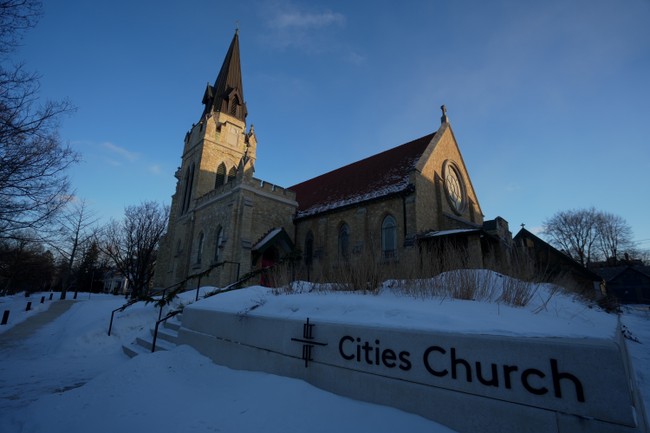
The piece looks at Nekima Levy Armstrong’s role in a church protest in St. Paul and the sizable nonprofit payday she pulled while leading a civil rights foundation, including specific salary figures, grant totals, and connections to a cannabis business tied to her name. It reports on the protest at Cities Church opposing ICE activity, details six years of Wayfinder Foundation compensation, and notes Armstrong’s current business venture. The article reproduces a quoted summary of the story and places an embed where multimedia originally appeared. Below is the rewritten article content for WordPress insertion.
When activists stage public confrontations while also running nonprofits, voters deserve to know how those organizations operate and how resources are distributed. Nekima Levy Armstrong has been a visible organizer in recent protests in St. Paul, including the incident at Cities Church that targeted immigration enforcement officials. That public activism draws scrutiny not only for tactics but for how cash flows through organizations linked to movement leaders.
The Wayfinder Foundation, where Armstrong served as executive director, reported substantial compensation to her across several years even as its grantmaking numbers stayed modest. Tax filings indicate Armstrong’s total take during a multi-year span exceeded a million dollars while the foundation’s grants in individual years were far lower than her compensation. Those figures are likely to raise questions about priorities inside nonprofits that claim to focus on anti-poverty work.
Below is the quoted summary that originally appeared and captures the basic facts of the incident and the nonprofit data:
Far-left agitator Nekima Levy Armstrong, who was one of the organizers of the storming of a Minnesota church to protest ICE on Sunday, raked in over $1 million during six years leading a Minneapolis civil rights nonprofit that addresses anti-poverty issues.
Armstrong, whose website identifies her as a civil rights lawyer and “scholar-activist,” helped to organize the storming of Cities Church in St. Paul, Minnesota, on Sunday.
In a Facebook post, she claimed that one of the church’s pastors is a leader at U.S. Immigration and Customs Enforcement. The demonstration is one of many throughout the Twin Cities in protest of the federal government’s surge of immigration enforcement officials to crack down on widespread fraud taking place in the state.
The filings show specific yearly breakdowns that are worth noting. In 2024 the foundation awarded roughly $158,811 in grants while Armstrong’s reported salary for that year was $215,726, plus about $40,548 in health and deferred compensation. In 2023 the foundation gave approximately $133,698 in grants while she received $170,726 in salary and $44,300 in other compensation reported as coming from related organizations.
Those are concrete numbers: in one recent year grants were a fraction of the executive pay. The 2022 filing likewise shows a pattern with $161,325 in grants paid out versus roughly $175,000 in salary plus additional compensation. Over a six-year leadership period, Armstrong’s cumulative compensation has been reported as exceeding $1 million, while annual grant totals remained comparatively small.
Armstrong also heads a business called Dope Roots, a cannabis company, which adds another layer of public interest in how her nonprofit work and private ventures intersect. The combination of activism, nonprofit leadership, and private business raises valid questions about potential overlaps, governance, and transparency that watchdogs and donors alike should expect to be answered.
The protest at Cities Church in St. Paul centered on claims about ICE involvement and immigration enforcement actions across the state, and it drew national attention for the confrontation inside a place of worship. Church leaders and congregants reacted strongly, and the event has prompted local discussion about protest tactics and the line between protest and intimidation. Given those tensions, financial disclosures tied to organizers become part of the story.
Tax documents and public filings are the main tools for examining nonprofit spending, and the figures tied to Armstrong and Wayfinder suggest a gap between executive compensation and grantmaking. That gap is likely to be used by critics to question whether donor funds are being directed toward the charity’s stated mission or toward sustaining an activist infrastructure. Transparency and accountability are the logical next demands.
Public scrutiny often follows when protesters occupy religious spaces or stage confrontational actions, and in this case the spotlight has turned to the finances behind the activism. Citizens and regulators may follow up to ensure laws and nonprofit rules are being observed, and to determine whether further inquiry is warranted. The story is still developing, and the financial details reported so far will remain central to how the public evaluates these events.



Add comment