
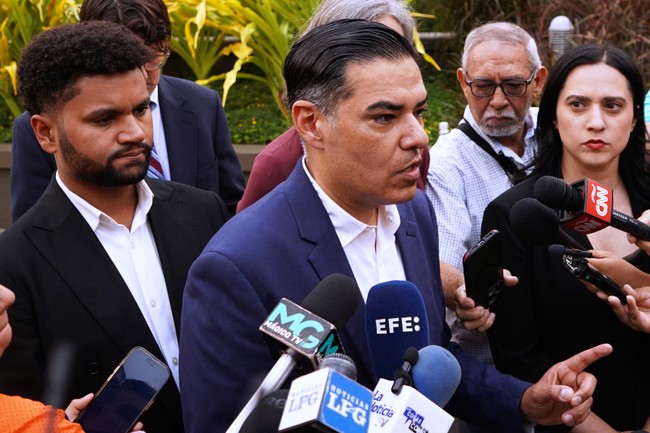
The House Oversight Democrats rolled out what they called “never-before-seen” photos and videos from Jeffrey Epstein’s island, billed as a transparency moment, but quickly faced accusations that much of the material was already public and that the release looked more like a political stunt than a revelation.
House Oversight Democrats were downright giddy on Wednesday when they released “never-before-seen” photos and videos of Jeffrey Epstein’s private island. The theatrical rollout—siren emoji energy, all-caps “BREAKING,” and boasts about transparency—felt like a press-conference production instead of a sober briefing. Rep. Robert Garcia framed it as a step toward justice, saying, “These new images are a disturbing look into the world of Jeffrey Epstein and his island.”
The whole thing had the makings of a blockbuster scoop, but the narrative began to wobble fast. A quick look showed some of the images had already been circulated months earlier, undermining the claim that these were newly discovered. When you’re trying to score points on transparency, re-hashing material the public already saw isn’t exactly a virtue signal.
Investigative reporter James O’Keefe and his O’Keefe Media Group pointed out that many of the photos were released back in May, and they publicly challenged the Oversight Democrats on the claim they were new. One of the key exchanges was blunt and direct, with O’Keefe writing, “Actually, @OKeefeMedia broke these photos in May,” O’Keefe wrote directly to the Oversight Dems . “We’re going to be asking @oversightDems for a retraction.” That raised the obvious question: will they admit the mistake?
The back-and-forth made the release look sloppy and political rather than investigative. O’Keefe that “even Time magazine” had given his media group credit for previously releasing some of the images that Democrats were labeling as “never-before-seen.” Major outlets had already noted overlap with Project Veritas material, so the claim of novelty evaporated quickly.
To make matters worse for the Democrats, the selection they touted as a transparency win included redactions on photos that had already been public. Dropping images with heavy black bars and trumpeting transparency reads as performative. When a political party tries to posture as a hero for victims while mislabeling old files as new, critics will call it out—and rightly so.
Hours after the initial splash, Democrats released another batch of images—an added 150 photos intended to shore up their narrative—but the damage was done. Once the “new” label was disproven, the second wave looked like damage control, not accountability. For observers already skeptical of partisan theatrics, this played more like a PR move than a serious investigative update.
House Oversight Republicans dismissed the release as selective and politically motivated, arguing the moment reeked of cherry-picked publicity. That argument landed easily because the rollout lacked basic sourcing transparency: who found what, when, and how had been obscured by press statements and social-media theatrics. In politics, perception matters, and this release handed critics a tidy narrative of incompetence and opportunism.
The Democrats’ handling of the Epstein material followed a recent string of missteps: misstatements, post deletions, and awkward redactions that raised more questions than they answered. Attempts to link high-profile figures to wrongdoing without airtight sourcing have backfired before, and this episode was another reminder that sloppy releases open the door to ridicule. If the objective was to build public trust, that hill just got steeper.
Beyond the immediate optics, this episode underscores a larger problem: when political calculation leads coverage, the interests of victims and truth take a backseat. Republicans and independents watching this saw a party more interested in scoring against political opponents than in rigorous disclosure. That posture corrodes credibility and makes real accountability harder to achieve.



Add comment