
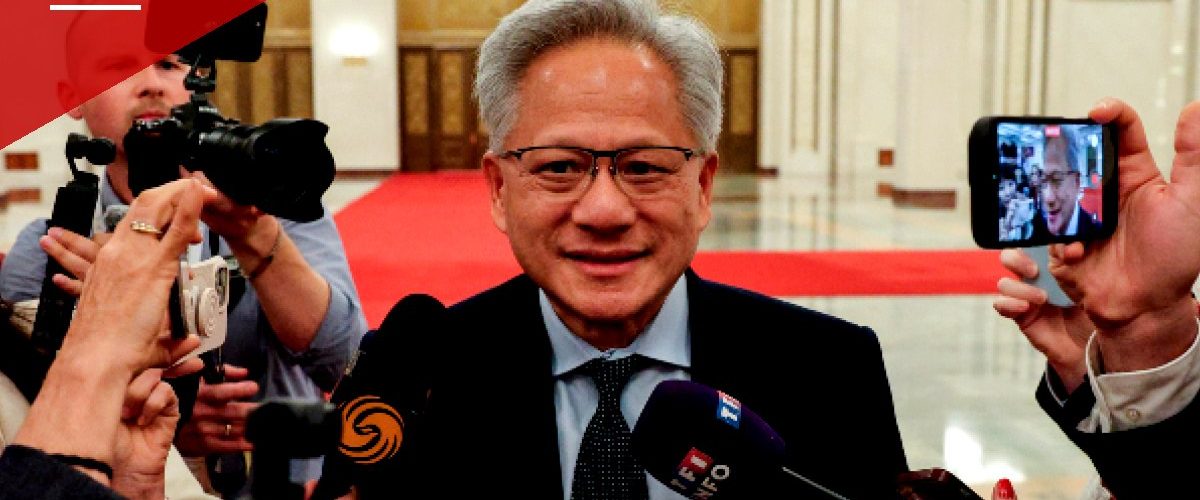
A developing scandal involving Nvidia CEO Jensen Huang and allegations of Chinese espionage is drawing scrutiny toward Commerce Secretary Howard Lutnick, according to investigative journalist Peter Schweizer, speaking on the latest episode of his podcast The Drill Down.
At the center of the controversy is Alice Huang, no relation to Jensen Huang, a Chinese national who runs the Singapore-based company Megaspeed. Alice Huang reportedly carried on an extramarital affair with the Nvidia CEO and has been accused of running what intelligence professionals call a “honeypot operation” on behalf of Beijing.
Schweizer says the Commerce Department’s reluctance to block sales of Nvidia’s most advanced chips to Megaspeed deserves closer examination, particularly given Lutnick’s family financial ties.
“Howard Lutnick’s family and company are heavily invested in those same Southeast Asia data centers,” Schweizer said. “And Lutnick supposedly blocked regulatory enforcement against Nvidia… This stinks to high heaven. There are a lot of questions around Howard Lutnick and his family deals and his former firm. That all needs to be looked at.”
Administration spokesmen have walked back earlier suggestions that Alice Huang was a direct employee of China’s Ministry of State Security. But Schweizer, who has written extensively on Chinese efforts to compromise American officials and executives, notes that a 2017 Chinese law obligates every citizen to cooperate with state security demands for information when asked.
A Possible Intelligence Play by Trump
Schweizer raised the possibility that President Trump may have known about Jensen Huang’s vulnerabilities for more than a year. When Trump traveled to China earlier this year, he brought several tech CEOs aboard Air Force One — but Huang was reportedly a last-minute addition, picked up during a refueling stop in Alaska.
“There are literally photographs of him with a backpack climbing aboard Air Force One,” Schweizer said, suggesting the circumstances invite questions about whether intelligence “tradecraft” was involved.
Schweizer floated the idea that Trump may have been running a classic counterintelligence technique known as “playback,” in which deliberately false information is fed to a potentially compromised person to trace where it travels.
“You pretend that everything is fine, but you’re selective of what you share with him, and you might even share [false] information with that source who’s going to pass it along maybe to the mistress or whoever,” Schweizer said.
Open vs. Closed AI Models
Schweizer argued the scandal connects to a deeper strategic divide between the U.S. and China over artificial intelligence. American firms such as Anthropic and OpenAI favor closed models, where the underlying algorithm stays secret and access is sold to customers. China favors open models, which expose the underlying code and let users override built-in guardrails.
“Closed models are ones that are developed in secret, the algorithm is secret. These are easier to monetize, because you’re not sharing your secrets with anyone,” Schweizer explained. “But if there are problems with it, they’re harder to expose because you don’t know its biases.”
“Open models are where you share the algorithm and information,” he continued. “But people can turn them into hacking machines and use them for nefarious purposes.”
According to Schweizer, China’s interest in open models reflects a strength it already has — gathering and exploiting information. Jensen Huang, now ousted as Nvidia’s CEO, was among the few tech executives who favored open models, partly because they help Nvidia sell more chips, making him a valuable target for Beijing’s influence efforts, Schweizer said.
Trump’s Balancing Act With Xi and Putin
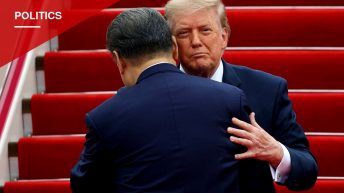
The scandal surfaced around the same time Trump held tripartite meetings with Chinese President Xi Jinping and Russian President Vladimir Putin. No details of those discussions have been made public.
Schweizer said Russia has little reason to resist expanding Chinese influence. “When it comes to expanding Chinese influence in the world, Russia is generally in favor of that. They don’t feel threatened by it, and they have a lot of common interests when it comes to technology controls and restrictions on the energy market,” he said, adding that if anyone could manage being outnumbered in talks, “it would be Trump.”
“I would imagine that Trump will rather casually toss out certain issues those two might have differences of opinion on, just to keep them off balance,” Schweizer said.
Co-host Eric Eggers compared the dynamic to a holiday gathering. “This meeting is like a dysfunctional family, all doing their own thing. There’s a history of bitterness and strife, but they’re all going to come together and pretend none of it happened,” Eggers said.
Schweizer extended the metaphor: “I think Trump is probably the dad. Xi is the scolding mom, and Putin is the rebellious teenager who lit the neighbor’s house on fire.”
China’s economy has struggled under sustained U.S. trade pressure, Russia is seeking an exit from its war in Ukraine, and the U.S. is working to end hostilities with Iran, raising the stakes for all sides involved in the talks.
Trump also mentioned he might stop in to see North Korean dictator Kim Jong Un while in the region. Schweizer was skeptical that approach would work. “I don’t think Dennis Rodman got anywhere with him, and I doubt that President Trump will either,” he said.

Add comment