
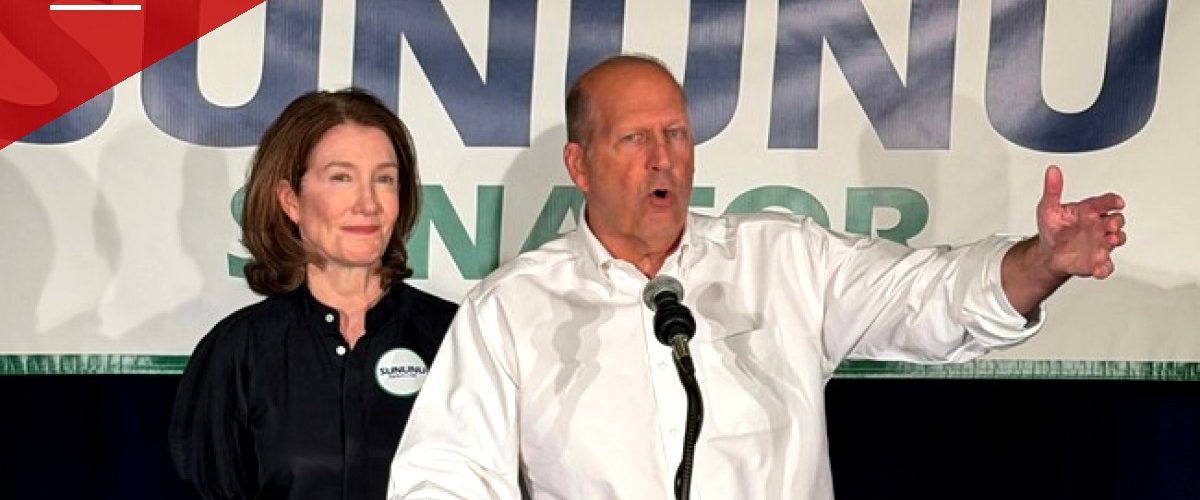
The New Hampshire Senate race has been reclassified from “Lean D” to “Toss Up” by Cook Political Report, a sign that a contest once considered a safe Democratic hold is now genuinely competitive heading into the 2026 midterms.
The race pits four-term Democratic Rep. Chris Pappas, endorsed by 2024 Democratic presidential nominee Kamala Harris, against Trump-backed former Sen. John E. Sununu, the Republican nominee. Both are seeking the seat held by Democrat Jeanne Shaheen, who is not seeking reelection.
Cook Political’s analysis notes that New Hampshire voters have a history of splitting their tickets, as they did when they elected Republican Kelly Ayotte governor in 2024 while backing federal Democrats. But the Sununu name carries significant weight in the state. John Sununu previously served as senator, his brother Chris Sununu served four terms as governor from 2017 to 2025, and their father, John H. Sununu, was governor from 1983 to 1989.
Cook Political wrote: “Despite headwinds against Republicans, there is one Senate race that some in both parties privately concede may be a sleeper offensive opening for the GOP: New Hampshire.”
Money is flowing accordingly. According to Cook Political, “Republicans are on pace to have a $20M advantage in the state. Sununu allies have already outspent pro-Pappas groups by almost a 2-1 margin, and Pappas allies are worried their race isn’t capturing the interest of national Democrats enough.”
Two public polls in August showed Sununu with a slight edge over Pappas in a hypothetical matchup, prompting New Hampshire state Rep. Sam Farrington, a Sununu supporter, to call it “the most overlooked Senate race” and declare that “all eyes should be on New Hampshire.”
Pappas has emphasized the historical difficulty Democrats face winning Senate seats in the state, previously noting that Shaheen and Sen. Maggie Hassan “are the only two people who have been elected as Democrats to the Senate from New Hampshire in the last half a century.”
A North Carolina precedent
Some observers are also watching for the possibility of a localized red wave in New Hampshire, even in a midterm cycle that historically disfavors the party in power in Washington. A similar dynamic played out in North Carolina in 2022, when a state-level red wave helped Republicans win control of the state Supreme Court — the second consecutive election cycle in which North Carolina defied national trends by electing more Republicans.
The NCGOP chairman during that period was Michael Whatley, who is now the Republican Senate nominee in North Carolina for 2026.


Add comment