
Florida Rep. Laurel Lee has introduced legislation that would require all ballots in federal elections to be received by the close of polls on Election Day in order to be counted, ending the practice in many states of accepting ballots that arrive days or even weeks later.
Lee, a Republican who represents Florida’s 15th Congressional District and previously served as the state’s Secretary of State, calls her measure the Ballots by Election Day Act. It would apply a uniform national deadline to federal elections: if a ballot isn’t in by the time polls close, it doesn’t count.
“When the polls close, voters should have confidence that the voting is over and election officials can move forward with determining the results,” Lee said in a press release. “The Ballots by Election Day Act applies that commonsense standard to federal elections across the country and provides greater certainty for voters, election officials, and the American people.”
The bill is modeled on Florida’s own election deadline. Lee said the state “has shown that we can provide voters with accessible ways to cast their ballots while maintaining a clear deadline for when those ballots must be received. Election Day should mean election results.”
California’s Slow Counts
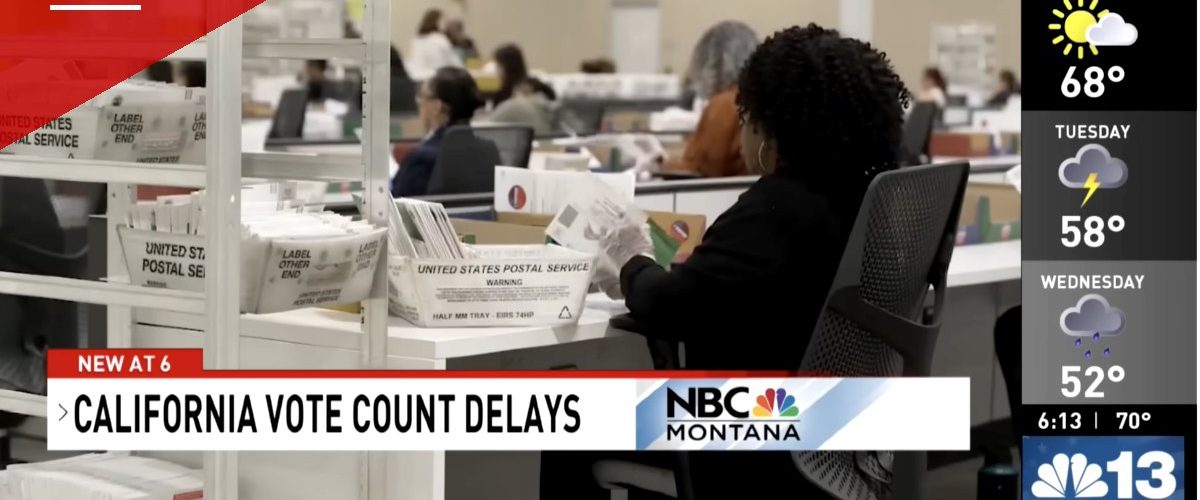
The legislation takes direct aim at practices in states like California, which counts ballots postmarked by Election Day but received up to a week afterward. In California’s June primary, officials were still tallying votes several days after the June 2 election.
That slow count had real consequences in the Los Angeles mayoral race, where late-arriving mail ballots allowed City Council member Nithya Raman to overtake reality television personality Spencer Pratt for the second and final spot on November’s general election ballot. About 2.2 million ballots were cast in that election, and officials didn’t reach the 85 percent tally mark until six days after the primary.
By contrast, according to a report from 77 WABC, Florida counted about 85 percent of the 3.3 million ballots cast in last month’s primary within 45 minutes.
In 2024, California’s extended ballot-receipt window delayed the country’s understanding of the partisan balance of the U.S. House of Representatives for more than a month. California mails ballots to every registered voter and places no limit on how many ballots a third party can collect and deliver — a practice known as ballot harvesting.
California is not the only state with an extended deadline. Fourteen states and the District of Columbia currently accept ballots postmarked by Election Day but received afterward, with grace periods that vary by state.
A Divided Supreme Court
The push for a uniform deadline comes months after the Supreme Court ruled 5-4 in Watson v. RNC, a case challenging Mississippi’s five-day grace period for receiving mail ballots. Justice Amy Coney Barrett, joined by Chief Justice John Roberts and the court’s three liberal justices, wrote for the majority that “the election-day statutes say nothing about ballot receipt, and we cannot add to the words Congress chose.”
Justice Samuel Alito dissented, joined by Justices Neil Gorsuch, Brett Kavanaugh and Clarence Thomas. “Allowing absentee ballots to pour in over the days and weeks after election day, by which point preliminary election returns are being publicly reported, creates greater opportunity for fraud and risks further undermining the public’s confidence in election integrity,” Alito wrote. He added that if late ballots are counted toward the outcome, “the electorate’s choice does not occur on election day, and the federal election-day statutes are violated.”
An Uphill Path in Congress
Florida Sen. Ashley Moody, also a Republican, is sponsoring companion legislation in the Senate and has called on Congress to “bring Florida’s blueprint for elections nationwide.”
Passage is far from certain. Senate Democrats have filibustered the broader SAVE America Act, which would require documentary proof of citizenship to register for federal elections, mandate voter ID, and limit mail-in voting. Republican leadership has not moved to force a filibuster fight over that bill.
Separately, the Trump administration this week asked the Supreme Court to lift a lower court’s temporary restraining order blocking new U.S. Postal Service rules meant to prevent noncitizens from voting by mail. The rules stem from a Trump executive order and have been challenged by left-leaning groups and Democratic state attorneys general. The administration argues in its filing that “the Rule’s regulation of the U.S. Mail—not federal elections—is plainly constitutional,” adding that states “cannot choose to use the federal mails to carry out their elections but then insist that their election-related mail is somehow exempt from the Postal Service’s rulemaking authority.” The Supreme Court had previously overturned a permanent injunction against the rule issued by U.S. District Court Judge Indira Talwani.


Add comment