
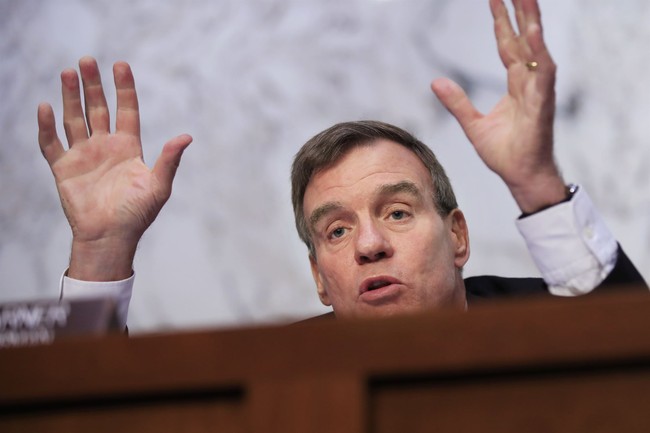
Sen. Mark Warner’s recent comments about the Department of Justice’s announcement in the J6 pipe bomb arrest created an unintended political moment, where his critique of resource allocation and previous investigations undercut the very party he’s meant to defend. Speaking as a senior Democrat and vice chair of the Senate Intelligence Committee, Warner questioned why officials were celebrating when, in his view, investigative resources had been shifted, and those remarks opened room for Republican critics to argue that years of Democratic leadership produced weak results. The exchange prompted sharp responses from conservatives who framed Warner’s words as an admission of failure and a vindication of a law-and-order approach that prioritizes the hunt for criminals over political prosecutions. Video from the interviews circulated quickly, letting the quotes speak for themselves and fueling a broader debate about priorities at the FBI and DOJ.
Warner said the arrest was “good news” but then questioned the timing and the emphasis on the announcement, suggesting that personnel changes and reassigned agents had hampered investigations. He raised concerns that “senior FBI officials across all key divisions have been fired for political purposes” and that investigators who normally handled counterintelligence and cyber work had been reassigned to immigration tasks. Those lines landed hard because they implied internal disruptions and diversion of investigative focus, precisely the sort of operational weakness critics have warned about for years.
But I got to tell you, it kind of makes me — looking at this crowd, doing a victory lap, when all the senior FBI officials across all key divisions have been fired for political purposes, when in some field offices, up to 45% of the FBI officers who were doing things like counter espionage and cyber have been assigned to do immigration cases.
It’s a little rich that they’re saying they [make] America safer. How much earlier could we have caught this guy if resources hadn’t been diverted?
Republican lawmakers quickly seized on Warner’s questions, pointing out that if agencies were so stretched or misdirected under a Democratic administration, then a shift in leadership that restored a focused law-and-order agenda should improve outcomes. Some conservatives argued Warner had accidentally validated the GOP argument that law enforcement should concentrate on violent crime and national security threats rather than politically motivated prosecutions. The reaction was swift, sharp, and unapologetic, framing Warner’s remarks as evidence that Democratic priorities had cost investigators valuable time.
The timing of Warner’s critique matters because the arrest announcement came after years in which the DOJ and FBI were under Democratic presidential leadership. Republicans noted that if resources had been diverted or if senior staff changes hindered work, that would reflect poorly on that period. GOP lawmakers contrasted Warner’s skepticism about victory laps with their view that a results-driven leadership restores focus and produces quicker arrests and safer communities.
Additional comments from law enforcement officials during the press conference underscored that approach, emphasizing internal investigative work and a direction from the top that prioritizes catching criminals. One senior official highlighted a concentrated team effort and dismissed the notion this was the product of a new public tip, pointing instead to the FBI’s own work. That messaging fit neatly into the Republican talking point that leadership focused on enforcing the law produces concrete results.
“Folks, this is what it’s like when you work for a president who tells you to get the bad guys and to stop focusing on other extraneous things not related to law enforcement. This is what happens.”
“We had a great team. […] It was not a new public tip this came from. This was our own internal work at the FBI.”
Video clips of Warner and responsive statements from Republican members circulated in the news cycle, with critics arguing the senator had done his opponents a favor by admitting the previous approach fell short. That framing pushed the narrative that operational disruptions inside the FBI and a focus on politically driven targets undermined core investigative missions. For conservatives, the exchange was an argument that restoring priorities around law enforcement and national security delivers measurable wins.
Beyond the partisan back-and-forth, Warner’s comments highlighted real questions about staffing, priorities, and how agencies allocate their resources. Even supporters of a broader enforcement agenda would say it’s reasonable to ask whether shifting personnel or changing investigative emphases affects case outcomes. But in the current climate, any such admission from a senior Democrat becomes political ammunition that rivals will not let go of easily.
The debate now centers on whether agency leadership and political direction will continue to be contested terrain, and whether future investigations will be judged on results or rhetoric. Warner’s offhand critique has ensured the topic won’t fade quickly, and Republicans will use it to press for accountability and a renewed focus on core law enforcement responsibilities.
Watch:
Watch:
Watch:


Add comment