
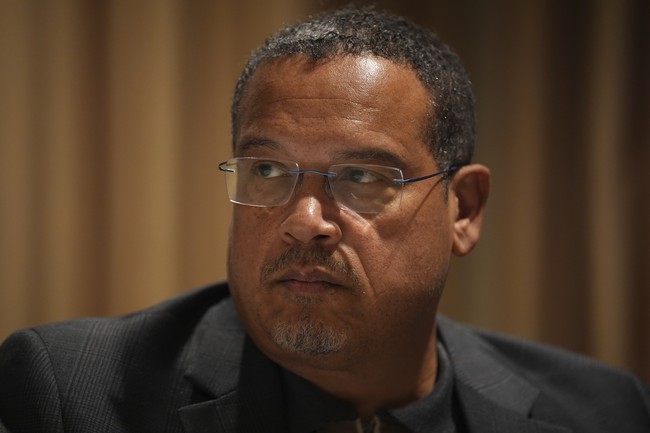
This article examines a viral clip of Minnesota Attorney General Keith Ellison urging organizers to mobilize voters who were not eligible or did not participate in the previous election, places that traditional outreach skips, and connects those remarks to a wider pattern of Democratic campaign tactics and local controversies surrounding progressive candidates in Minnesota.
The clip shows Ellison speaking at a campaign event and telling supporters to expand the electorate by engaging groups who were absent last time. His language raised eyebrows because it framed turnout-building as an explicit project to find people who were newly eligible, newly naturalized, or previously disinterested. For many conservatives, the remark sounded less like grassroots organizing and more like an admission of deliberate targeting that stretches familiarity with standard voter outreach.
In the circulated footage, a political research account posted the video and summarized Ellison’s words in stark terms, prompting rapid sharing. The reaction was fueled by the phrase that quickly became the focal point of commentary: “We gonna get them all this election.” That line has been repeated by critics who argue it signals a squeeze play on new or marginal voters to tilt results.
The clip is not isolated; Ellison reportedly made nearly identical comments in a January interview, repeating the phrasing about people who were not naturalized citizens or not old enough to vote in the last election. He said, “But there’s a whole lot of people who were not, uh, naturalized citizens in the last election and were not old enough to vote in the last election, and who somehow just sat it out because they didn’t like the choices in the last election.” Repetition of the same theme suggests a strategic point rather than an offhand remark.
Beyond the video, this controversy feeds into ongoing local scandals tied to Democratic networks in Minnesota, where some elected officials and hopefuls have intersected with communities under investigation. Critics point to meetings between high-ranking Democrats and members of families who later faced charges in a federal fraud case, arguing those appearances raise conflict questions when conversations about resources and political support intersect. Those connections have kept scrutiny on how political influence and community advocacy sometimes overlap in ways voters may find troubling.
One target of these dynamics is the progressive Senate candidate who has been vocal about community ties and cultural identity. Opponents characterize her as a flashy defender of certain constituencies even while controversies swirl around welfare and fraud stories in Minnesota. Political opponents have leaned into those episodes to argue that ideological zeal has outweighed judgment in candidate selection and endorsements.
https://x.com/RNCResearch/status/2079333925386617319
Ellison’s call to “go places you normally don’t go” and to reach neighborhoods “that you don’t necessarily speak the language” has been presented by critics as a blueprint for outreach that bypasses standard civic norms. To Republican observers, that language suggests a willingness to prioritize raw turnout over the integrity and clarity of voter eligibility. That interpretation feeds a broader narrative about how modern campaigns prioritize demographic expansion and agility over electoral predictability.
Conservative commentators also highlight the potential for confusion when campaigns aggressively court populations with unclear status or limited civic experience. They warn that mobilizing newly naturalized or recently eligible voters without careful safeguards risks mistakes, misunderstandings, and exploitation. The concern is both practical and political: mistakes become headlines, and headlines can shape voter sentiment in tight races.
The exchange also underscores a tactical divide in campaigning philosophy. One side frames this approach as inclusive, bringing fresh voices into the democratic process. The other side sees a deliberate push to manufacture advantages by accelerating the political integration of particular groups for short-term gains. The viral clip widened those lines, making the tactic itself a campaign issue rather than a simple outreach anecdote.
Public trust in elections depends on clear rules and fair practices, say critics who ask whether rapid naturalizations and targeted registrations are being pursued as political levers. They argue that democracy works best when changes to voter pools happen transparently and with oversight, not hurried to meet an election calendar. For the Republican perspective, the answer lies in defending stable, well-regulated civic processes against opportunistic tactics.
The video and surrounding controversies will likely be used as talking points through the campaign season, shaping debates about outreach ethics and the limits of political persuasion. Whether voters see Ellison’s remarks as standard mobilization rhetoric or as proof of a willing exploitation of newly eligible populations will depend on how campaigns and media frame the follow-up. Either way, the clip has pushed the conversation about campaign tactics into the spotlight and turned routine organizing language into a matter of electoral contention.


Add comment