
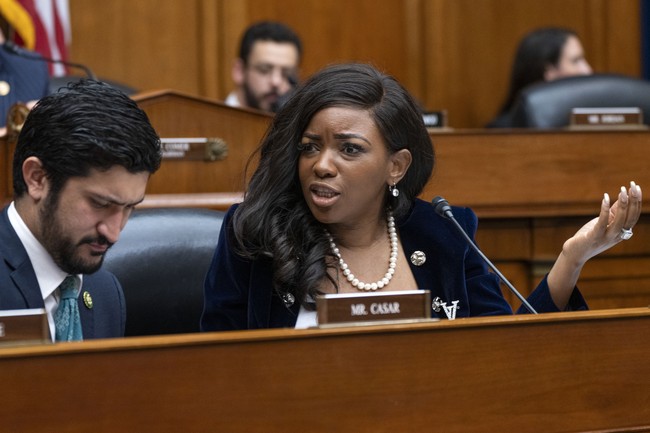
The House Oversight Subcommittee hearing on the Smithsonian’s exhibits turned into a notable exchange when Democrat Rep. Jasmine Crockett tried to connect World Cup fandom to race, only to meet a witness who declined to follow that line and gave a straightforward answer instead.
The hearing was framed around how history and public institutions present the past, and Republicans pressed the museum on perceived ideological shifts. One moment stood out because it drifted away from the museum topic and into a surprising World Cup riff by Rep. Crockett. The exchange quickly exposed how a partisan angle can collapse when the witness answers plainly.
Crockett offered a striking line about the tournament: “The World Cup that captured the imaginations of the entire world when they saw all these people of color that was playing for all these teams.” That sentence landed awkwardly in the hearing, because most fans cite the sport, national pride, and drama, not racial identity, as reasons to watch. Her comment sounded like a forced attempt to insert race into a topic that, for most Americans, was entertainment and international rivalry.
She doubled down by speculating about support in the final, asking, “If you recall, the last two teams, it was Argentina and Spain, and it seemed like the vast majority of the world was rooting for Argentina- or actually against Argentina, right?” The question was clumsy and uncertain, and it set up a simple factual reply. The witness, Professor David Blight, gave the kind of practical answer that defused the moment: “Spain had the best team. Maybe that’s why they were rooting for them.”
https://x.com/EndWokeness/status/2079599936660811930
That response highlighted the disconnect between political framing and everyday explanations. Fans evaluate teams based on players, tactics, and form, not political narratives. When a hearing aims to scrutinize cultural institutions, detours into speculative social readings of sports risk undermining the committee’s credibility and appearing contrived.
Crockett then asserted, “There’s also a racist history.” The statement was vague and confusing in context; it left observers unsure whether she meant historical relations between nations, perceived bias in fandom, or something else entirely. Her line prompted puzzled looks and an exchange that made it clear the witness was not going to validate a race-centered interpretation of World Cup support.
Some in the audience tried to parse what she meant, and others assumed she was labeling broad public preferences as racially motivated. Either reading was a stretch. Most people I spoke with about the tournament described it in terms of great matches, memorable goals, and fans celebrating, not racial narratives.
The hearing’s larger theme—how museums curate history and whether they are reshaping the past—remains an important congressional issue. But moments like Crockett’s World Cup interlude show how political theater can distract from substantive oversight. Republicans on the panel pressed for clarity about institutional change, while this particular detour undercut the seriousness of the proceeding.
For viewers and citizens, the exchange was also a reminder that not every public event needs to be filtered through identity politics. International sports bring people together across cultures and languages, and the World Cup’s appeal comes from competition, passion, and spectacle. Turning those shared experiences into a vehicle for partisan points is often unnecessary and counterproductive.
The hearing continued to focus on museum practices, public trust, and the role of federal institutions in presenting history, but the Crockett moment will likely be the clip people replay. It illustrated how an attempt to race-bait a popular cultural moment can backfire when the facts and common sense responses are allowed to stand. The witness’s straightforward reply undercut the attempt to recast a sporting event as primarily a racial statement.
Congressional oversight thrives on clear questions and clear answers, and when either side indulges in performative framing, the public loses. This episode reinforced that principle in a small but highly visible way, as an odd detour into soccer fandom revealed more about political instincts than it did about the Smithsonian or the World Cup.


Add comment