
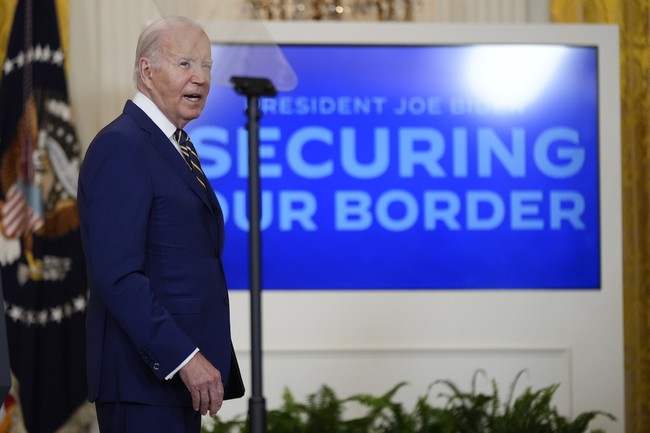
The newly obtained White House memo shows senior Biden advisers considered last-minute moves to expand Temporary Protected Status for more than 3.1 million noncitizens before President Trump returned to office, detailing requests from lawmakers, mayors, and advocacy groups and outlining the legal and logistical risks of such a push.
A memo dated January 2, 2024, obtained by Sen. Eric Schmitt, lays out pleas from the Congressional Hispanic Caucus, several Democratic senators, and various advocacy organizations to broaden TPS designations before the transition. The document admits applicants face an average six-month processing time, meaning any redesignations in those final days would create a backlog for the incoming administration to handle. The memo also acknowledges past litigation blocked earlier Trump-era rollbacks because the administration had not compiled a full factual record.
Stakeholders argued the urgency was to prevent a potential Trump administration from carrying out mass deportations against vulnerable people and families with mixed immigration status. The memo explicitly records that advocates were prepared to litigate to defend new TPS decisions and expected courts to sustain those protections. That legal strategy, combined with administrative delays, would leave a sizeable caseload for whoever was president on inauguration day.
Schmitt highlighted the political scope of the requests, noting they came from a wide array of Democrats in Congress and local leaders seeking rapid action. The memo says, “YOUR senior team has received requests from stakeholders, including some Members of Congress (principally the Congressional Hispanic Caucus as well as Senators Bennett (D-CO), Booker (D-NJ), Cortez Masto (D-NY), Durbin (D-IL), Hirono (D-HI), Lujan (D-NM), Duckworth (D-IL), and Padilla (D-CA)), some mayors, and a range of advocacy organizations to take TPS-related actions for additional countries before the end of YOUR Administration.”
The document forecasts how the controversy would land politically, noting opponents would frame certain redesignations as de facto amnesty or as creating safety zones for criminal elements. It specifically mentions likely Republican criticism of a Venezuelan redesignation, warning it would be depicted as a shield for Tren de Aragua gang members even though the memo did not state gang members would automatically qualify. That predicted messaging shaped the partisan battle lines on the issue.
https://x.com/SenEricSchmitt/status/2080381767584714922
The memo also provides numbers to quantify the requests and the potential scale of any expansion, estimating eligibility could touch millions. Because processing typically spans months, the paper notes Biden could enlarge the eligible population but could not realistically finish adjudications in time, leaving the incoming Trump administration with a backlog and the choice to continue, revise, or terminate those protections. That scenario was precisely the point opponents warned about: temporary measures becoming effectively permanent because of administrative inertia and court intervention.
Although some extensions happened shortly after the memo was drafted, the largest proposals recorded in the file were not implemented before the transition. The Biden team ultimately extended protections for nearly one million Venezuelan, Salvadoran, and Ukrainian nationals, but did not redesignate Ecuador or Guatemala as the memo had contemplated. Those partial moves still left open the question of how broad an incoming president’s authority would be to unwind such designations.
The memo notes prior legal setbacks and identifies how future litigation might play out, saying the Trump administration had lost earlier rounds largely for failing to develop a sufficient factual record. That admission undercuts any suggestion the obstacles to termination were purely judicial overreach and instead points to avoidable procedural missteps. Advocates hoped to exploit that learning curve by pushing last-minute actions bolstered by prepared lawsuits.
Sen. Schmitt used the memo to argue the pattern of TPS use under Democrats had turned a temporary humanitarian tool into a vehicle for mass migration, a point he repeated on the Senate floor. He framed TPS’s evolution as a one-way trajectory away from enforcement and back toward permanence, describing a cycle of emergency declarations, extensions, and judicial reliance that entrenched protections over time. That rhetoric illustrates why Republicans view sudden expansions as a policy and political threat.
In the aftermath, the Supreme Court narrowed the availability of judicial review for many TPS termination disputes, a shift that strengthened presidential authority to end protections without prolonged lower-court holds. That decision changed the legal landscape the memo anticipated, reducing one of the key tools advocates planned to use to lock in new designations. Still, the memo remains a snapshot of the last-minute pressure campaign and the trade-offs a departing administration weighed when setting immigration policy on autopilot.

Add comment