
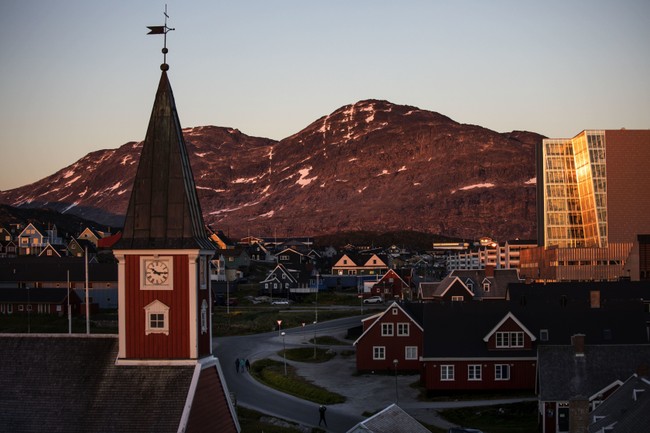
This article examines a recent push by a GOP congressman to make Greenland a U.S. state, explains the strategic and constitutional issues involved, and assesses political and logistical hurdles that make statehood unlikely despite renewed interest from some quarters of the Republican Party.
Talk about adding new states has resurfaced in GOP circles, and Greenland is one of the places being floated because of its strategic position in the North Atlantic. Its geography gives it influence over access between the Atlantic and the Arctic, which matters for military posture, shipping lanes, and emerging resource access. That combination of strategic interest and natural resources is why some lawmakers are raising the idea again.
Representative Randy Fine of Florida has introduced legislation aimed at authorizing executive steps toward acquiring Greenland and putting it on a path to statehood. The proposal is framed as backing for presidential action to pursue sovereignty and, if taken all the way, eventual admission to the Union. Even supporters admit the measure faces steep political obstacles and would still require the full constitutional process for admitting a new state.
A House Republican is pushing for Greenland to become the country’s 51st state as President Donald Trump publicly pushes for the Danish territory to come under U.S. rule.
Rep. Randy Fine, R-Fla., is introducing a bill on Monday aimed at authorizing Trump “to take such steps as may be necessary” to acquire Greenland and set it on the pathway of becoming part of the United States.
“I think it is in the world’s interest for the United States to exert sovereignty over Greenland,” Fine told Fox News Digital in an interview.
“Congress would still have to choose to make it a state, but this would simply authorize the president to do what he’s doing and say the Congress stands behind him. And then it would expedite it into becoming a state, but it would still be up to Congress about whether to do that.”
Practical politics make this an uphill fight. Any Senate action would face the 60-vote threshold that blocks many controversial measures, and the House and Senate majorities at any given time determine how viable a push for statehood would be. The last time the nation added a state was Hawaii in 1959, and admitting a 51st state now would be an unprecedented political battle, not just a procedural step.
Beyond votes, the constitutional process is explicit: Congress admits new states, and a proposed state must draft and approve a constitution that Congress accepts. Article IV, Section 3 of the Constitution places the power squarely with Congress and adds limits on forming states within the jurisdiction of other states or by merging parts of states without proper consent. That legal framework means congressional approval is indispensable no matter what diplomatic or executive actions precede it.
New States may be admitted by the Congress into this Union; but no new State shall be formed or erected within the Jurisdiction of any other State; nor any State be formed by the Junction of two or more States, or Parts of States, without the Consent of the Legislatures of the States concerned as well as of the Congress.
Strategic concerns are part of the argument for interest in Greenland, and they are real. The island sits near busy Arctic sea lanes, has reported deposits of minerals and energy resources, and is seeing activity from other powers in the region. Russian naval presence in the Arctic is substantial, and occasional Chinese ship activity has been noted near Greenland, raising U.S. security planners’ eyebrows about influence and access.
Denmark currently has sovereignty responsibilities for Greenland, but defending and supplying such a remote territory presents logistical challenges for Copenhagen. Greenland itself lacks a conventional military force of its own, which leaves defense reliant on its sovereign and any allied support arrangements. Those realities feed arguments that closer U.S. defense involvement, or some form of stronger American presence, could serve mutual interests.
Even if the executive branch pursued a negotiated transfer of control or defense arrangements, the admission of a new state remains a separate constitutional matter. Any treaty-level arrangements or purchases would have to be reconciled with Congress’s exclusive admission authority. That separation of powers means presidential enthusiasm alone cannot convert Greenland into a state; it still needs legislative action and a constitutional process.
For congressional advocates, framing a measure as authorization to the president is a way to show institutional support for a strategic aim while leaving the ultimate decision to lawmakers. But political reality matters: members must weigh constituents’ views, geopolitical implications, and international reactions. The broader diplomatic relationship with Denmark and the preferences of Greenlanders themselves would shape any viable pathway forward.
The debate touches on energy and mineral access, Arctic security, and U.S. posture in a region where other powers are active. None of those factors guarantees success, but they explain why the idea keeps resurfacing. For now, statehood for Greenland remains a provocative proposal that highlights broader questions about American strategy and constitutional limits on adding new members to the Union.
Tags: DENMARK, GREENLAND, MARCO RUBIO, TRUMP ADMINISTRATION



Add comment