
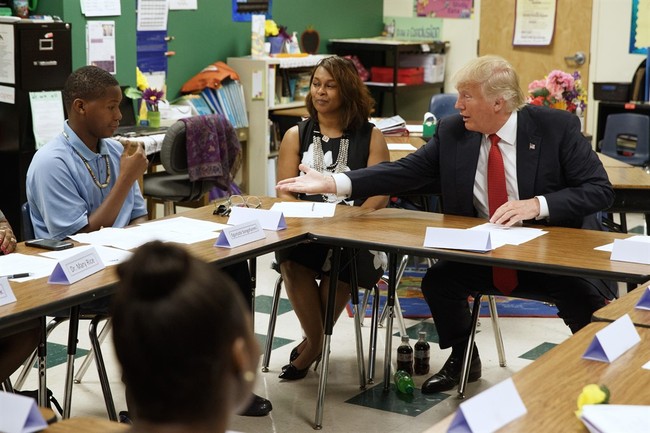
This article contrasts the Trump administration’s embrace of school choice with the Biden administration’s earlier reluctance, outlines recent federal actions expanding options for families, highlights persistent resistance from many Democratic governors, and examines data on public school performance and spending to argue that competition and parental choice can improve outcomes.
Under President Joe Biden, school choice rarely featured in federal education messaging and often seemed sidelined by the administration. In contrast, the second Trump administration has placed school choice at the center of its education priorities, making it a visible and recurring theme in federal policy. That shift represents a deliberate pivot toward empowering parents and expanding alternatives to traditional public schools. The debate is now less about whether choice exists and more about who can access it.
On January 26, the Department of Education “kicked off its celebration of National School Choice Week, a time to highlight the many different types of education across the United States and to empower families to choose the best learning option for their child’s success.” Secretary of Education Linda McMahon said, “During National School Choice Week, we celebrate how school choice has changed the lives of millions of students by empowering parents and families to choose a school or program that best meets their child’s needs.” Those statements made clear that the administration intends to promote choice not as an experiment, but as a national priority.
In the first year of the administration, officials point to a string of actions intended to expand options. The Department awarded $500 million to the Charter Schools Programs, touted a major national expansion in the form of the Education Freedom Tax Credit, and encouraged states to use up to 3% of their federal Title I allocations to support choice initiatives. The department also issued guidance aimed at maximizing safe school options for families and provided frameworks for using school improvement dollars to create alternatives for students in failing districts.
Looking ahead, a White House announcement explained: “Beginning January 1, 2027, Americans can reduce their tax burden by contributing to an approved Scholarship Granting Organization. While anyone in America can take advantage of this tax credit next year, families cannot receive a scholarship if their governor blocks their state’s participation.” That conditional structure hands real power to governors and has become a flashpoint in state capitals, with many Democratic governors declining to participate and thus limiting choices for millions of families in blue states.
Polling indicates this stance is politically risky for opponents of choice. A nationwide poll reported that “Nearly three quarters (74%) of voters favor School Choice where parents are allowed to choose the public, private or technical trade school they send their children to.” The same poll found that “eight out of ten voters (81%) agree that the U.S. should empower parents and prioritize individual students’ needs by providing greater access and more choices to ensure children receive the best education.” It also noted that by nearly a 2-to-1 margin voters prefer parents to decide education over local school boards, teachers’ unions or government.
Critics of the current public education model point to stagnant or declining outcomes as evidence that the status quo needs disruption. Recent results from the National Assessment of Educational Progress show decreases in average scores across subjects, with fewer students achieving proficiency in math, science, and reading. That trend raises questions about whether monopoly-style systems, insulated from market pressures, can deliver consistent improvement for all students.
Other data cited by reform advocates highlight troubling signs inside higher education pipelines as well. A University of California San Diego faculty report pointed to a “30-fold spike in freshmen needing remedial math classes alongside a sharp decline in writing skills since 2020.” Observers argue this decline traces back to K-12 preparation and underscores the need for alternative pathways that better match diverse student needs and career goals.
Financial arguments also enter the discussion. Public school spending per pupil has increased substantially, even as public school enrollment has fallen in many places. Yet private schools on average charge lower tuition than the per-pupil expenditure in public districts, which leads some to ask whether taxpayer dollars are being used efficiently and whether families should have greater choice over how those dollars follow students.
Proponents stress that school choice is not an attack on public schools but a mechanism to make them stronger. By exposing schools to competition for students and families, supporters say public schools will have incentives to innovate and to be more responsive to parents. In theory, that competition can drive improved performance and accountability without eliminating public education as an option.
Where governors block participation in federal choice programs, millions of families remain excluded from scholarships and tax-credit driven opportunities. That reality has turned school choice into a state-by-state political contest. For advocates and for many parents, the central argument is straightforward: families should be able to select the best educational fit for their children, and policy should expand—not restrict—that freedom.


Add comment