
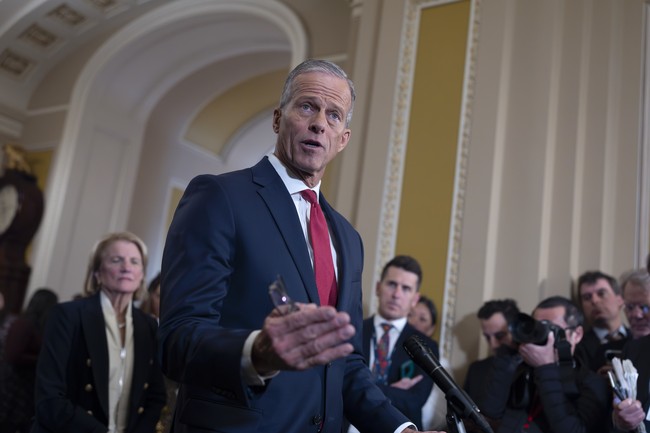
The Senate moved a five-bill minibus forward after a late deal carved Department of Homeland Security funding out as a two-week continuing resolution, setting up a short, partial shutdown while the House prepares to act. Senators pushed through a 71-29 vote on the minibus with changes that force the package back to the House, and party leaders scrambled to avoid broader disruption while defending immigration enforcement and border security priorities. A mix of amendments, roll call fights, and last-minute negotiations laid bare tensions within the GOP over concessions to Democrats and how to protect ICE and other border operations. The outcome leaves a narrow window for the House to take up the bills and creates a brief funding gap that leaders expect to close quickly.
The minibus vote followed a failed cloture test earlier in the week, which signaled how tight the margins were and how much distrust persists inside the chamber. Leader John Thune set up the test vote, and senators made clear they would not accept measures that undercut law enforcement tools. That posture framed the debate as Republicans worked to hold the line against provisions they view as hostile to ICE and border security.
Late Thursday, President Trump and Senate Democrats struck an agreement to remove DHS funding from the six-bill package and fund it instead with a short-term continuing resolution for two weeks. That change was designed to prevent a long-term impasse while the rest of the appropriations work proceeded. The swap means five of the six bills passed by the Senate will return to the House untouched, while the DHS CR will require additional attention.
The minibus ultimately cleared the Senate 71-29, but the modification obligates the House to reconsider the legislation, and the lower chamber was not scheduled to be in session until Monday. That timing creates a brief partial shutdown at midnight Friday, though leaders emphasized the interruption should be short-lived. House Republicans face pressure to move quickly while also ensuring the package reflects the protections they sought during debate.
Sen. Eric Schmitt, R-Mo., argued that while Republicans didn’t want to have a government shutdown, they wouldn’t legislate “stupid s—” into the DHS bill.
“We’re not like telling [ICE] they need judicial warrants when they already have administrative warrants,” Schmitt said. “We’re not doing that.”
The floor was active with amendment fights, and several senators demanded roll call votes to make their positions public. Some GOP senators even placed temporary holds to ensure leadership didn’t cut side deals that would weaken enforcement or betray priorities. Those maneuvers reflected ongoing concern that bipartisan cover could be used to smuggle in concessions that hurt border security.
Among the measures considered were several high-profile amendments touching on immigration and funding levels across defense and domestic programs. The Senate recorded votes on a slate of proposals, including multiple amendments from Senator Mike Lee and a Sanders amendment requiring a 60-vote threshold. The final package included the appropriations minibus covering Defense, Financial Services and General Government, Labor-HHS, Transportation-HUD, Homeland Security, and State-Foreign Operations as amended.
4. Lee amendment #4234
5. Lee amendment #4286
6. Sanders amendment #4290 (60-vote affirmative threshold)
7. Merkley amendment #4287
8. Passage of Cal. #302, H.R.7148, Appropriations Minibus (DOD, FSGG, LHHS, T-HUD, Homeland Security, SFOPS), as amended. (60-vote affirmative threshold)
Senator Eric Schmitt introduced a targeted amendment to reinforce ICE operations and push back against sanctuary policies, aiming to restore clear lines of authority for federal immigration enforcement. That move resonated with members who view sanctuary policies as undermining the rule of law and public safety. The amendment and the debate around it illustrated the GOP’s commitment to protecting federal law enforcement tools even while negotiating with Democrats.
It was notable who crossed the aisle on certain votes, including an unexpected aye on Senator Bernie Sanders’ amendment that drew attention and criticism from some conservatives. Those crossings underscore the complex arithmetic in a Senate with narrow margins and mixed priorities. Leadership warned that every vote mattered, and Majority and Minority leaders urged members to remain present as the House would need to reconvene with tight margins.
Punchbowl News reported that Speaker Johnson and House leaders convened with rank-and-file Republicans before the Senate tally, stressing the need for members to return to Washington to handle the resumed business. Johnson reportedly hoped to pass the five bills and the DHS continuing resolution on Monday, but doing so would require careful maneuvering and, potentially, substantial bipartisan cooperation. That reality puts House Republicans in the position of balancing constituent demands for border security with the procedural hurdles of passing spending measures.
“All of the leaders said that members need to show up to Washington because of the tight margins.
Margins only getting tighter. Five of the six spending bills are coming back to the House untouched, Johnson said. (They were bipartisan, bicameral deals, so this was expected).
JOHNSON also said that he hopes to pass the five bills/DHS CR Monday.”
Expect a short, targeted disruption in federal operations as lawmakers sort out the path forward, and plan for quick votes once the House reconvenes. The current situation highlights the tough choices facing Republicans who want to avoid needless shutdowns but will not accept measures that weaken immigration enforcement. Members on both sides will now watch how the House responds to the Senate’s amended package and whether the two chambers can finalize funding without expanding the window of uncertainty.
The discussion continued in a thread outlining procedural options and the difficulty of passing spending measures on suspension, which would require a two-thirds majority and heavy Democratic votes. That approach would skip a separate rule vote but demands cross-party support that isn’t guaranteed. At every step, the balance between governing responsibly and defending core enforcement policies is shaping decisions in both chambers.



Add comment