
The House returned to session with Republicans forcing a clear choice: will Democrats publicly reject socialism or dodge the question? A Rules Committee fight over a nonbinding resolution condemning socialism turned into a heated exchange that Republicans say exposes Democratic discomfort with the issue. The committee advanced the resolution on party lines, setting up a full House vote and giving Republicans a campaign talking point heading into November. The hearing highlighted clashes over process, hypotheticals, and whether mainstream Democrats will be pressed to stake out a firm position.
Republicans framed the resolution as simple: put socialism on the record and make members answer yes or no. That tactic is meant to draw a contrast between Republican opposition to government control and what GOP leaders portray as a Democratic flirtation with collectivist ideas. GOP members argued that socialism has a history of failure and that voters deserve clarity from those seeking power. Democrats countered that the resolution was political theater, and several refused to support moving it forward.
At the Rules Committee hearing, exchanges grew loud as Democrats tried to reframe the debate around real-world concerns like grocery and gas prices. “So you’re concerned about rising gas, or are you concerned about grocery prices? You know, don’t worry. Republicans in Congress are passing another non-binding resolution condemning socialism,” McGovern said. That line underscored a Democratic claim that Republicans were avoiding bread-and-butter issues.
Republicans pushed back by turning hypothetical questions into pointed examples of where government intervention could go wrong. When Democratic Rep. Joe Neguse floated a scenario about the federal government taking a stake in a grocery chain, GOP Rep. Bryan Steil responded bluntly and without hesitation. “Some folks on your side of the aisle would like to have government-run grocery stores,” he shot back. “I think that’s nuts.” The exchange illustrated the gulf in how each side views the proper role of government in markets.
Temperatures rose enough that the committee chair had to restore order as interruptions mounted. Democrats accused Republicans of whipping up a “boogeyman” to score political points, while GOP members said the refusal to vote for the resolution amounted to dodging accountability. The committee advanced the measure with zero Democratic votes, which Republicans hailed as a clear demonstration of their point. That party-line result sets up a procedural vote and likely a full House decision on the resolution.
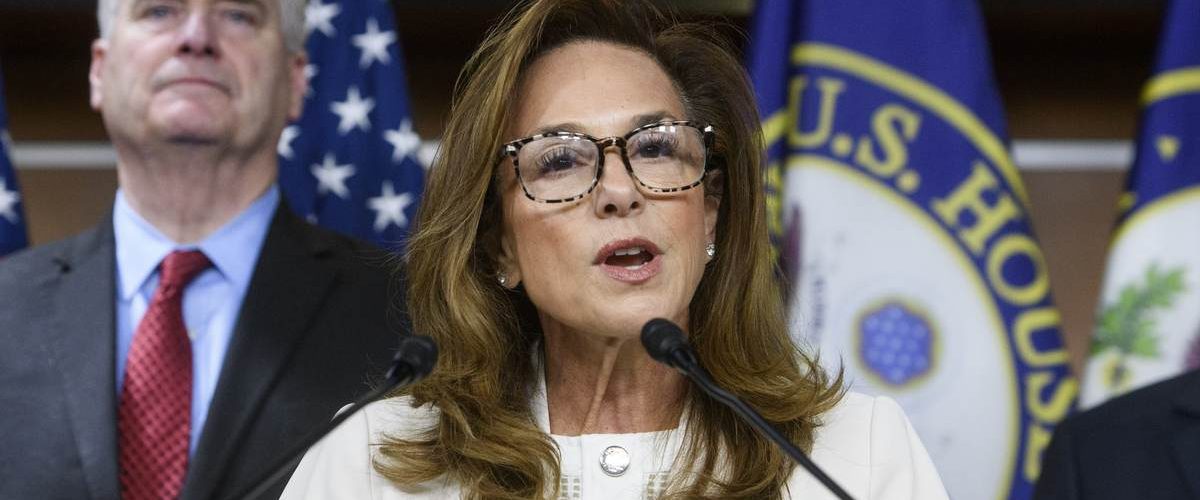
Republican messaging heading out of the hearing focused on holding Democrats to a binary test: either reject socialism outright or explain why they will not. House Republican Conference Chair Lisa McClain emphasized the tactic as intentional pressure to force clarity. Republicans also included policy attachments in the package, like support for the SAVE America Act, to broaden the stakes and give Democratic opposition more to explain on the campaign trail. For GOP strategists, the hearing produced both a headline and a record to use in the midterm push.
The hearing’s dynamics gave Republicans material to argue that Democrats are either unwilling or unable to reject an ideology associated with central control. That argument is rooted in a Republican perspective that government-run systems lead to shortages, repression, and diminished liberty. By extracting a floor vote, Republicans aim to create contrasts that are easy for voters to understand and for campaigns to amplify. The tactic also forces swing-district Democrats to take public positions where they may prefer ambiguity.
Democrats maintain that the resolution distracts from pressing economic concerns and unfairly paints a broad spectrum of policy proposals as socialist. They repeatedly framed the debate around immediate challenges faced by families, arguing that symbolism from Washington will not lower prices at the pump or in the grocery aisle. Still, Republicans argued that ideology matters and that voters deserve to know where candidates stand on the scope of government power. The clash reflected a larger fight over political branding in an election year.
https://x.com/Arkadalo/status/2094570641835823233
During the hearing, interruptions and sharp back-and-forth exchanges underscored how partisan this issue has become. Committee members traded barbs while trying to keep the focus on their respective narratives: accountability for Republicans and practical priorities for Democrats. The procedural advance ensures the dispute will land on the House floor, where every member will be able to be recorded for voters. Republicans see that record as a weapon heading into November.
House Republicans just advanced a resolution condemning socialism.
Not one Democrat on the committee voted to even let it move.
They called it a waste of time. Nonsense. Silly season.
Asking Congress to reject an ideology that has produced mass graves, empty shelves, and secret police is apparently too much for the Democrats.
Then they spent the hearing yelling about grocery stores and trying to trap Republicans with hypotheticals instead of saying the obvious: government-run everything is a disaster.
One of them even flipped out when he could not get the answer he wanted.
If your party cannot vote to denounce socialism without a tantrum, you are not fighting it.
You are covering for it.
Put it on the record.
Yes or no.
Stop hiding behind process complaints while the DSA crowd keeps marching into real power. 🇺🇸
With the committee result behind them, Republicans will press the issue on the House floor and on the campaign trail, arguing that voters deserve a clear line on ideology. Democrats will continue to argue that the GOP tactic is diversionary and that practical economic fixes should come first. The showdown over the resolution is likely to persist as both parties tee up messaging for voters in the weeks before the election.



Add comment