
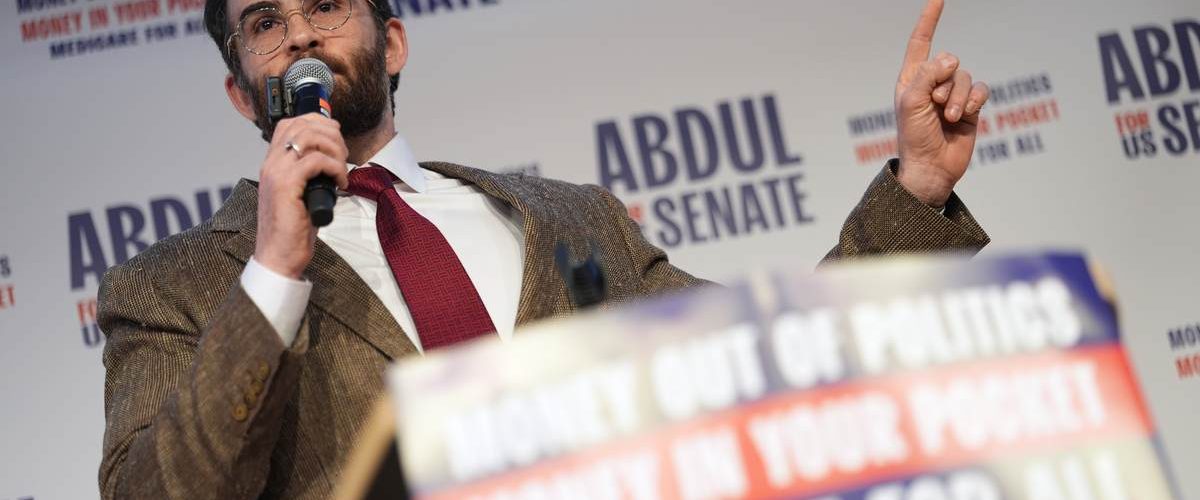
Quick summary: A progressive streamer’s on-record comments praising his dislike for America have become a major liability for a Michigan Senate campaign, forcing candidates to defend associations and sparking sharp Republican criticism that this alliance reveals deeper ideological problems on the left.
Hasan Piker tried to spin away criticism tied to Michigan Senate hopeful Abdul El‑Sayed, but his own words undercut that defense. Piker publicly said, “I say I hate America all the time,” and doubled down: “A lot of mother***ers want to kill me over that tape, but at least I say with my f***ing chest, people will be like ‘Hasan, you hate America.’ I’m like, ‘Yeah, I do. I do hate America.’” Those exact lines keep resurfacing and they are hard to dismiss.
The tape has circulated for years, so attempts to act surprised ring hollow. When a self-described leftist celebrity openly declares contempt for the country, it becomes more than online noise. Voters and opponents on the right treat that confession as evidence of a broader pattern, not an isolated rant.
Conservative officials have been quick to point out the political cost. Sen. Tim Sheehy posted, “Hating America seems to be a pattern with these two,” linking Piker and El‑Sayed in voters’ minds. Republican critiques frame the connection as proof that Democrats tolerate extreme voices rather than repudiating them, and that accusation lands in swing states where margins are thin.
El‑Sayed has tried to separate his campaign from the streamer, insisting the race is about affordability and healthcare. He told a TV host, “This campaign is not about a streamer in California,” and later, “This campaign is about affordability in Michigan. This campaign is about the ability to have healthcare.” That line of defense looks weak when the streamer has repeatedly campaigned with Democrats and cultivated a political audience.
Media appearances made the association unavoidable. Katy Tur observed on air that the streamer “does campaign with a lot of Democrats,” undercutting attempts to paint him as irrelevant. When a political influencer with an enormous platform aligns with candidates, his statements become fair game and political baggage for anyone who courts his backing.
https://x.com/WesternLensman/status/2094056268818210817
Local Democrats in Michigan appear uneasy. Several have publicly distanced themselves from the streamer’s remarks, describing some comments as “simply inexcusable.” Those reactions reveal internal anxiety: when a controversial figure becomes a liability, the party must decide whether to defend, disown, or awkwardly ignore the problem.
El‑Sayed’s own record hasn’t helped him shake the controversy. Old messages and remarks about sensitive topics have resurfaced, and critics point to them to argue there’s an ideological affinity between El‑Sayed and radical online figures. Those historical statements now sit alongside Piker’s declarations, creating an impression that questions about loyalty and judgment are legitimate.
Republicans emphasize that political optics matter in close races. In a state where margins can swing on turnout and messaging, any association that hints at anti‑American sentiment is gold for the other side. Conservative strategists argue voters deserve clear answers: do candidates denounce those views or tacitly accept them?
The controversy also spotlights how modern politics mixes digital influencers and electoral campaigns. Streamers and online personalities are no longer peripheral; they can shift narratives and energize audiences. When their rhetoric crosses red lines, candidates who link to them face real consequences at the ballot box.
From a conservative viewpoint, this episode is about accountability and clarity. If a candidate benefits from a celebrity’s reach, he must answer for that celebrity’s statements and values. Americans deserve candidates who will clearly affirm national loyalty, not hedge or deflect when confronted with explicit claims of hatred.
Beyond immediate campaign dynamics, there’s an ideological critique at play. Critics see a pattern of the left amplifying divisive voices because they draw attention and mobilize niche audiences. That tactic can work short term, but it risks alienating mainstream voters who expect leaders to defend the nation’s basic principles.
For Republicans, the takeaway is straightforward: hold opponents to account for who they associate with and force choices on whether they condemn anti‑American rhetoric. In tight races, those choices could tip the scale, and voters will remember whether candidates stood up for the country or shrugged when confronted with contempt.
*Record scratch.*
This echoes in campaign events and interviews where Piker’s comments are raised and where El‑Sayed’s rebuttals are tested. Attention keeps returning to the tape because the words themselves are unequivocal and because the political consequences are immediate.
“The streamer in California does campaign with a lot of Democrats,” a host observed, stressing the practical impact of that relationship. When activists and influencers are treated as political assets, mainstream candidates must reckon with the baggage that comes with them.
Republicans will likely keep pressing this line through the fall, framing the issue as a choice between candidates who publicly affirm America and those who tolerate or embrace voices that openly reject it. That contrast has proved effective before, and these moments crystallize it again.

These evil bastards are Enemies Within and should be sent to GITMO; Case Closed!