
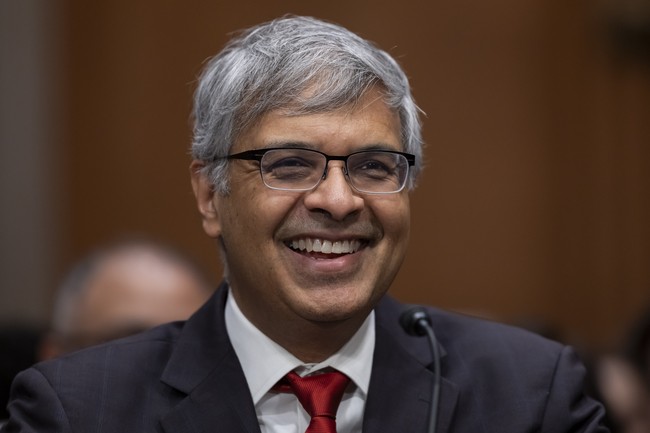
The CPAC speech by NIH Director Jay Bhattacharya made one thing clear: the NIH has shifted direction and is promising to rebuild American biomedical leadership, protect research from foreign influence, and refocus science on practical health outcomes for Americans.
Jay Bhattacharya took the CPAC stage and opened with a sharp line that set the tone: “It’s no longer Tony Fauci’s NIH.” He followed that with a historical frame, invoking Vannevar Bush and the idea that federal science should expand opportunity across the country, not concentrate power in a few elite institutions.
Bhattacharya reminded the audience that America has long led biomedical discovery, supporting breakthroughs that changed the lives of millions. He emphasized that the NIH remains central to that effort, investing heavily in research that has driven treatments for HIV, gene therapies for genetic disorders, and advances across cancer and cardiovascular medicine.
“I want to tell you a great story about how we can make America healthy again. And I’m going to begin with a perspective from 1944 that still challenges us today. There was a man named Vannevar Bush. He wrote a book called, The Endless Frontier,’ that warned that the scientific progress of the United States was becoming unevenly distributed. Too much research capacity, he argued, was concentrated in a small number of institutions. He called on the federal government not just to invest in science, but to build a system that expanded opportunity across the country. And for 80 years, we’ve answered that call with extraordinary commitment. I’ve been now to the great scientific institutions of the country, and I’ve seen American scientists just devoted to the cause of discoveries that will make America healthy again.”
He didn’t shy away from national security concerns either, warning that ceding biomedical leadership risks handing advantage to rivals with different values and goals. Bhattacharya called this a Sputnik moment for biotech and manufacturing, noting how much of medicine’s supply chain sits overseas and how foreign manufacturing already supports therapies developed in the U.S.
“With that leadership comes responsibility. If the U.S. steps back from leadership in biomedical research, emerging technologies and global health, we risk ceding that leadership to others, particularly China. Whose governing values, ethical frameworks, and strategic priorities differ from ours. I’m telling you, today, that we are at a Sputnik moment.
“The Chinese biomedical research enterprise is challenging American supremacy. You heard earlier in this conference from others who have told you about how the Chinese have taken big advances in their biomedical research enterprise. Many Americans receive their medicines from factories that are in China. The newest therapies for cancer, genetic diseases, they use Chinese manufacturing and expertise even though the underlying ideas were created by American scientists and funded by American taxpayers.”
The crowd reacted loudly, and Bhattacharya acknowledged their anger as warranted. He argued the United States must set global standards in research, grounded in openness, scientific integrity, and respect for human dignity, not cede that role to countries with different priorities.
“The work we do here in the United States sets the standards for the world, grounded in openness, scientific integrity, and respect for human dignity and human rights, rather than allowing them to be defined elsewhere. In 2025, the NIH invested almost $50 billion in biomedical research. And I’ll tell you, it’s no longer Tony Fauci’s NIH.”
Bhattacharya painted the practical payoff of American-led research with specific examples, including gene therapies that can correct lethal genetic defects and turn death sentences into normal lives. He used the story of a child called Baby KJ to illustrate how NIH-funded work can replace defective genes and offer a normal lifespan.
“Through NIH-funded research, American scientists discovered a way to replace the genes that were making him sick and then correct the underlying defect so that he will live a long and healthy life. That is what biomedical leadership looks like. It’s delivering health for the American people, and that is what President Trump and Secretary Kennedy are all about.”
He was candid about shortcomings: scientific advances have not always translated into better health for Americans, especially for chronic conditions. Bhattacharya pointed to rising rates of cancer, cardiovascular disease, diabetes, and Alzheimer’s as evidence that research alone is not enough unless it is tied to outcomes that reduce disease burden and health-care costs.
“The advances that we’ve made have not translated over for the benefit of the American people the way they really should. Rates of cancer, cardiovascular disease, diabetes, Alzheimer’s disease, and other conditions continue to rise. And these diseases account for the vast majority of health care costs in the United States. The way to solve the budget deficit is by making America Healthy Again.”
To fix that gap, Bhattacharya proposed structural changes to funding. He wants to separate the competition for research awards from the institutional support that props up labs, believing that competition and market principles can reduce concentration and reward the best ideas across more institutions. His plan aims to break the reinforcing cycle that funnels large shares of NIH money to a handful of elite universities.
“They need to be a competition based on costs. If you separate out the competition for the awards, the research science, we go identify the scientists and fund those great ideas. And then the institutions compete for the institutional funds. And then we essentially create a portal where the scientists themselves lead the way rather than any woke institution.”
Drug repurposing got a lot of attention in his remarks as a fast, affordable way to address unmet needs. Bhattacharya cited examples like metformin, thalidomide, and propranolol to show how existing drugs can be redirected to treat different conditions, lowering costs and shortening timelines compared with new drug development.
“A drug for Type 2 diabetes called Metformin is now widely used to treat polycystic ovary syndrome. It’s a cheap drug that can make the lives of so many women better. A drug once prescribed for morning sickness, Thalidomide, and actually caused a huge scandal when it was used for the wrong thing, is now used as an important therapy for blood cancers like multiple myeloma. Even a common beta blocker. for hypertension called Propanolol can act as a safer replacement for toxic treatments for kids with vascular tumors.
“Huge problems can be addressed with medicines we just already have, if only we had the research to actually figure out what they can be used for.”
Bhattacharya argued that repurposing is especially valuable where market incentives fail, such as rare diseases, and pointed to ongoing trials exploring vaccines and cancer drugs for new uses. He closed by reiterating confidence that, with these shifts, America can reclaim biomedical supremacy through pragmatic, market-oriented reforms.



Add comment