
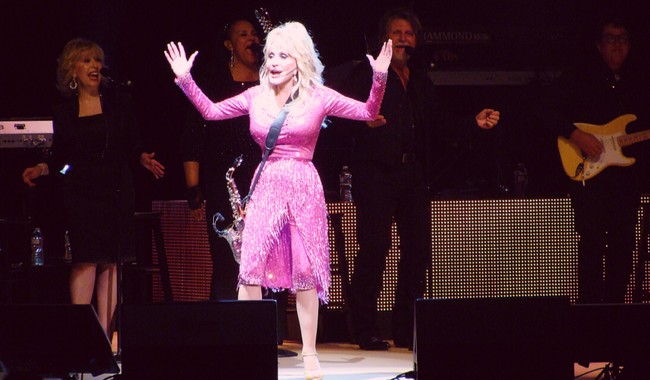
The piece looks back at Dolly Parton’s life and legacy, focusing on her planned farewell, towering career achievements, savvy business moves, refusal to play partisan politics, and the private life that grounded her amid fame.
The news of Dolly Parton’s death landed as a shock even after she and those close to her had been open about recent health struggles. “after bravely facing a brief battle with cancer, Dolly departed her Earthly life today at the Vanderbilt-Ingram Cancer Center surrounded by loved ones.” That statement, supplied by her publicist, set the tone for a carefully choreographed goodbye that Dolly herself had apparently helped arrange.
Her family chose to speak through a prepared video message, a final wink of control from an artist who always managed her public image. “This video announcement is something Dolly asked of me years ago, before I fully absorbed it as a future reality,” her nephew and head of security said. “… I have imagined the heaviness of this moment, but haven’t truly felt it until now.”
https://x.com/realbensellers/status/2092324689347481861
In the brief message, Seaver described Parton’s wish for comfort after a career built on glitter and hard work. “Dolly called me and said she wants to rest in a beautiful bed of plush cotton, because after a life wearing heavy rhinestones, she finally deserves to be comfortable and have some rest,” he said. That mixture of practicality and showmanship summed up how she handled both life and legacy.
Parton’s career began after she moved to Nashville at 18 and got a break on The Porter Wagoner Show in 1967, launching decades of songwriting and performance. Her catalog includes enduring songs like Jolene and I Will Always Love You, and she was a versatile musician who could pick up guitar, banjo, fiddle, dulcimer or autoharp with ease. That songwriting and stagecraft turned her into a cultural force far beyond country music.
Beyond records, Parton built a substantial business footprint that included nearly 50 studio albums and a theme park that became an economic anchor in East Tennessee. Annual royalties and related ventures contributed to an estimated net worth in the hundreds of millions, and she expanded into hospitality with hotels tied to her brand. Those investments reflected a rare combination of creative genius and entrepreneurial instinct.
Her public persona—big hair, big outfits, big jokes—was part costume and part shrewd marketing, but it never obscured an astute, disciplined mind. She was willing to use sexuality and spectacle as a tool, but she also understood the long game of reputation and audience. That balance allowed her to command a wide audience while keeping control of her story.
Parton was also notable for refusing to be dragged into partisan warfare, a stance she cultivated for decades. “I’m neither a Republican or a Democrat,” Parton joked during a 2019 conversation with Tennessee political figures. Her refusal to pick sides was less dodge than strategy—she steered clear of alienating listeners who supported wildly different causes.
When politics pressed in, she deflected with humor rather than outrage, and often used self-deprecation to diffuse tension. After donating to a COVID-19 vaccine effort and facing critics, she quipped it was “9 to 5 percent effective,” leaning on a career-defining gag instead of a policy debate. That approach let her keep goodwill across ideological lines, preserving the broad affection she relied on.
Observers noted that Parton worked to build bridges rather than deepen divides, a trait that grew out of a life forged by hard work rather than inherited fame. She had every reason to be loud and combative, but she chose a different route: charm, humor, and steady hard graft. That made her an unusual unifier in a world of loud partisanship.
Her private life had its own quiet strength, particularly in a nearly sixty-year marriage that outlasted the dizzying swirl of celebrity. She and her husband met early in her Nashville years and stayed together until his death, a steady anchor as her public star rose. The family’s statements about her passing mixed pride and sorrow, emphasizing a belief in comfort and reunion rather than only loss.
Across decades on stage, in the boardroom, and in the public square, Dolly Parton kept the essence of her story intact: a working-class dream that grew into global influence without surrendering the instincts that made her beloved. She planned the exit with the same mix of flair and practicality she used to craft her life, leaving behind music, businesses, and a public persona that resisted easy categorization.



Add comment