
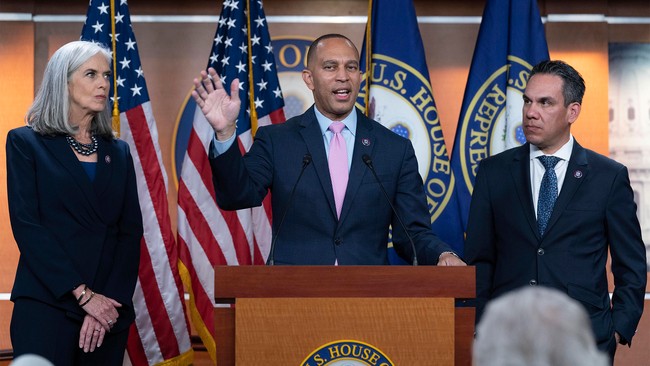
The party in power is taking a hit in the polls, yet public responses are mixed and a surprising share of voters still say they want Democrats to control the House — a contradiction that deserves a straight look. This piece walks through the numbers, the context behind the drops, and the odd voter behavior that leaves both parties exposed going into the midterms. Quotes and raw polling figures are presented exactly as reported to keep the record straight.
Americans are clearly souring on the Democratic Party’s performance in Congress, and the change has been sharp and unmistakable. The shift reflects anger over high-profile failures and a sense that priorities have drifted from everyday concerns to internal battles and culture fights. That growing frustration shows up in headlines and conversations nationwide, and it’s showing up in granular polling results.
At the same time, a large slice of voters is signaling they’d prefer Democrats to win the House if the midterms were held today, which is puzzling given the low approval numbers. Voters often make choices based on a mix of factors: personality, single issues, local candidates, or simply dissatisfaction with alternatives. The disconnect suggests many people dislike both parties but still favor one over the other for reasons that are not purely approval-based.
These poll results were driven in part by a widely publicized shutdown that stretched for more than a month and dragged the issue of governance into the spotlight. Events like a lengthy shutdown can shift short-term perceptions quickly, and the numbers here reflect that volatility. Voters punished the party seen as responsible for the stalemate, and that shows up in the disapproval totals.
Just 18 percent of respondents approve of the job congressional Democrats are doing, according to a Quinnipiac survey released Wednesday, while 73 percent disapprove.
That approval rating marks a new low since Quinnipiac began asking the question in 2009, surpassing the 19 percent of voters who approved of Democrats in July.
Seventy-three percent disapprove?! Ouch. That kind of number is rare and dramatic, and it signals a deep credibility problem for the party. Approval at those levels usually forces serious reflection among party leaders about strategy, messaging, and candidate recruiting.
Even within the Democratic base the trend is visible: support has slipped among those who usually give the party a pass. That erosion inside the party’s own ranks can make the difference in close races and in primary fights where turnout matters. When a significant share of your own voters shift to disapproval, it weakens incumbents and hands ammunition to opponents.
Even among Democratic respondents, just 42 percent said they approve of how Democrats in Congress are performing, while 48 percent disapproved. In October, nearly 60 percent of Democratic respondents approved of how congressional Democrats were handling their jobs, while 36 percent disapproved.
Commentators and data analysts have noticed how stark the numbers are, and some have used colorful analogies to capture the scale of the drop. Those kinds of lines stick in the public conversation and can amplify the sense of crisis. Pundits get a lot of mileage out of numbers this low, and that can feed back into voter perceptions.
Republican congressional approval is not great either, with a substantially negative view among the electorate, but the gap between the parties’ likeability and voters’ stated House preference is striking. Polls show just 35 percent approval for Republicans in Congress with 58 percent disapproving, yet the midterm preference margins are narrow. The mix of low approval across the board and a tilt toward Democratic control of the House is a real political puzzle.
Republicans in Congress are also in the red, as just 35 percent of respondents said they approve of their performance and 58 percent disapproved. In addition, 47 percent of respondents said they would want to see the Democratic Party win control of the House if the midterms were held today, while 43 percent favored the GOP.
That 47–43 split is small enough that turnout, candidate quality, and local dynamics will decide many races. Historical patterns show the party in power often loses ground during midterms, but current approval numbers suggest both sides face vulnerabilities. The contest looks like it will be fought on bread-and-butter issues voters cite as urgent: inflation, crime, and basic services.
For voters, the choice next year may come down to which set of failures feels more manageable and which party offers believable fixes. Right now, neither side enjoys wide public trust, and that opens the door to surprises and upset victories. Campaigns on both sides will have to convert dissatisfaction into votes rather than just commentary.
What’s clear from the data is that political fortunes can shift quickly, and voters do not always act in straightforward, purely retrospective ways. The coming months will test whether these polls represent a temporary mood or a durable realignment ahead of the 2026 cycle. Meanwhile, both parties should treat these numbers as a warning that public patience has limits and that competence still matters to the electorate.


Add comment