
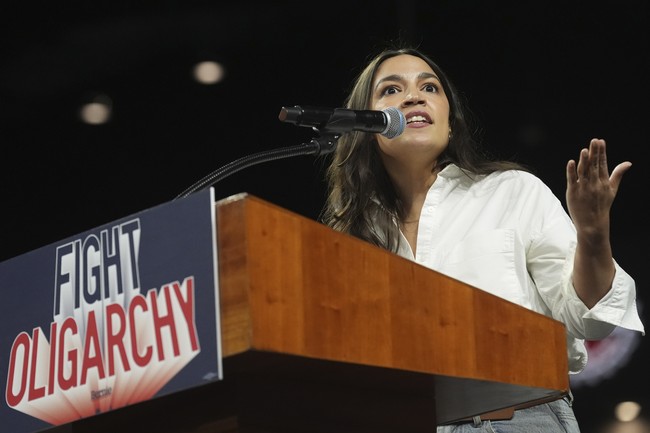
This article examines allegations that Representative Alexandria Ocasio-Cortez used campaign funds for personal psychiatric or wellness services, outlines the payments reported to a mental health provider, and considers legal and political questions raised by classifying those expenses as campaign consulting while contrasting Ocasio-Cortez’s public lifestyle with challenges in her district.
Republicans watching Democratic behavior often see a pattern: controversial actions met with silence from allies and career advancement for the accused. When public figures cross ethical lines, the left rarely enforces strict accountability, which only fuels skepticism about how campaign dollars are spent. This context frames why reports about Representative Alexandria Ocasio-Cortez are drawing attention and harsh critique from the right.
Federal records show three payments in 2025 to a psychiatrist tied to a private mental health chain, totaling $18,725. Those entries are labeled as leadership training and consulting on campaign filings, which immediately raises questions under federal campaign finance rules. The key probe centers on whether these payments were legitimately campaign-related or instead paid for personal mental health care.
The mental health provider in question lists services such as ketamine-assisted therapy, an FDA-approved esketamine nasal spray, transcranial magnetic stimulation, and other clinical treatments. That mix of therapies is more consistent with medical care than political coaching, which creates a credibility gap when a campaign labels such services as leadership development. For critics, the mismatch between service type and expense description undermines the claimed purpose.
Paul Kamenar, counsel to a nonprofit watchdog, described the arrangement in blunt terms, arguing the expenditures do not meet the standards of legitimate campaign spending. He stated: “While I can understand why AOC would spend $18,000 for a shrink whose specialties include narcissistic personality disorders, using her campaign contributions for what appears to be an expense for personal use violates federal campaign finance laws. While she describes these expenses as ‘leadership training,’ Dr. Boyle has no expertise in that area, unlike several Democratic campaign consultants. This looks like yet another example of misuse of campaign contributions.”
That quote, repeated exactly as given, highlights the central allegation: campaign funds may have been diverted to what amounts to personal medical or therapeutic care. If true, the issue is not merely political embarrassment but a potential violation of the Federal Election Commission’s rules. The FEC applies the “irrespective test” to determine whether payments are personal expenses or legitimately campaign-related costs.
Observers on the right point to a pattern of behavior rather than an isolated transaction, suggesting this fits a larger trend of Democratic operatives treating campaign war chests as flexible. High-end travel, luxury accommodations, and conspicuous leisure by political figures tend to amplify suspicions among conservative voters and watchdogs. When a representative’s reported spending appears out of sync with the needs of their constituents, political backlash is predictable.
Critics also contrast public appearances and private spending with the conditions in parts of the representative’s district, noting persistent crime, open-air drug markets, and other quality-of-life issues. For many conservatives, leadership means addressing local problems first rather than allocating campaign cash to services that read like personal therapy or lifestyle perks. That contrast fuels arguments that priorities are misplaced.
Legally, the outcome depends on whether investigators find a plausible campaign-related justification and whether the provider legitimately offered consulting services tailored to political leadership. Campaigns often hire consultants for strategy and training, but those consultants typically have a record in political advising. A clinician specializing in psychiatric treatments is a different case, and that differentiation will be central to any official review.
Beyond the legalities, the political implications are immediate. Allegations of misused funds feed narratives about elite Democrats being out of touch and insulated from consequences. For Republican critics, this is another example of the left’s double standard: aggressive scrutiny of opponents paired with leniency toward their own. That perception can be weaponized in campaign messaging and accountability efforts.
If investigations find that campaign funds were improperly used, consequences could include fines or other FEC sanctions and a fresh round of negative coverage that damages credibility. Even absent formal penalties, the political fallout will likely be exploited by opponents as evidence of ethical lapses and misplaced priorities. For voters who prioritize fiscal integrity and lawfulness, such revelations matter a great deal.
At stake is not only adherence to campaign finance rules but public trust in elected officials’ stewardship of donor money. When filings show expenditures that look personal rather than political, skepticism spreads quickly. Conservatives will continue to press for transparency and consequences when campaign resources appear to be misapplied.



Add comment