
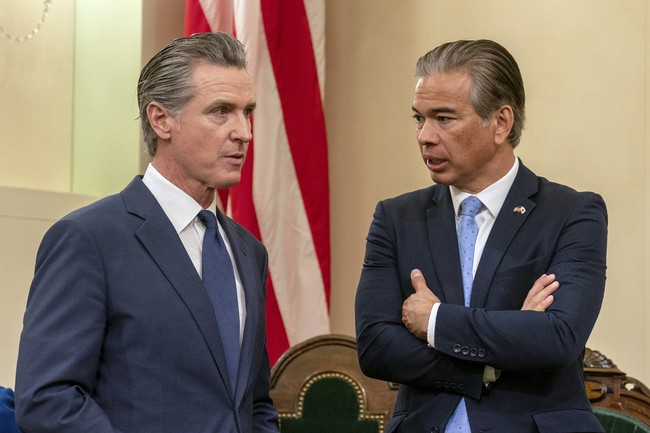
This article examines the emergency writ filed by Democratic Attorney General Rob Bonta to stop Riverside County Sheriff Chad Bianco’s count of a 45,896-vote discrepancy tied to Governor Gavin Newsom’s Prop 50 redistricting plan, outlines the claims and counterclaims around the numbers, and considers why the AG would seek to block a court-supervised physical audit.
Rob Bonta has asked the Court of Appeals for an emergency writ aimed at halting Sheriff Chad Bianco’s effort to audit a reported 45,896-vote gap from last year’s special election tied to Proposition 50. The figure sits inside a broader dispute about how 657,322 votes were certified in a county that reportedly had 611,428 ballots cast, a discrepancy that demands explanation. The petition marks a stark escalation after other attempts to limit the inquiry.
Sheriff Bianco says his intent is narrow: verify the total number of ballots and identify where any mismatch came from, not to recount choices on Prop 50. He argues the county needs a transparent, independent physical count overseen by a court-appointed special master to resolve whether records, processing, or something else produced the large variance. That distinction is central to what he describes as a law enforcement probe rather than a partisan stunt.
Bianco posted a video calling out what he characterized as political interference. “The political corruption in California just gets bigger and bigger,” the sheriff stated. “Our embarrassment to law enforcement, Attorney General Rob Bonta, just filed an emergency writ with the court of appeals to stop ballots from being counted in Riverside County.”
State election officials and the county registrar pushed back, saying the true discrepancy is much smaller—roughly 103 votes—and attributing the bulk of the difference to unprocessed or misinterpreted data during routine reporting. That explanation, if true, would make this a paperwork and data-reconciliation issue rather than evidence of systemic trouble. Yet the AG’s aggressive legal move leaves observers wondering why a quick physical verification under court supervision is being resisted.
Bianco has publicly described repeated contacts from the AG’s office—phone calls and letters—that he views as attempts to shut down the probe. He warned that filing an emergency writ was an intimidation tactic meant to stop the audit before a neutral tally could proceed. If the data are clean, Bianco says, allowing the count to happen would vindicate the system and end the controversy.
“Why in the world would Rob Bonta want that count stopped?” he rhetorically wondered. “Unless he was afraid of what that count would uncover.”
Legal context matters: a Riverside Superior Court judge had previously approved the investigation’s continuation and authorized a court-appointed special master to oversee an independent process intended to preserve chain of custody and transparency. That judicial green light framed the audit as a lawful inquiry into an anomalous set of numbers rather than an extrajudicial power grab. The appeals filing seeks to reverse or pause that momentum.
Critics of the probe view the AG’s writ as a cover-up to shield the broader political effort behind Prop 50, which gives the state legislature authority to redraw congressional districts in a way that could benefit Democrats for the rest of the decade. Those critics argue that any suppression of an independent count fuels suspicions about the measure’s legitimacy and its potential to shift up to five House seats.
Supporters of the state’s certification process counter that elections are secure and that administrative issues explain the mismatch, but they have not, to critics’ satisfaction, embraced a court-supervised physical count as the quickest way to close the debate. That reluctance is the root of the controversy: if the issue really is a 103-vote reporting glitch, why oppose a neutral physical tally that would end the story?
Bonta’s legal team is banking on appeals court intervention, while Bianco warns that an appellate stay would effectively sweep the issue under the rug. “We have an extremely politically biased appeals court, so this is going to be interesting,” Bianco explains. “What’s it going to be? Let law enforcement count the ballots as part of a lawful investigation? Or halt the investigation and sweep it under the rug?”
County officials including the registrar have maintained that certification stands and that procedural explanations account for the disparity, urging calm and a technical review. Still, the optics of an AG blocking a physical verification in a high-stakes redistricting fight fuel national attention and sharpen partisan lines. Any unresolved doubt about county-level numbers risks inflaming broader debates over election integrity and the future of congressional maps.
“All California voters should be demanding transparency, not legal maneuvers and cover-ups.”
The dispute is now in the courts, and the outcome will determine whether a supervised physical count proceeds or whether litigation will stall the process and leave the larger questions unanswered. For now, the competing narratives—administrative error versus suppressed scrutiny—are what voters and officeholders must weigh as the legal drama unfolds.

Add comment