
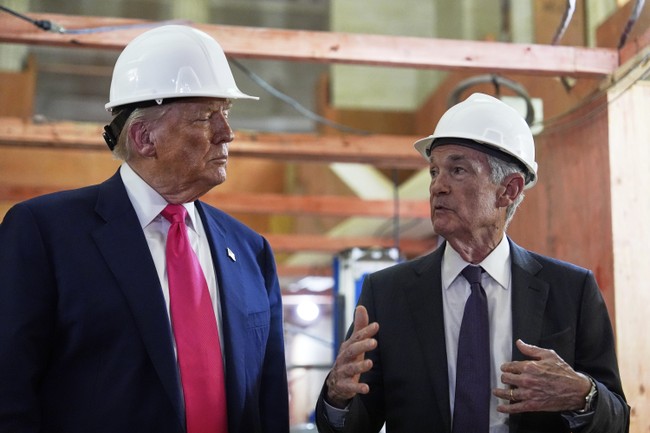
At the U.S.-Saudi Investment Forum, former President Donald Trump mixed dealmaking with a blistering, plain-spoken attack on Federal Reserve Chair Jerome Powell, skewering the Fed’s spending and tempo on interest rates. He praised the massive Saudi investment while lampooning what he called wasteful renovation costs at the Fed and mocking the idea of hiring thousands of economists. Trump painted the Fed chief as out of touch and joked about firing him, all while celebrating the economic promise of incoming capital.
Trump opened by celebrating the trillion-dollar investment commitment from the Gulf while immediately pivoting to critique the people running the Fed. He framed the Fed chair job as cushy and out of sync with real-world thrift, arguing that taxpayers and investors are on the hook for overpriced projects. The lively tone made it clear he saw a contrast between bold private investment and what he called bureaucratic overspending.
Love the fed job – to me, it’s the easiest job in the world. You play golf for 28, 29 days, then you go and make a little speech, tell everybody – in the case of the current guy – the wrong information, because he has no clue, but if you have good instincts, you know, it’s all based on instincts…
I see they want to hire 3,000 economists. Three thousand to report to the Fed chairman. What are they going to do, take all this information… 3,000 economists?!
He used the hiring plan as a punchline, implying bureaucratic bloat rather than competent policy work. For Republicans and fiscal conservatives, that image lands hard: thousands of economists reporting into an unelected regulator feels like a recipe for groupthink and runaway budgets. Trump’s barbs framed the Fed’s choices as detached from the priorities of taxpayers and entrepreneurs who build real wealth.
Trump didn’t stop at personnel. He blasted an eye-popping renovation price tag and ridiculed construction choices he said were needlessly elaborate. Calling the chairman “this clown,” he contrasted a $4 billion Fed overhaul with what he called a sensible $25 million job, arguing that common-sense cost controls have vanished inside the Fed’s projects. That point fed into a broader Republican critique: when the government can tolerate such spending, taxpayers lose and private projects get judged by different standards.
Then make a little speech, tell everybody, in the case of the current guy, the WRONG INFORMATION because he has no clue!”
“[The Fed] is building a basement into the POTOMAC RIVER! I could’ve told them that’s too expensive!”
He’s hilarious!
The crowd reaction underscored how sharp messaging lands when it’s personal and visual. Trump’s line about building a basement into the Potomac River was a vivid image that made bureaucratic excess tangible. For many in the audience, that kind of specificity is more persuasive than abstract policy debates, and it drives home the idea that fiscal reckoning is needed at institutions that operate without electoral accountability.
He also took aim at the Fed’s rate decisions, blaming Powell for moving too slowly and for failing to deliver the relief he believes markets and the public want. Trump told Treasury Secretary Scott Bessent he’d love to remove Powell immediately, using blunt language to signal impatience with a central bank seen as obstructionist. That willingness to directly target an unelected central banker plays into conservative calls for accountability and restraint in economic governance.
“ I’d love to fire his a–. He should be fired. [The] guy’s grossly incompetent. And he should be sued for spending $4 billion to build a little building. I’m building a ballroom that’s gonna cost a tiny fraction of that, and it’s bigger than the whole thing put together.”
Trump’s comparison of his own private projects to Fed construction work was meant to highlight a perceived double standard between private-sector cost discipline and public-sector extravagance. In Republican circles, that contrast is a powerful political narrative: leaders who build with efficiency and invite investment are rewarded, while insulated bureaucracies rack up costs. The rhetoric marries fiscal populism to pro-growth messaging about attracting foreign capital.
The president’s remarks also posed an implicit challenge to the media and political opponents who scrutinize private spending choices but remain quiet about government boondoggles. He asked where the activists and critics were when a multibillion-dollar federal renovation was under way, implying selective outrage. That argument taps into a broader conservative frustration with inconsistent standards from the political and media establishment.
From a policy perspective, the episode highlights tensions over central-bank independence, spending transparency, and the proper pace of interest-rate changes. Trump’s approach blended theatrical jabs with concrete dollar figures and a pro-investment posture, aiming to make a complex financial debate approachable. Whether you agree or not, his performance forced the Fed’s choices into a public spotlight at a high-profile economic event.



Add comment