
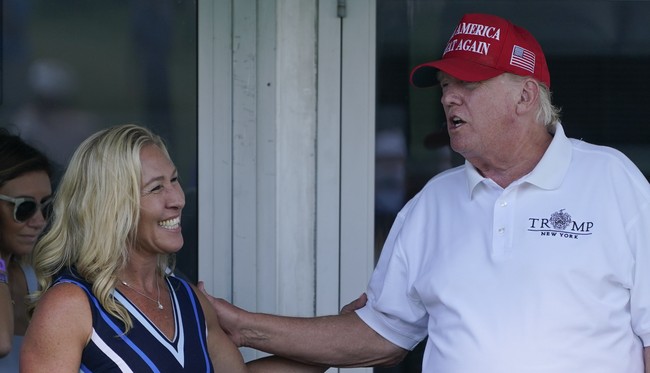
This piece reviews Rep. Marjorie Taylor Greene’s announcement that she will leave Congress in January, President Trump’s immediate public reaction and softer comments later, and how those remarks fit into the wider intra‑party dynamics and media response. It covers the background polling and internal pressures that reportedly influenced her decision, includes direct quoted material from the public letter and interviews, and shows Trump shifting from a sharp critique to a conciliatory note while responding to reporters. The article keeps the original quoted passages intact and places the preserved embeds where they appeared in the source.
Rep. Marjorie Taylor Greene surprised many when she said she would retire from Congress in January, and the announcement immediately sparked a flurry of reaction. Insiders say polling suggested she faced an uphill fight, and that pressure multiplied tensions between her and other Republican leaders. Those forces, combined with speculation about a primary organized around a Trump endorsement, seem to have helped push her to step back for now.
However, according to insiders, the president sent Greene polling that indicates she can’t win, strongly suggesting she shouldn’t run. That, in turn, appears to have increased her already tense relationship with other Republican leaders like Speaker Mike Johnson (LA-4). In her letter, she blasted “Establishment Republicans” and accused Trump of organizing a primary against her.
“I have too much self-respect and dignity, love my family way too much, and do not want my sweet district to have to endure a hurtful and hateful primary against me by the President we all fought for, only to fight and win my election while Republicans will likely lose the midterms,” she wrote. “And in turn, be expected to defend the President against impeachment after he hatefully dumped tens of millions of dollars against me and tried to destroy me. It’s all so absurd and completely unserious. I refuse to be a ‘battered wife’ hoping it all goes away and gets better.”
The reaction from some on the left who suddenly express respect for Greene after her departure has a predictable spin, but that doesn’t erase the internal GOP realities that influenced her choice. Party leaders fret about winnability and optics, especially with midterms and 2026 on the horizon. For elected officials, the calculus often comes down to which fights are worth taking and which risks could cost the broader agenda.
Early on Saturday, President Trump weighed in on Greene’s announcement on his preferred social platform. His initial post was pointed and blunt, cataloguing polling and relationships that he viewed as part of the problem. That initial tone matched what many expected: a direct, no‑nonsense assessment that called out contributors to her political troubles.
“Marjorie ‘Traitor’ Brown, because of PLUMMETING Poll Numbers, and not wanting to face a Primary Challenger with a strong Trump Endorsement (where she would have no chance of winning!),” he writes, “has decided to call it ‘quits.'”
“Her relationship with the WORST Republican Congressman in decades, Tom Massie of Kentucky, also known as Rand Paul Jr. because he votes against the Republican Party (and really good legislation!),” he adds, “did not help her. For some reason, primarily that I refused to return her never ending barrage of phone calls, Marjorie went BAD.”
That tough opening, however, softened as Trump closed his post by recognizing service and offering gratitude. A line that will be replayed reads, “Nevertheless, I will always appreciate Marjorie, and thank her for her service to our Country! President DJT” — a short, personal note that leaves room for repair. The shift shows the dual instincts common in party leadership: discipline when necessary and reconciliation when possible.
On his way to a golf course at Andrews, Trump stopped for reporters and repeated much of his earlier assessment, then veered toward a more conciliatory tone toward the end of his remarks. Observers noted that his public comments moved from critique to a willingness to mend fences, reflecting both political calculation and a desire to keep the coalition intact ahead of future contests.
Watch:
Reporters also asked whether he would patch up relationships with figures he’s clashed with, mentioning his recent thaw with some high-profile personalities. The implication was clear: if healing is possible with others, it should be possible within the party too. Trump’s response suggested openness to reconciliation and a pragmatic approach to keeping the GOP united.
In a brief phone interview with NBC News, the president said, “It’s not going to be easy for her” to revive her career in politics, though he added, “I’d love to see that.”
In the meantime, Trump said, “she’s got to take a little rest.”
…
Asked if he believed he could overcome his differences with Greene, Trump said in the interview, “I can patch up differences with anyone.”
The famous Robert Frost line about fences — “Good fences make good neighbors” — floated through some commentary as a metaphor for how relationships might be managed going forward. Whether the party adopts a firmer distance or pursues repairs, the balance will be tested as candidates and leaders position for 2026. That tension between accountability and unity will drive a lot of conversations in GOP circles in the months ahead.
The episode underlines a pragmatic side of politics: personal feuds and sharp rhetoric can coexist with an effort to preserve the broader movement. For Republicans focused on winning and governing, the calculus is straightforward: win where you must, mend where you can, and keep the coalition intact. Time will tell how that approach plays out for Greene, Trump, and the party at large.


Add comment