
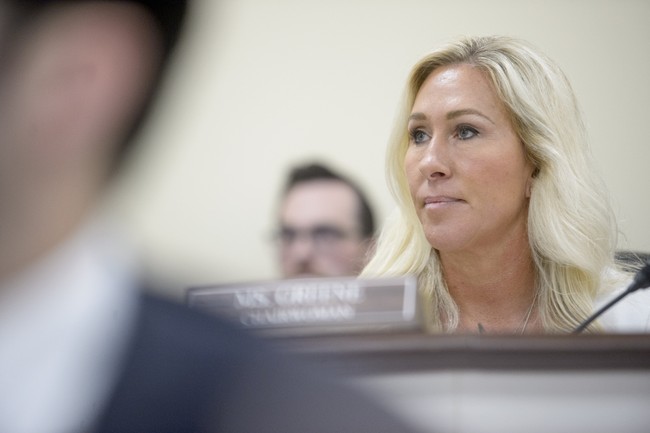
Checklist: explain the media’s new treatment of Marjorie Taylor Greene; recount her resignation timing and motives; examine how her criticisms reshaped her coverage; assess whether principle or opportunism drives her moves; place her decision in the context of political ambition and media incentives.
Marjorie Taylor Greene’s recent behavior and sudden resignation have put her in a strange spotlight where conservative infighting meets mainstream media fascination. After publicly clashing with Republican leadership over the government shutdown and backing an extension of Affordable Care Act subsidies, she quickly became a figure the press could showcase when she opposed elements of her own party. That dynamic has produced coverage that looks more like admiration than the usual hostility she receives from the left.
Her announcement that she will resign from Congress on January 5, 2026, arrived with immediate questions about timing and motive. Observers noted the date comes just after her pension vests, a detail that invites suspicion about whether financial calculation played a role. But focusing only on pensions misses the wider context: Greene appears to be repositioning herself politically and personally for something beyond the House.
In public statements she framed her time in Congress as frustrating because she could not force the kind of change she wanted. She wrote that “the results are always the same.” That line captures a core theme of her resignation message: a sense of impotence within the chamber and impatience with the slow grind of legislative politics.
Greene has openly suggested she’d prefer higher office, naming the Senate and governorships as the kinds of roles where she could wield more influence. When prominent voices, including the president, told her she could not win those contests, her response grew bitter and public. That bitterness has translated into open attacks on party leaders and, at times, on former allies, shifting her posture from insurgent backbencher to political gadfly.
The mainstream press has reacted to that posture in a predictable way: when a Republican publicly breaks with his or her party, outlets on the left suddenly find fodder for friendly segments and appearances. As one observer put it, “the enemy of my enemy will appear on my show.” That pattern helps explain appearances and soft profiles that would have been unthinkable for Greene when she was fully in-step with the loudest, most controversial parts of her brand.
That newfound favorable attention has an obvious strategic upside for Greene: it amplifies her voice while giving her a platform to reframe her image. Interviews where hosts praise her courage, call her brave, or position her as a maverick all function as promotional oxygen for someone preparing to leave one office and chase another kind of influence. The optics matter, and the media response has helped create a narrative of a Republican who finally dared to criticize her own tribe.
But the substance of her criticisms invites skepticism about whether principle drives her moves or simple political calculation. She has publicly opposed a shutdown that would have put Democrats on the defensive and has embraced policies like extending ACA subsidies, positions at odds with many conservative voters. She has also attacked the president and his policies while alleging he might even try to primary her, mixing personal grievance with political positioning.
There are practical reasons to doubt she was in real danger of losing her seat absent a major collapse. Even critics concede that her district likely would have re-elected her, which suggests resignation reflects dissatisfaction rather than imminent defeat. Reports about weak constituent services and a tendency to inflame rather than advance policy goals help explain why she might feel boxed in by the job’s realities.
Leaving on January 5 lets her step away right after a key pension milestone and gives her freedom to reshape her public persona without the constraints of representing a district. Free from daily House responsibilities, she can attack party leadership and the president more directly, feed media narratives that confer new legitimacy, and chase opportunities that require a different profile. For now, that strategy appears calculated to maximize attention and reset expectations about where she fits inside a post-Trump conservative ecosystem.
What remains uncertain is whether this strategy will produce the higher office or media career she hints at seeking. Breaking with party orthodoxy won her softer press coverage, but it also risks alienating core voters who supported her because she spoke and acted as a hard-charging conservative. The trade-off is clear: she gains short-term visibility and sympathetic segments but may sacrifice the base trust that once anchored her political life.
Whether you view Greene as brave, self-interested, or some blend of both depends on how much weight you place on motives versus outcomes. What is undeniable is that her resignation, its timing, and the reactions it has provoked reveal a modern political playbook: use intraparty conflict to secure cross-press attention, then convert that attention into a new platform. For Greene, that platform begins the day after her pension vests.



Easy now to earn extra cash per month simply doing work from home. change your life completely and makes it better than ever. earns more than $13k every month simply doing online job for 3 or 4 hours a day. i made $12694 from this by working online in last month. details on this website…
HERE → 𝐰𝐰𝐰.𝐒𝐚𝐥𝐚𝐫𝐲𝟑.𝐜𝐨𝐦