
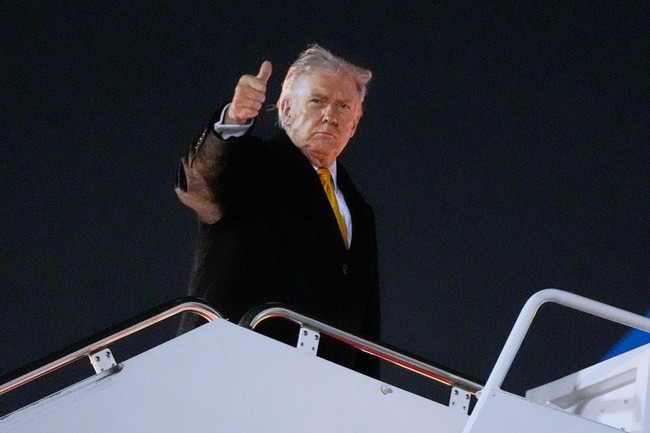
President Trump, returning to Washington from Mar-a-Lago, pushed back hard against anti-ICE protesters after a deadly incident in Minneapolis, defending law enforcement and promising to expose who bankrolls organized agitators.
On the flight home to Washington, D.C., President Trump spoke with reporters about multiple topics but made clear his anger over how Immigration and Customs Enforcement officers were treated during recent protests. He emphasized that ICE officers were enforcing policies he won on and said attacks on them could not be tolerated. The president framed the episode as part of a broader problem of coordinated hostility toward law enforcement.
He singled out Renee Nicole Good and her associate Rebecca Good, calling their conduct unacceptable and labeling them professional troublemakers who harassed agents. The president said videos and reports show behavior that went beyond peaceful protest and into targeted intimidation. He warned that those organizing and funding such operations would be exposed and held to account.
“It was highly disrespectful of law enforcement,” said President Trump. “The woman and her friend were highly disrespectful of law enforcement. You saw that. They were harassing, they were following [ICE] for days and for hours. And I think, frankly they’re professional agitators. And we are going to find out who’s paying for it.”
Noting the professional-looking signs held by some anti-ICE protesters, the president added, “These are professional agitators. And law enforcement should not be put in a position where they have to put up with this stuff. What that woman and her friend – and their other friends – were doing to law enforcement, not just ICE, but law enforcement, was just outrageous.”
At another point in the gaggle the president described Renee Good in blunt terms and expressed sympathy for the tragic outcome while maintaining that the actions leading up to it were dangerous. “The woman was very violent – she’s a very radical person. It’s very sad what happened. Her friend was very radical.” He used the moment to stress respect for officers across agencies and to question narratives that cast the incident solely as a victim story.
When a reporter asked whether the ICE agent involved would “be back on the force,” Trump steered attention back to the conduct he saw on camera and to the need to back those who enforce the law. “We have to respect our law enforcement. At a very minimum, [Renee Good] was very, very disrespectful to law enforcement.” He doubled down on the principle that you cannot confront or harass police, ICE, Border Patrol, or other officers without consequences.
The administration’s message was clear: law enforcement deserve support, not vilification, and organized efforts to bait or harass officers will be investigated. The president promised to trace funding and coordination behind protest activity that appears professional and sustained rather than spontaneous. That assertion underscores a push to distinguish between legitimate, peaceful dissent and orchestrated campaigns that place officers in harm’s way.
Local footage and accounts from the Minneapolis incident show a tense encounter in which Renee Nicole Good accelerated a vehicle toward an ICE agent, while Rebecca Good urged her on from nearby. Observers and officials have pointed to video that suggests both women were actively participating in a pattern of stalking and confrontational behavior. Those details have fueled a debate over responsibility and how media and political leaders frame such events.
The president framed the episode as emblematic of a larger breakdown in respect for cops and agents, arguing that law and order must be restored and that those who provoke violence should not be treated as blameless. He reiterated that enforcing immigration laws and protecting communities were priorities he was elected to carry out. By promising to uncover who finances and coordinates these protest efforts, he signaled an intent to go after networks behind dangerous crowd tactics.
Throughout the exchange, Trump’s tone mixed condemnation of the protest behavior with support for officers who faced a threatening scene. He insisted that the country cannot allow organized confrontations aimed at law enforcement to become normalized. The remarks fit with a broader administration approach that prioritizes backing police and immigration agents while criticizing what it calls managed protest operations.


Add comment