
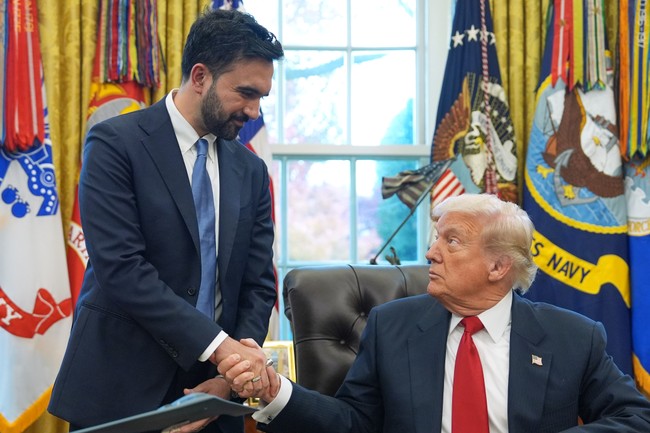
This piece looks at President Trump’s White House meeting with New York City mayor-elect Zohran Mamdani, reflects on a Michigan Republican lawmaker’s commentary about socialism versus capitalism, and considers why a president who prizes deal-making would sit down with a self-described democratic socialist ahead of Mamdani taking office.
The meeting between President Trump and Zohran Mamdani drew a lot of noise, but not the chaos some expected. The president is a dealmaker who reads people quickly, and he chose to meet the incoming mayor of New York City for a reason. From a Republican vantage, meeting someone labeled a socialist is less about endorsement and more about showing strength, assessing intentions, and protecting Americans’ interests.
Across the country, debates about socialism and capitalism are heating up, and some voters seem to be flirting with big-government promises. Michigan state Representative David Martin wrote a pointed piece warning that socialism weakens the link between effort and reward, and he reminded readers why capitalism built this country. His perspective captures a conservative worry: when government takes on the role of rewarding outcomes instead of protecting rights, incentives erode and ambition shrivels.
Many left-leaning voices celebrate Mamdani as a symbol of change, but labels matter. The public deserves clarity about what “democratic socialist” policies would actually mean for taxes, public services, and private sector opportunity. Republicans argue that a system which disconnects personal effort from personal benefit undermines the very fabric of upward mobility America depends on.
Socialism is enjoying a strange resurgence in American politics. New York City’s newly elected mayor, Zohran Mamdani, calls himself a “democratic socialist.” A recent Gallup survey shows that 39% of Americans, including 66% of Democrats and 51% of independents, now say they approve of socialism.
Representative Martin’s argument rests on basic economic common sense: people respond to incentives. If government promises benefits without clear limits or consequences, those incentives can vanish. Conservatives emphasize personal responsibility, property rights, and free enterprise because those institutions produced widespread prosperity over generations.
Martin drew on a classic defense of rights to make his point, invoking a 19th-century thinker who focused on the role of law. That historical perspective is useful because it reminds readers that the purpose of government is protection, not control. Republican policy aims to keep the state from smothering individual initiative with heavy-handed redistribution or bureaucratic overreach.
All of us want to be rewarded for our own efforts. We want the dignity that comes from charting our own path, taking risks, creating value and providing for our families. Under socialism, the connection between effort and reward is weakened or erased altogether. When that happens, initiative withers and opportunities shrink.
This point was understood long ago by Frédéric Bastiat, the 19th-century French economist who wrote that “life, liberty, and property do not exist because men have made laws. On the contrary, it was the fact that life, liberty, and property existed beforehand that caused men to make laws in the first place.” Bastiat recognized that the role of government is to protect our natural rights rather than control them.
There’s something practical in the approach Trump took: meeting someone who will run America’s largest city lets the president test motives and map potential policy battles. Republicans can applaud that kind of engagement while still opposing policies they see as harmful. The point is to protect citizens and American prosperity, not to pretend ideological opponents don’t exist.
New York City will be a live experiment for whichever policies Mamdani pursues, and conservatives will watch for the real-world effects. If communities see rising costs, declining services, or shrinking opportunities, critics will point to those outcomes as evidence of the risk in big-government experiments. Republicans will keep pushing for policy that protects opportunity and rewards hard work.
The larger debate is straightforward: one side favors expanding government control and promises, and the other favors empowering individuals through markets and rule of law. For conservatives, the latter remains the proven engine of opportunity. That’s why the Michigan lawmaker’s warning matters and why Trump’s decision to meet the incoming mayor can be seen as a strategic move rather than a political endorsement.
New York’s choices over the coming months will test competing visions. Republicans will argue that protecting liberty and personal responsibility, not expanding government dependency, is how communities thrive. Watching how the city responds to policy shifts will tell us a lot about which approach works in practice.



Add comment