
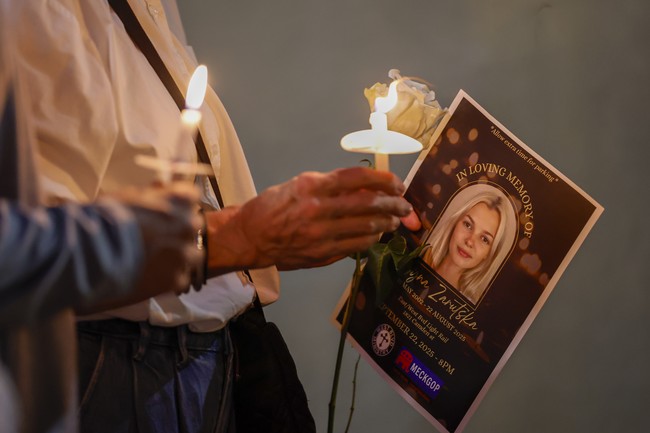
The controversy over a proposed mural honoring Iryna Zarutska in Providence, Rhode Island, has exposed sharp divisions in local politics, free speech, and public mourning, and this article lays out the developments, reactions, and possible next steps in plain terms.
City officials and local activists collided over a mural meant to honor 23-year-old Iryna Zarutska, a Ukrainian refugee tragically killed on a light rail system in Charlotte last August. The crime and the suspect, 34-year-old DeCarlos Brown, Jr., became focal points in broader national debates about public safety and accountability. What began as a gesture of remembrance spiraled into a political fight when the mural’s funding connection to Elon Musk drew criticism from city leadership.
Providence Mayor Brett Smiley labeled the mural “divisive” and publicly urged the Dark Lady LGBTQ club to remove the artwork, which set off a firestorm. That pressure prompted the club’s owners to announce they would discontinue the project and remove the mural, a move that many saw as bowing to an angry political mob. For Republicans and free-speech supporters, the mayor’s intervention crossed a line by involving government pressure in what should be an independent expression by a business and an artist.
The artist and others who backed the mural pushed back, arguing the piece honored a young life and deserved a place in the community regardless of who helped fund it. Supporters noted that murals for other victims have been erected without similar controversy, and they saw the backlash as politicized censorship. Calls grew to find alternative locations or sponsors so the completed work could be displayed outside the orbit of city hall.
Jessica de la Cruz, the Rhode Island Senate Minority Leader, urged constituents to contact the mayor and demand accountability for what she framed as an infringement on free expression. Her words underline a key point in this dispute: when government officials pressure private entities to remove art, it raises First Amendment concerns. The blockquote below preserves the exact quoted appeal used by her to mobilize public response.
“The First Amendment is first for a reason. When government interferes with free expression, it’s not a minor offense—it’s a serious matter. Call the Mayor’s office today and ask him to apologize for intruding on the First Amendment rights of an artist and a business. “
Local media voices and talk radio hosts added momentum by reporting that a local business owner might be willing to collaborate with the artist to relocate the mural. That possibility offers a clear path forward: move the piece to neutral ground, let the artwork stand on its own merits, and remove politics from an act of remembrance. Advocates argue this would restore civic balance and respect the grieving process without letting elected leaders dictate artistic choices.
Critics of the mayor called the decision shameful and framed it as proof of Democratic intolerance when faced with anything associated, rightly or wrongly, with political opponents. They pointed out the irony of tolerating left-leaning murals while dismissing a tribute to Zarutska. For those worried about rising violent crime, the mural was never meant to be partisan but rather a recognition of a life taken too soon.
The debate has broader implications for how cities handle public expression and private memorials. If elected officials can publicly pressure businesses to remove tributes because of perceived political ties, other community groups may be chilled from honoring victims or discussing sensitive issues. Republicans see a dangerous precedent forming: political litmus tests applied to community mourning and art.
There is energy among residents and leaders who want the mural preserved in some form, either at the original site if permitted or at a new location where it can be displayed without further controversy. They argue that honoring a victim of violent crime should be a unifying act, not a battleground. Persistence from supporters, combined with a neutral host for the artwork, could still lead to a completed mural seeing the light of day.
Meanwhile, conversations about crime, accountability, and public safety continue to shape local and national politics, and the Zarutska mural episode is likely to remain a touchstone for debates over free expression and political influence in municipal decisions. The community now faces a choice: let political posturing dictate who may be publicly remembered, or find ways to separate remembrance from partisan conflict so that grief and art are respected.
JessicaforRI is Republican Jessica de la Cruz, the Rhode Island Senate Minority Leader. She’s also urging people to call the mayor’s office to express their displeasure over his public pressure to have the mural taken down:
WPRO talk radio host Tara Granahan also posted an encouraging update, noting that there is a business owner who may be willing to work with the artist, presumably to relocate the mural:
I hope they keep the pressure on until the completed version of that mural can see the light of day. Because if leftist-inspired murals like the ones of George Floyd are okay to put up in Providence, surely Iryna Zarutska is deserving of one:

Add comment