
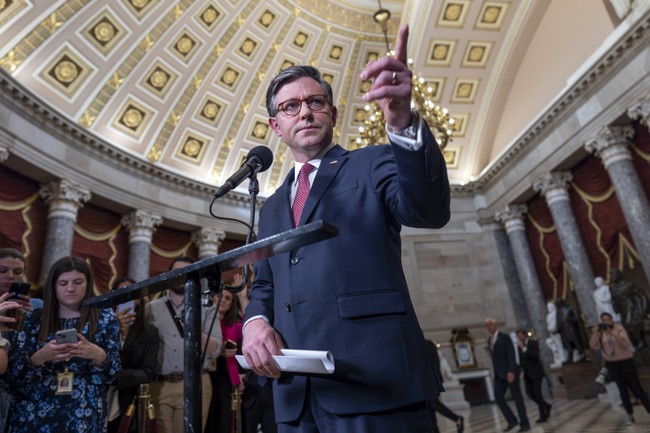
Speaker Mike Johnson became the first sitting U.S. House Speaker to address the U.K. Parliament, marking a symbolic moment on the 250th anniversary of American independence and a clear recommitment to the shared values that bind the United States and the United Kingdom. His speech leaned into history, common purpose, and the urgency of defending free institutions against both external threats and internal decay. Johnson stressed secure borders, robust defense, and the need to cultivate civic responsibility in younger generations. He framed the alliance as vital to preserving Western liberty and called for renewed resolve on both sides of the Atlantic.
Johnson opened by acknowledging the weight of history and the honor of being the first in his office to speak in Parliament. He said plainly that this moment felt like a return to “the spiritual birthplace of our own nation,” and he used that imagery to press why the relationship matters today. The speech tied World War II-era cooperation to present-day dangers, arguing that allies must stand firm together when values and sovereignty are under pressure. That message was aimed at leaders and citizens alike.
It is a profound honor to be speaking in Parliament today, to be the first U.S. Speaker of the House ever given this honor. I take it very seriously. As proud Americans, it’s as though we have returned to the spiritual birthplace of our own nation, and the history here, the weight of it is palpable, as you know.
[…]
We have returned at a pivotal moment, obviously, in the great histories of our countries. To mark this anniversary that we have in our nation and to celebrate what we’ve achieved together in the past. And importantly: to face and overcome together the challenges of our present day. And I want to tell you my friends, we will do that together; I bring you that message.
Johnson highlighted a recent exchange with U.K. Prime Minister Keir Starmer and used it to underline bipartisan cooperation on transatlantic priorities. He praised Starmer’s framing of the U.S.-U.K. partnership as built on mutual respect and focused on results, and he signaled a continuity of partnership despite differences of the moment. That steady, pragmatic tone reinforced his call for common action against global threats and internal erosion of civic faith. He framed the alliance as both practical and philosophical.
He [Starmer] noted, of course, that the UK and the U.S. are close allies and that our strong, constructive partnership all these years has been built on mutual respect and focused on results. I thought that was exactly the right message and the right tone. And because of that we’ve always been able to work through our differences calmly. As friends, we will continue to do that. I want to assure you this morning that that is still the case.
Johnson did not shy away from naming the cultural and intellectual currents he sees as threats to Western civilization. He warned about growing skepticism toward history and institutions, and he called out a mindset that defines itself by what it tears down rather than what it preserves. The speaker argued that when younger generations are cut off from the “deeper wisdom of the Western world,” their willingness to defend free institutions will wither. That concern framed a patriotic appeal for education, civic participation, and renewed stewardship.
We have faced in America, just as you have here, a truly menacing skepticism towards history and our national institutions. And it’s even come to the point where great heroes like Sir Winston Churchill are questioned for their legacy. What has taken hold is a mindset that defines itself not by what it loves and seeks to preserve, but instead by what it condemns and seeks to tear down. And this growing disaffection, we see, particularly among our younger citizens, is a serious threat to the health of both our nations. If the next generation is never exposed to the deeper wisdom of the Western world, or the enduring tradition of the British parliament, or the genius of America’s model of Republican self-government, then why would they feel any obligation to defend or preserve them?
Freedom of speech and conscience featured strongly in Johnson’s remarks, presented as nonnegotiable foundations of liberty. He warned against censorship and argued that liberty lives in the free exchange of ideas, not in silencing unpopular views. The speaker specifically referenced individuals unjustly persecuted for exercising those freedoms and urged joint efforts to defend them. His point was both moral and strategic: free societies survive by debating, not forbidding, truth.
Our courage, clarity and conviction to defend truth, just as our ancestors did. And it means being able to say that some things are true, and good, and enduring, and others are not. And to call evil and madness what it is. It means repairing what we see in clear disrepair. From restoring, for example, secure borders that protect from the real and measurable harms of mass uncontrolled migration. From pushing back on policies that erode our citizens most basic liberties, especially the fundamental freedoms of speech and conscience. History teaches us: we can never go down the road of censoring and silence in unpopular opinions, because liberty is kept alive in the free marketplace of ideas. History further teaches us that the best solution to the problem of free speech is always more speech and those being unjustly persecuted for exercising those freedoms, such as Jimmy Lai, the British national being held in Hong Kong, must be defended. And the U.S. stands with the U.K. as you work to free him.
Johnson emphasized secure borders and strong defense as practical necessities for protecting liberty, not merely policy points. He cast border security as a basic responsibility of national leadership and argued that failing to protect citizens undermines the very freedoms leaders claim to champion. The speech tied military strength and economic vitality to moral clarity about what the West stands for. In that sense, policy becomes an expression of values.
For Americans, our independence is not a rebuke of our British roots but rather a renewal of what is the best of what Britain had to offer the world. If renewal requires remembrance and stewardship, it also requires responsible citizens. Strong institutions are essential, of course; but when people are taught that their lives are determined by systems and structures, responsibility quickly disappears and with it, their purpose and their meaning. In both of our nations, we have too many people today on the sidelines. Particularly younger generations. We should want our citizens involved, gainfully employed, and contributing to their communities, of course.
Stable and thriving societies need families that raise children. They need churches and communities that form character, and patriotic men and women dedicated to leaving their country better than they found it. The simple truth is that freedom cannot survive if we outsource our responsibility as citizens.
His closing appeal was forward-looking and unapologetically confident about Western institutions, while calling for real work at home to keep those institutions healthy. Johnson urged that faith in human progress and capacity for self-correction remain central to Western identity, and he reminded listeners that military and economic strength are meaningful only when tied to a clear purpose. The address was both a diplomatic gesture and a call to action for conservatives who see the West’s survival as dependent on renewed civic virtue.
Johnson’s full 23-minute speech is below. WATCH:


Add comment