
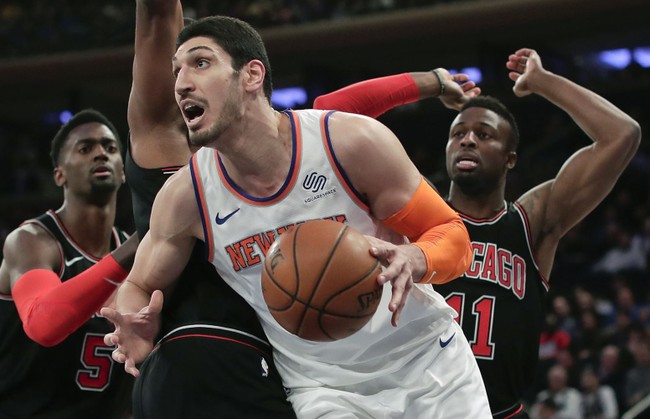
The WNBA has reportedly concluded that former NBA players Enes Kanter Freedom and Royce White are not eligible to play in the league after both publicly declared themselves women and sought to enter the draft, a decision that settles this immediate stunt but leaves larger policy questions unresolved.
After a few weeks of theatrics and public sparring, the league quietly landed on a practical answer: Kanter Freedom and White will not be accepted as WNBA players. The decision follows a flurry of statements, meetings, and public pressure that made the league look indecisive on a basic biological question. For conservatives watching, the ruling reads like a common-sense affirmation that women’s sports must preserve their original purpose.
The controversy began when Kanter Freedom announced he was “officially declaring myself a @WNBA prospect” and claimed that simply declaring one’s identity should be enough to qualify. White then echoed the stunt with his own declaration: “I’m transgender. I’m a woman, so I’ll be declaring for the WNBA draft in 2027 as well.” Those public claims were designed to force clarity from the league.
ESPN reported that multiple league sources confirmed the two former NBA players would not be eligible for the WNBA, and that practical steps were taken without immediately rewriting the collective bargaining language. The CBA already says, “only players who are women are eligible to play in the WNBA,” but it leaves the word woman undefined, and the league has no public transgender-athlete policy. That gap is what the players exploited to provoke a response.
https://x.com/Outkick/status/2091977395515392150
The WNBA initially issued broad statements about inclusion and denounced what it called “hate and vitriol” surrounding the episode, while also describing some challenges as “bad faith efforts.” Those messages leaned into woke framing and avoided answering the core question directly. Critics argued the league’s early tone framed common-sense concerns as hostility rather than policy issues about fairness and safety in competition.
The practical enforcement came after a chaotic night in Chicago when Kanter Freedom, sitting courtside wearing a shirt reading: “WOMAN noun. adult human female,” was confronted by a Sky player and escorted out. He later posted: “I just got kicked out of a @WNBA game for supporting WOMEN! Let that sink in, AMERICA!” He followed with, “It’s always women hating on other women.” Those moments turned the abstract policy fight into live theater.
Players and allies pushed back in real time. Natasha Cloud reportedly approached Kanter Freedom during the game and shouted toward him, which led to security removing him after tensions escalated. Cloud later posted support for transgender people, writing: “To every trans kid/person, You are a part of MY community & tribe. You belong. You’re loved. You’re seen. You’re perfect as you are. & you will always be protected by me.” That contrast of positions highlighted how emotions run high on both sides.
Supporters of biological distinctions in sport pointed to Indiana Fever guard Sophie Cunningham, who had publicly opposed biological males competing in women’s sports and sparked much of the backlash that followed. Her comments prompted protests and then invited the stunt declarations from Kanter Freedom and White. The result was a messy public dispute about identity, safety, and competitive equity.
Despite the ruling against Kanter Freedom and White, the WNBA reportedly does not plan an immediate rewrite of its rules. Sources say there are currently no real-world eligibility cases demanding a formal transgender-athlete determination, and officials will continue reviewing the issue. That suggests the league expects more pressure tests and legal challenges rather than swift policy clarity.
Conservatives will see this as a win for protecting women’s sports, but the underlying ambiguity remains. By resolving these two cases informally, the league avoided defining the term woman in a public policy document, leaving a gap that could invite future legal fights or activist stunts. The long-term debate over eligibility standards and the balance between inclusion and fair competition is still very much alive.
The episode also raises questions about how sports leagues handle cultural pressure and political posturing. Kanter Freedom and White were blunt about their motives, and their actions forced the WNBA into a defensive posture before it landed on a practical, if temporary, answer. Whether the league will now craft a durable policy that protects competition while addressing civil-rights concerns remains unclear.
Expect this story to keep evolving. If Kanter Freedom or White pursue legal action, or if other parties mount challenges, the WNBA will be pushed to either publicly define eligibility criteria or face more courtroom tests. For those who prioritize fairness in women’s athletics, the informal ruling is only a first step, not the final word.

Add comment