
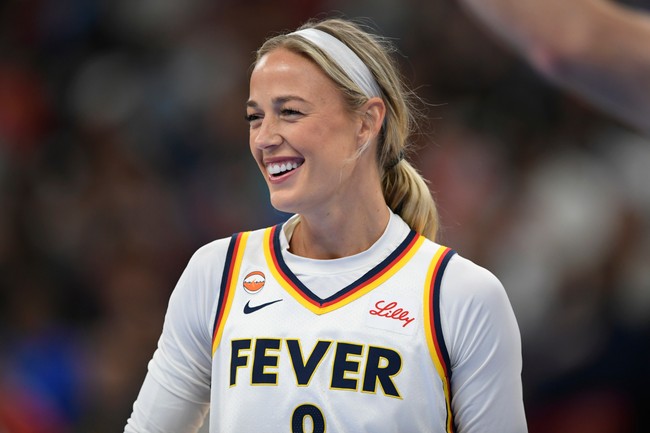
The Indiana Fever’s Sophie Cunningham drew attention on and off the court in Toronto, where fans gathered to back her stance on protecting girls’ and women’s sports and authorities took actions that raised free-speech concerns; supporters rallied outside Scotiabank Arena, a mobile digital billboard ran messages about fairness, police cited the driver, and Cunningham later handled boos inside the arena with poise.
The Fever beat the Toronto Tempo 101–95, and Sophie Cunningham finished the night with 13 points, including a perfect 3-for-3 from three. The on-court performance was solid, but the real drama bubbled up outside the arena where a Sophie Cunningham appreciation rally had organized. Supporters came to press the point that girls’ and women’s sports should remain for biological females, and the crowd included recognizable activists from the movement.
Canadian powerlifter April Hutchinson helped lead the Toronto gathering, and many rally-goers wore shirts promoting XX-XY Athletics. That apparel has prompted confrontations at other events, and its appearance in Toronto drew mixed reactions from passersby and a handful of counterprotesters. Hutchinson described the encounter as mostly peaceful until a small group tried to provoke something, saying, “Only about five were wearing protect trans kids and protect the dolls t shirts, [they] walked by and said that our signs were disrespectful.”
Canadian powerlifting champion April Hutchinson led a Sophie Cunningham rally in Toronto ahead of the Indiana Fever’s game against the Toronto Tempo, marking the first such rally outside the U.S.
The gathering drew Cunningham supporters as well as a small group of counterprotesters, while a mobile billboard prompted Toronto police to issue tickets over alleged municipal sign violations.
https://x.com/FoxNews/status/2090072971587006753
Cunningham later scored 13 points in the Fever’s win and praised Toronto fans despite receiving boos during the game.
Organizers told police in advance about the rally so officers could be aware of the plans and, in their view, “ensure our safety.” That outreach to law enforcement is common for public demonstrations and was meant to keep things calm. The issue that escalated involved a large mobile truck with a digital billboard carrying a message from athletes about fairness in women’s sports, which drew the attention of officers.
Police moved in when the truck drove near the arena and promptly issued fines tied to alleged municipal violations. The driver was cited on the spot, and the tally of penalties quickly mounted to $1,230 according to those at the scene. Supporters say the action felt less like routine enforcement and more like a crackdown on a specific viewpoint being displayed in public.
One attendee described the moment from the truck’s perspective: “Police swarmed the truck, ordered Mark to turn the video off, and claimed it was illegal for him to play that ad. They issued a $615 ticket on the spot. Not for any traffic offence, but purely for the content. When Mark put one of the officers on the phone with me, the cop repeated the same absurd claim: that it’s illegal to show a video on a truck.”
Back inside Scotiabank Arena, Cunningham faced a mix of boos and cheers but chose to focus on the energy rather than the negativity. She told reporters, “You’re going to get boos you’re going to get cheers, but just the fact that they’re so passionate, they’re loud and they’re putting out for the city, I think it’s amazing.” Her response highlighted a belief that vocal crowds are part of what makes sports meaningful.
Supporters of protecting women’s sports see the heavy-handed response to the billboard as a worrying sign about how public expression is treated when it challenges prevailing campus or institutional narratives. They argue that fairness in competition and the right to speak publicly about it deserve the same protections as other causes. Critics, meanwhile, stress public-safety rules and municipal codes, pointing out that local regulations often govern signage and mobile advertising.
The contrast between a peaceful rally and the swift municipal enforcement left many attendees and observers asking whether authorities prioritized content over consistent rule application. For those who made the trip to Toronto, the rally was meant to be a show of solidarity for female athletes and a statement that fairness should be debated openly. The sizeable fine and the demand to turn off a message about fairness in sports fed a narrative among supporters that speech was being curtailed.
Meanwhile, the on-court story remained straightforward: Cunningham played well, the Fever won, and she acknowledged the mixed reaction with calm and gratitude for the arena’s energy. The incident outside the arena, though, kept the conversation alive about where the line falls between municipal enforcement and free expression. For people focused on protecting girls’ and women’s sports, the episode reinforced a sense that advocacy will be necessary both in the stands and on public streets.
The evening combined basketball, grassroots mobilization, and a clash over public messaging, leaving supporters encouraged by turnout and frustrated by how officials handled the mobile billboard. Whether this becomes a test case for municipal regulation or a one-off dispute, it underscored a broader cultural fight over the future of women’s athletics and public debate about fairness.

Add comment