
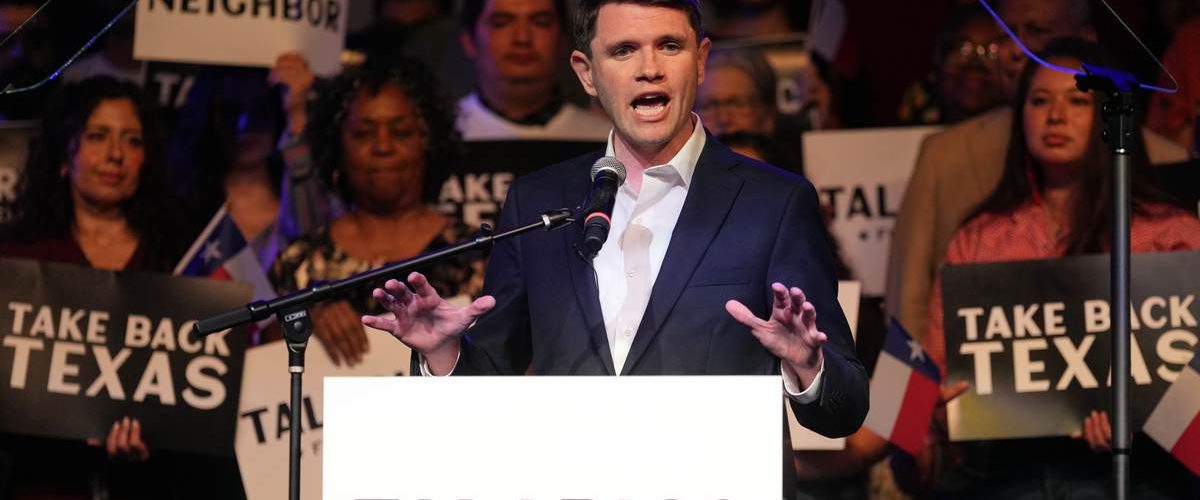
The Texas Senate race has a candidate casting himself as a churchgoing moderate, but a close look at the congregation he attends raises serious questions about how authentic that claim is. This article examines what the church promotes, how it aligns with James Talarico’s public statements, and why those connections matter politically in Texas.
James Talarico presents himself as a moderate Democrat who attends church and even preached during seminary, offering an image meant to reassure voters. Yet the church he’s associated with emphasizes social and identity politics in ways that many Texans will find out of step with traditional Christian practice. That gap between image and association is what opponents are already seizing on.
The congregation in question identifies openly with progressive labels and expansive inclusion language that reads more like a corporate diversity statement than a church mission. The advertised priorities place identity categories and social advocacy front and center, while scripture, sin, and salvation are not emphasized in the same way. For voters who expect clear religious commitments from a churchgoing candidate, that contrast is striking.
Talarico has gone to St. Andrew’s Presbyterian in North Austin since he was 2 years old, and he’s preached there himself while at seminary. St. Andrew’s calls itself “Presbyterian & Progressive,” which is putting it mildly. Pull up the homepage and there’s no scripture, no sin, no salvation, nothing that would’ve made sense to a Presbyterian fifty years ago. Just a pledge to “affirm the full participation of all ages, sex and gender identities, races, color, and ethnicities in all our endeavors,” like an HR seminar broke into the sanctuary and started redecorating.
That quoted description plainly shows why critics label the church as woke: the messaging privileges identity and social programs over traditional theological concerns. For a statewide candidate who claims moderation, close ties to a congregation with such an orientation invite scrutiny. Skeptical voters will wonder whether the candidate’s policy instincts are shaped more by progressive activism than by conventional conservatism or traditional faith values.
Keep scrolling. It gets worse. St. Andrew’s is a “More Light” congregation, the PC(USA) label for churches that fully affirm and ordain LGBTQ clergy, and the church says outright it exists to help congregations “lead LGBTQIA+ service and advocacy.” It’s partnered with Out Youth Austin, an outfit built around “youth of all sexual orientations and gender identities.” So when Talarico told his own congregation in 2022 that “our trans community needs abortion care, too,” nobody there should’ve blinked. He was quoting the mission statement.
St. Andrew’s also holds a formal designation as a “Reproductive Freedom Congregation,” a badge abortion-rights groups hand out to churches that fall in line. It’s stapled right next to the LGBTQ material, same page, same self-satisfied tone, like unrestricted abortion access is just another item on the parish activity calendar.
Those quoted passages show the church’s public commitments, and they align with policy positions that are politically contentious in Texas. When a candidate stands with a congregation that endorses abortion rights and full LGBTQ advocacy, opponents can easily frame that candidate as beholden to activist priorities. For many conservative-leaning voters, those associations are disqualifying, regardless of the candidate’s rhetorical claims to moderation.
There is also a legal angle that complicates the narrative: the church has been connected publicly to sheltering an undocumented family, an action Talarico acknowledged in a prior interview. The legal status of church sanctuaries is murky, relying on constitutional protections and religious freedom claims that have not been definitively resolved by the Supreme Court. That ambiguity creates political risk for any candidate linked to such actions.
From a campaign perspective, these religious and legal entanglements offer clear contrast points for opponents. Texas voters tend to be skeptical of institutions that appear to prioritize ideological causes over conventional religious teachings or legal norms. Highlighting that contrast is an effective strategy for conservative challengers intent on painting the candidate as out of step with mainstream state values.
Ultimately, the mix of progressive church messaging and contested legal activity makes it harder for the candidate to credibly claim the safe, moderate image he wants. In a statewide race where cultural issues matter, these affiliations will be scrutinized and debated, and they will influence how voters perceive sincerity and judgment.

Add comment