
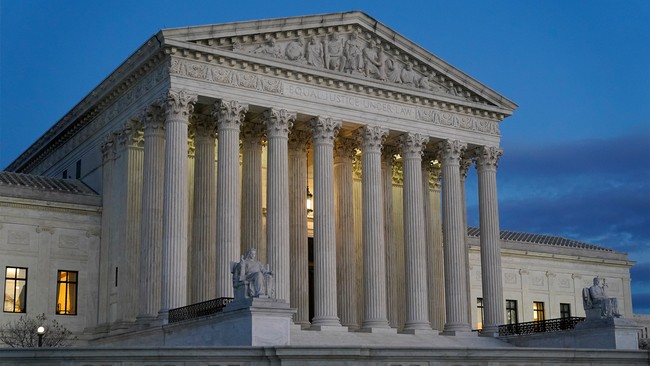
The Supreme Court has temporarily allowed Texas’ new congressional map to remain in place, issuing a stay of a lower court order that had blocked the map; the decision was handed down 6-3 with a per curiam order and a separate concurrence by Justice Alito, while a 17-page dissent was filed by Justice Kagan joined by Justices Sotomayor and Ketanji Brown Jackson.
Republicans can view the stay as a win heading into the midterms, because the practical outcome is straightforward: the newly drawn map will be used for upcoming elections while the legal fight continues. The court’s action halts the lower court’s injunction and keeps the status quo, avoiding last-minute changes to election rules that the majority said would sow confusion. That reasoning aligns with long-standing caution about altering election procedures on the eve of voting.
The path to the Supreme Court began after a three-judge district court panel enjoined the Texas plan, prompting the state to take the appeal directly to the high court. The Supreme Court responded quickly with an administrative stay and later a formal stay pending appeal on the merits, reflecting how redistricting cases get fast-tracked because of election timelines. For Republicans who backed the map, the decision preserves the legislature’s work while the justices review the legal claims.
In a short per curiam order the court explained its preliminary view that Texas meets the traditional criteria for interim relief. The order highlights two alleged errors by the district court and notes a strong showing of irreparable harm and the public interest favoring the stay. The majority emphasized that lower courts should be cautious about altering election rules close to elections, citing prior precedent on that principle.
Based on our preliminary evaluation of this case, Texas satisfies the traditional criteria for interim relief. See Indiana State Police Pension Trust v. Chrysler LLC, 556 U. S.960 (2009) (per curiam). Texas is likely to succeed on the merits of its claim that the District Court committed at least two serious errors. First, the District Court failed to honor the presumption of legislative good faith by construing ambiguous direct and circumstantial evidence against the legislature. Contra, Alexander v. South Carolina State Conference of the NAACP, 602 U. S. 1, 10 (2024). Second, the District Court failed to draw a dispositive or near-dispositive adverse inference against respondents even though they did not produce a viable alternative map that met the State’s avowedly partisan goals. Contra, id., at 34–35.
Texas has also made a strong showing of irreparable harm and that the equities and public interest favor it. “This Court has repeatedly emphasized that lower federal courts should ordinarily not alter the election rules on the eve of an election.” Republican National Committee v. Democratic National Committee, 589 U. S. 423, 424 (2020) (per curiam). The District Court violated that rule here. The District Court improperly inserted itself into an active primary campaign, causing much confusion and upsetting the delicate federal-state balance in elections.
That blockquoted language is central to the majority’s reasoning, stressing both procedural caution and skepticism about the lower court’s handling of evidence. The court pointed out an alleged failure to give the legislature the benefit of the doubt on intent and criticized the district court for not penalizing challengers who did not offer an alternative map matching the state’s partisan objectives. Those findings frame the stay as corrective and protective of state prerogatives in drawing lines.
Justice Samuel Alito wrote a short concurrence joined by Justices Clarence Thomas and Neil Gorsuch, taking a sharper tone on the record about the role of partisanship in mapmaking. Alito makes clear that when a map’s stated purpose is political advantage, challengers must produce an alternative map that would serve the same partisan goals if they claim the true motive was racial. His concurrence stresses the legal standard he believes the lower court should have applied.
First, the dissent does not dispute—because it is indisputable—that the impetus for the adoption of the Texas map (like the map subsequently adopted in California) was partisan advantage pure and simple.
Alito continued in the accompanying text that if challengers could have produced a competing plan that achieved the State’s partisan aims but did not, that failure creates a strong inference in favor of the State’s explanation. He criticized the district court for applying what he viewed as the wrong legal standard and for falling short of the correct tests set out in prior cases. That line of argument will be important as the case moves toward a full merits review.
On the other side, a 17-page dissent authored by Justice Elena Kagan and joined by Justices Sonia Sotomayor and Ketanji Brown Jackson disagreed strongly with the stay. The dissent underscores the deep split on the court about how to evaluate intent, evidence, and the proper remedies when a map is challenged under the Voting Rights framework. The presence of a robust dissent signals that the merits phase will be contested and closely watched.
With the stay in place, Texas will use its new congressional map for the immediate election cycle, and the legal battle shifts to full briefing and argument on the merits. The debate now turns to whether the Supreme Court will accept the state’s claims at final review and how it will balance evidence of partisan intent against claims of racial motive and voting rights. For Republican strategists, the interim result protects legislative choices and buys time until the court resolves the larger questions.



Add comment