
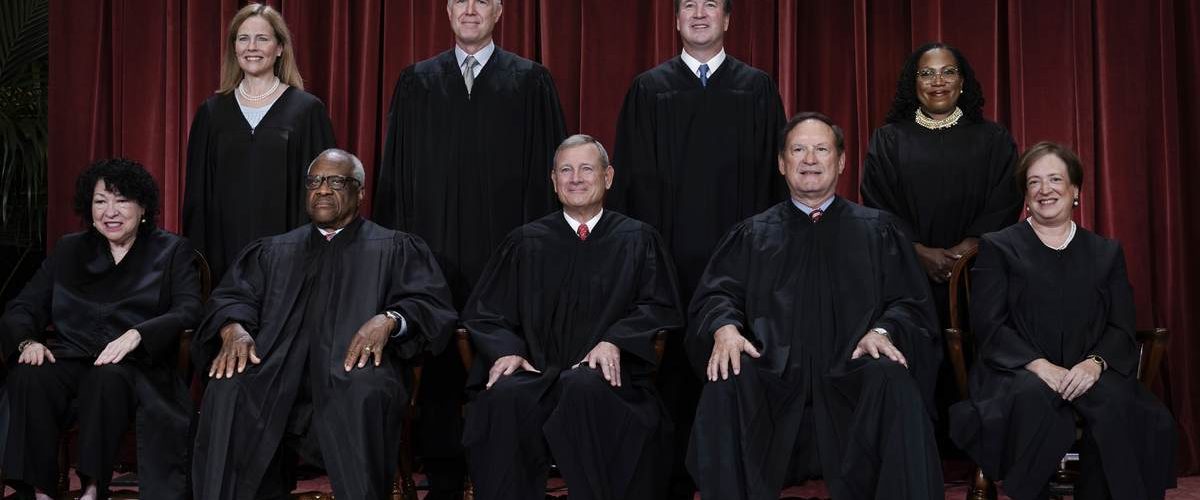
The House vote this week rejected a constitutional amendment that would have locked the Supreme Court at nine justices, handing Democrats a clear choice on whether to foreclose court expansion permanently or leave the option for future majorities. The measure failed 212-206, with only one Democrat joining Republicans in support, and the debate exposed how each party views the Court’s role and the power of Congress over its structure.
The proposed amendment was simple and short: “The Supreme Court of the United States shall be composed of nine justices.” That single sentence was designed to remove any uncertainty about whether future Congresses and presidents could add seats to the Court. Republicans framed the vote as forcing Democrats to put a position on the record, arguing the public deserves clarity on whether expanding the Court is on the table. The outcome showed nearly every Democrat preferred flexibility rather than a binding constitutional limit.
House Speaker Mike Johnson said Republicans wanted Democrats to “put their money where their mouth is” and make a definitive statement about court-packing. The public debate has been heating up as Democrats discuss sweeping “Supreme Court reform” should they regain power. House Minority Leader Hakeem Jeffries called such reform “necessary” and suggested a range of options remain possible, telling listeners, “There’s a variety of different options that are on the table,” and adding, “And I think that we can’t foreclose any single one of them.” Those comments underscore why Republicans pushed the straightforward fix.
The vote tally—212-206—fell well short of the two-thirds threshold needed for a constitutional amendment to pass the House. Only one Democrat crossed the aisle to vote with Republicans: Rep. Don Davis of North Carolina. That lone defection did not change the result, but it did illuminate the political split inside the Democratic caucus. For Republicans, the refusal of most Democrats to lock the Court at nine justices looked like a political dodge to preserve options for power plays in the future.
Democrats defended their stance by arguing that a constitutional fixation on nine justices would itself limit Congress’ constitutional authority over the federal judiciary. They claimed the amendment would entrench the current conservative majority and remove a legitimate tool for future legislatures. Representative Jamie Raskin and other Democrats pointed to past Senate actions and nominee fights as evidence that Republicans have already engaged in tactics that reshaped the Court’s composition.
Republicans countered that the threat Democrats pose is not theoretical. House Judiciary Committee Chairman Jim Jordan warned that expanding the Court to change its ideological balance would amount to an attack on judicial independence. During debate, Republicans emphasized the risk of policymakers treating the Court like a political utility instead of an impartial arbiter. They argued the amendment would have prevented a cycle of retaliation where each new majority reshuffles the judiciary to suit its preferences.
Beyond the immediate vote, the discussion revealed distinct approaches to power. Democrats appear willing to consider structural changes when it suits political goals, while Republicans insisted on preserving institutional stability. That contrast was central to the messaging from GOP lawmakers during the debate, who framed the amendment as a modest, principled step to stop a partisan scramble for control of the Court.
Several Democrats, including Rep. Mary Gay Scanlon, warned that enshrining nine justices would “undermine our system of checks and balances” and permanently restrict future Congresses from acting. Their position rests on the idea that flexibility is necessary to respond to future crises or perceived abuses. But Republican critics say handing one party the perpetual right to alter Court composition whenever it gains power would further politicize the judiciary and weaken public confidence in its impartiality.
https://x.com/GuntherEagleman/status/2095285008843849946
The episode is likely to follow both parties into campaign season, where court reform and judicial appointments will be major themes. Republicans will highlight the vote as proof that Democrats refuse to forgo court-packing, while Democrats will frame the Republican proposal as an unnecessary constitutional constraint that cements a conservative advantage. Either way, the debate over the Court’s size is no longer an abstract academic question; it is a political flashpoint shaping how voters view institutional norms and the balance of power.
Editor’s Note: Do you enjoy RedState’s conservative reporting exposing the radical left and woke media? Support our work so we can keep bringing you the truth.



Add comment