
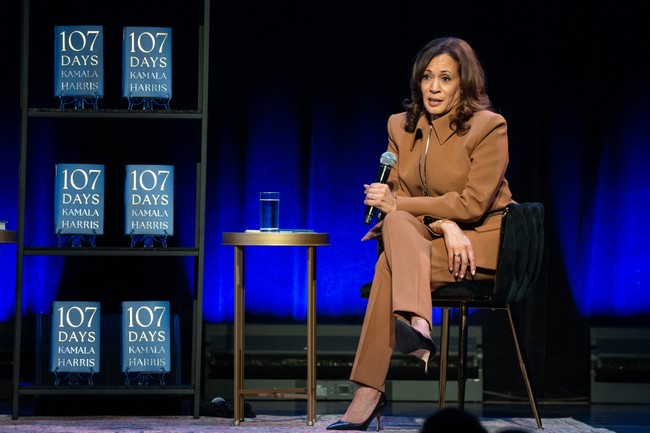
I’ll lay out why Kamala Harris’s recent interviews — with Jaime Harrison and Jimmy Kimmel — reinforce the case against her as a 2028 contender, highlight questionable judgment on the Epstein records and DOJ independence, and note a bizarre anecdote about a post-assassination-attempt phone call that undercuts her credibility.
KAMALA HARRIS is out promoting her book and her recent TV appearances reveal weaknesses that matter politically. Her answers on whether she might run in 2028 were noncommittal in a way that keeps her in the conversation without convincing anyone she is ready. The interviews offered more than promotion; they showed repeated lapses in judgment and tone-deaf moments that will follow any campaign.
In an interview with former DNC chair Jaime Harrison, Harris was asked about 2028 and left the door open while the interviewer became emotional about the idea of a Black woman president. That exchange looked calculated to tug at identity-based sympathies rather than offer a clear political case for her candidacy. The performance reminded watchers that identity appeals alone do not make a strong statewide or national campaign pitch.
Harris doubled down on praising fellow justices in a way that struck many conservatives as uninformed. She called the dissents of Justice Ketanji Brown Jackson “brilliant,” which will not land with voters who read the opinions and see a different legal judgment. That kind of praise for judicial reasoning that many see as flawed raises questions about Harris’s legal instincts and how she evaluates constitutional matters.
Observers pointed to sharp rebuttals from other justices as evidence that Jackson’s dissents are not universally admired even within the judiciary. Those rebuttals highlight how the mainstream of legal thought leaned against Jackson’s approach in a major case, and Harris’ blanket praise looks like partisan cheerleading. Voters expect nuanced legal judgment, not one-size-fits-all endorsements.
On Jimmy Kimmel’s show Harris was asked about how she and her husband recovered emotionally after the 2020 loss, and she admitted it took “some time” to bounce back. That came off as humanizing in isolation, but the overall interview blended softballs with moments that raised eyebrows. When hosts mix personal questions with political ones, candidates need to be sharp on the policy and firm on accountability; Harris did not always hit that balance.
Kimmel also asked about the Epstein files and why the Biden-Harris team did not release them, which is a question that has dogged the administration. Harris’s answer leaned on the notion that the Department of Justice needed to be independent and that they were careful not to interfere. To many Republicans and independent voters, that explanation rang hollow given other high-profile interactions between the administration and law enforcement.
“To give you an answer that will not satisfy your curiosity, I will tell you, we, perhaps to our damage, but we strongly and rightly believed that there should be an absolute separation between what we wanted as an administration and what the Department of Justice did. We absolutely adhered to that and it was right to do that.
“The Justice Department would make its decisions independent of any political or personal vendetta or concern that we may have, and that’s the way it worked.”
Republican critics will point to the inconsistent record of DOJ independence when it comes to actions that affected political rivals, and they will ask why Epstein-related materials were not handled differently if there were real concerns. The public remembers aggressive actions that look partisan, and that memory erodes trust in explanations about institutional restraint. Harris’ defense sounded like ideology rather than a robust factual account that could settle doubts.
Harris also claimed that when she called former President Trump after the assassination attempt at a golf course she heard him talking about selling his book. That anecdote reads as petty and unbelievable to many, because it makes light of a serious situation and seems designed to tarnish an opponent. Even if true, the story undercuts the expected dignity in a call about a life-threatening event and gives critics more fodder.
Across both interviews Harris displayed a mix of defensiveness and rhetorical missteps that will be hard to shake in a primary or a general election. Campaigns hinge on discipline, credibility and steady judgment, and these appearances reinforced doubts instead of resolving them. For voters who prioritize competence and consistency over identity appeals and theatrical moments, these interviews make a tough case for Harris as the right 2028 choice.

Add comment