
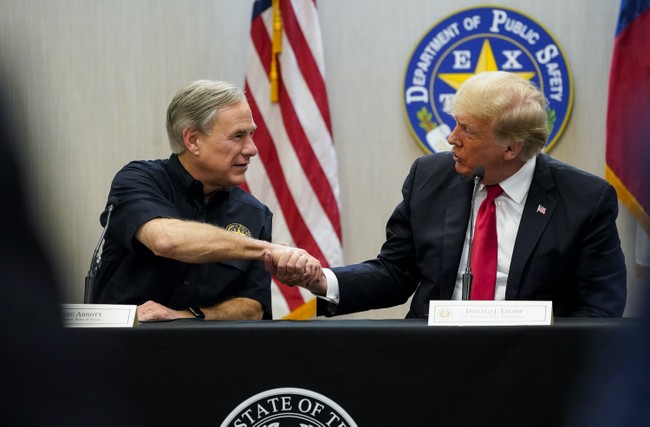
Texas is booming, and a new clash between Governor Greg Abbott and President Donald Trump over the rapid rise of AI-driven data centers has put economic momentum and infrastructure strain on a collision course. This piece looks at the political split, the energy and water demands of massive server farms, and pragmatic solutions that could let Texas keep winning without shortchanging residents. It preserves key statements and quotes from the original reporting and keeps the focus on the stakes for Texas and the nation.
Texas has long marketed itself as a place for business growth, drawing talent and investment from higher-tax, more regulated states. That migration helped fuel the state’s recent economic boom, and the rise of artificial intelligence simply increases demand for places with cheap land, favorable regulation, and strong energy markets. Data center developers see Texas as ideal, but the infrastructure required to support those server farms is not trivial.
Governor Abbott is pushing for rules that would make developers internalize the costs their projects impose on the grid and local services. He has directed regulators to ensure data centers cover necessary infrastructure investments and urged developers to add on-site power generation rather than shifting costs to residents. Those steps reflect a conservative outlook on fiscal responsibility: let private projects pay their way so taxpayers and ratepayers are not left holding the bill.
President Trump, by contrast, is warning that discouraging data centers could be a strategic mistake for Texas and the country. He framed the opportunity as massive economic upside, predicting that “Data centers could be bigger than oil.” That line captures a national-priority argument: energy policy and industrial strategy should encourage rapid expansion of critical technology infrastructure to keep the U.S. competitive in AI.
The artificial intelligence boom is fueling a data center rush in Texas and opening a rare divide between President Donald Trump and one of his closest political allies — Republican Gov. Greg Abbott.
Projects bringing billions of dollars in investment to Texas also create enormous demand for electricity, raising questions over who will be on the hook to pay for potential power grid impacts. Abbott has moved to address those concerns, directing regulators to ensure data centers cover the infrastructure costs needed to serve them and calling on developers to add their own power generation rather than shift costs onto Texas residents.
Trump isn’t happy with Abbott’s approach and called the Lone Star State’s stance toward data centers a “mistake,” pointing to the economic investment the projects can bring to communities willing to host them.
There is truth on both sides. The AI industry will require enormous amounts of compute and therefore large, stable supplies of electricity and cooling. Texas experienced catastrophic grid failures in 2021, which makes caution understandable. Conservatives who care about reliable markets should want infrastructure expansions that don’t threaten residential power or drive up bills unexpectedly.
At the same time, Republicans who prioritize energy dominance and industrial leadership should not reflexively choke off investment that can create jobs, tax revenue, and technological capacity. The president’s emphasis on making energy and AI central pillars of national strategy reflects that frame, arguing that policy should be designed to capture economic benefits rather than lose them to competing jurisdictions.
The president has made energy dominance and U.S. leadership in artificial intelligence central pillars of his second term.
“For Texas to say no to data centers is a mistake in the sense that it could be bigger than oil,” Trump told Punchbowl News in an interview published Friday.
“Data centers could be bigger than oil,” he predicted.
Practical solutions exist that align with both sets of concerns. Small modular nuclear reactors offer a pathway to reliable, scalable electricity without putting additional stress on the traditional grid. Requiring developers to invest in on-site generation or fund grid upgrades can prevent cost shifting while still letting projects move forward.
Water is another constraint. Conventional data center cooling consumes significant water, and parts of Texas are water-scarce. That means siting and design choices matter: air-cooled systems, advanced liquid cooling with closed-loop recycling, or alternative cooling technologies can reduce freshwater demand even as capacity grows. Policy can incentivize these options so growth is sustainable.
Dallas has swiftly become a global magnet for data center capacity, rising through comparison indexes to a top position among world markets. That momentum shows the state’s competitive advantages are real, but momentum alone is not a license to ignore infrastructure limits. Sound policy should protect residents, secure supply, and preserve Texas’s business-friendly climate without surrendering its long-term resilience.

Home-based job that pays more than 12,000 Dollar per month by doing simple tasks on a laptop or mobile device part-time. Last month, I earned 24,863 Dollar from this job by working 4 hours per day online. Very simple jobs to do, and the earnings are insane. Everyone can now make more money online by joining the website listed below…..
𝒋𝒖𝒔𝒕 𝒖𝒔𝒊𝒏𝒈 𝒕𝒉𝒊𝒔 𝒔𝒊𝒕𝒆.. Www.PayAtHome1.Com
AI-driven data centers: and Extremely BAD IDEA and will be detrimental to Texas and the USA!!!
Trump: “Data centers could be bigger than oil.” I say What the hell are you talking about!!!
Are you pushing for Orwellian 1984 and Terminator SkyNet to bring on the Dystopian Globalist Totalitarian World and the extermination of humanity???!!!
H2O is the basic Life Force for Human Beings and the Natural Environment!!! Take all this Hi-Tech to hell where it belongs with all those on the planet who are pushing it! People like Elon Musk with his Net Worth near a $Trillion, sure all you fat cats and rulers love this CRAP! Don’t give a damn about Humanity and the Eco-system!!!