
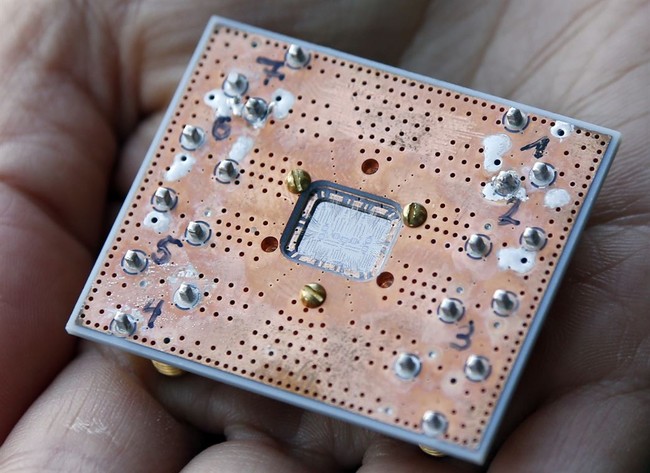
The United States has just taken a major step in quantum networking: a laser on a Stony Brook rooftop sent photons across 13 miles of open air to Brookhaven National Laboratory, demonstrating a permanent free-space link that plugs into a growing 161-mile, eight-node quantum testbed and signaling a clear push to build domestic quantum infrastructure.
A few photons left a hair-thin fiber on a Stony Brook rooftop and arrived 13 miles away at Brookhaven National Laboratory in Upton, with nothing but open air connecting the two sites. Researchers recorded their first clear nighttime reading shortly after midnight, capturing entangled photons with an ultrafast camera inside Brookhaven’s Quantum Lighthouse. This link is being treated as the first U.S. demonstration of a permanent open-air quantum segment attached to a larger terrestrial network.
The experimental shot used a fiber with a five-micron core to launch a tightly confined beam, then relied on precision optics and adaptive mirrors to hold the path steady through turbulent air. Entangled photons traveled from a rooftop station called the Watchtower and registered at Brookhaven, where teams carefully coordinated timing, pointing, and detection to make the connection. The project aims to test entangled photons for secure communications, quantum sensing, and the kinds of links that could connect quantum processors in different places.
Darío Gil, the Energy Department’s undersecretary for science, was on site in the Lighthouse when the beam arrived, ceremonially cutting a ribbon that covered the receiver before the photons were revealed to the sensor. He also highlighted Genesis, the DOE’s AI-for-science program, which traces back to an executive action set in motion by the White House. That initiative folded quantum information science into a broader federal push to solve major national research challenges and accelerate applied science across multiple fields.
Policy moves played a big part in the momentum behind this work. A presidential order asked the Department of Energy to lead on a list of at least 20 national science problems, and quantum information was named alongside manufacturing, biotechnology, and semiconductors. White House science officials later outlined a funding plan of more than $5 billion across hundreds of projects targeting AI for quantum computing, sensors, and communications, signaling a serious national investment in the technology.
Another executive order directed federal agencies to speed the deployment of advanced AI tools for cybersecurity and critical infrastructure protection, and a separate quantum-focused order charged the science adviser with producing an updated national strategy within 180 days. Agencies including the FBI, the Departments of Defense, Commerce, and Energy were assigned responsibility for security and foreign-threat assessments related to quantum progress. That mix of operational and strategic attention reflects how the government sees quantum technology as both an economic and national-security priority.
On the engineering side, researchers had to overcome atmospheric challenges that do not exist in fiber-based telecom systems. Commercial fiber networks are tuned for traditional telecom wavelengths, and many quantum processors run at infrared wavelengths that require conversions. Going through open air avoids some of those conversions but exposes the beam to heat gradients, wind, and building-induced turbulence that shove the beam off target while adaptive optics pull it back into alignment.
Brookhaven scientist Justine Haupt credited the coordinated work from equipment teams on both ends for the success, emphasizing the choreography required to make the experiment run like a single instrument rather than two separate labs. She said, “Bringing all those pieces together — and then adding the quantum layer — is what makes this capability unique.” That quantum layer includes entanglement distribution, timing synchronization, and ultrafast detection that must all operate in concert at night and over real-world distances.
Plans are already moving forward to scale the concept. A third rooftop station now stands at Yale University, and the next test will attempt a 30-mile crossing from Stony Brook to New Haven over Long Island Sound. Brookhaven’s longer-term ambition is to push quantum information skyward, eventually linking ground nodes to satellites and creating a hybrid space-terrestrial quantum backbone for secure links and distributed quantum computing.
Before reaching satellites, teams must master 30 miles of choppy air over Long Island Sound and the engineering headaches that come with maritime atmospheric dynamics. Adaptive mirrors, vibration isolation, and predictive tracking will play critical roles as the link distance grows and the system moves toward daylight operations and routine use. Success at those distances would mark a leap in network architecture by enabling direct free-space quantum links that complement fiber routes.
These demonstrations are strategic as much as technical, showing how federal funding, targeted policy, and university-lab partnerships can accelerate capability while keeping development on U.S. soil. The momentum has a diplomatic and competitive edge too, because the ability to field resilient quantum networks matters for both commercial advantage and national security. In that context, the experiment’s timing and backing make clear that quantum networking is now in the national spotlight.


Add comment