
The Senate adjourned for the holidays without passing a major five-bill spending package that would fund Defense, Labor, HHS, Education, Commerce, Justice, Interior, Transportation, and HUD, after Democrats, led in part by Colorado’s senators, held up the deal over a dispute about the future of a climate research center in Boulder.
Washington left town with a big chunk of federal funding unresolved, and the immediate consequence is uncertainty for agencies and programs that rely on timely appropriations. Republicans pushed the package as a way to prevent another shutdown by Jan. 30, while Democrats used holds to extract leverage on a separate fight over the National Center for Atmospheric Research. The outcome: no deal, and lawmakers heading home for the holidays.
Lawmakers have spent the last month since the government shutdown building consensus on a five-bill spending package that would go a long way toward preventing another one come Jan. 30.
The package would have funded the departments of Defense, Labor, Health and Human Services, Education, Commerce, Justice, Interior, Transportation, and Housing and Urban Development, which represent a massive chunk of Congress’ overall funding responsibilities.
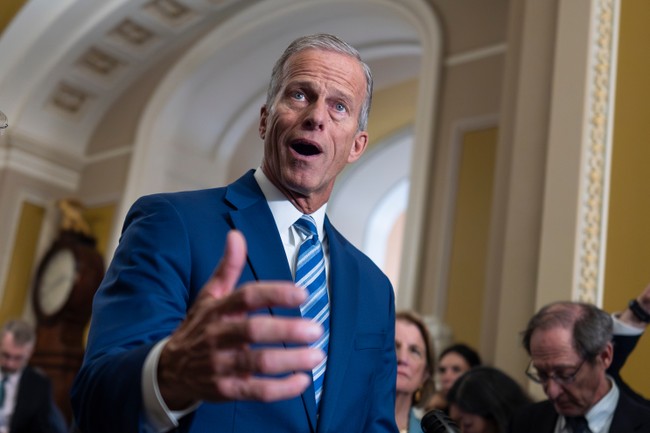
But a deal never materialized, and the lights of the Senate chamber went out for the last time of the year as lawmakers beelined from Washington, D.C., back to their home districts. Senate Majority Leader John Thune, R-S.D., remained hopeful that when the Senate returned, Democrats would cross the aisle to finish the job.
“The Democrats are indicating that they want to do them, they just didn’t want to do them today,” Thune said. “So hopefully, when we get back, we’ll test that proposition, and hope that we’ll take them to face value, and hopefully we’ll get moving, and get moving quickly, because we’ve got a lot to do.”
The hold that broke the momentum came from an unlikely place: two Democratic senators from Colorado defending a federal research center that critics say is steeped in political advocacy on climate alarm. Senate Republicans had cleared internal holds and wrangled amendments, but the remaining blockage centered on keeping the National Center for Atmospheric Research intact in Boulder. That single issue stalled an otherwise agreed package that covered a sprawling set of federal responsibilities.
Senators John Hickenlooper and Michael Bennet wanted assurances that Congress would preserve NCAR, and they conditioned lifting their objections on a vote outcome they viewed as essential. Their stance reflects the familiar tug-of-war where local economic interests collide with national fiscal oversight. Keeping a major federal employer in state lines is politically understandable, but it shouldn’t paralyze the federal budget process for the whole country.
Office of Management and Budget Director Russ Vought weighed in on the controversy, signaling a review of NCAR and how its roles might be redistributed. On Wednesday, Director of the Office of Management and Budget Russ Vought indicated that the NCAR was . Colorado’s senators responded by insisting on a guaranteed outcome, seeking to force a vote that Senate Republicans say they cannot and should not promise.
Republicans argue that NCAR’s functions are executive branch responsibilities and can be reorganized inside the administration without Congress micromanaging operational placement. That position is rooted in the separation of powers and in the practical view that essential research tasks can move to other locations or agencies if necessary. The pushback from Colorado’s delegation came across as protectionism, prioritizing a local institution over finishing appropriations that fund the national government.
Office of Management and Budget Director Russ Vought called the facility in a “one of the largest sources of climate alarmism in the country,” and vowed a comprehensive review was underway and that any “vital activities such as weather research will be moved to another entity or location.”
Hickenlooper suggested that he and Bennet would lift their hold only if they received a guaranteed outcome on an amendment vote — a proposition Republicans have time and again this year for several other Democratic issues that they said they couldn’t do.
The consequence of this impasse is simple: Congress failed to finish a major chunk of its work before recess, passing the buck to next month when the calendar crunch will be even tighter. That’s on the senators who refuse to prioritize must-pass funding over a single policy fight. Voters and agencies alike are left holding the bill while lawmakers trade leverage for headlines.
Republicans intend to return and press the issue, asserting that essential government functions should not be held hostage to partisan demands or local agendas. Democrats, meanwhile, see opportunity in blocking a package to elevate their priorities and extract concessions. Either way, the result is the same: another round of brinkmanship that makes governing harder and spending decisions less predictable.
Expect the debate to pick up immediately when the Senate reconvenes, and expect both sides to frame the story in their own terms. Meanwhile, agencies and employees across the departments in question face continued uncertainty until lawmakers choose to finish the work they left undone.



Add comment