
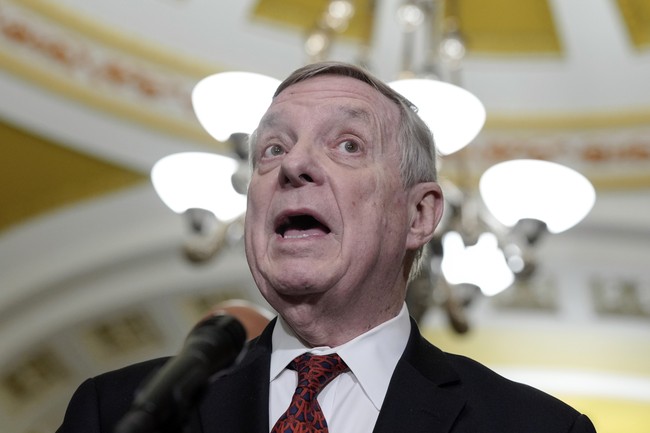
The Senate floor moment with Sen. Dick Durbin sharing an image tied to the Alex Pretti shooting has become a controversy about truth and tactics, after the photo he displayed appears to be AI-generated and not an authentic record of the scene. This article lays out what was shown, why the image looks fake, and why that matters for public trust and ongoing investigations. It also explains why, from a conservative perspective, elected officials using questionable material on the floor undercuts serious oversight. The focus remains on facts, the video timing, observable image errors, and the broader implications for political messaging.
Sen. Dick Durbin presented a blown-up photo during a Senate speech and described the image as “graphic” but “necessary.” The picture was offered as if it captured the last seconds before Alex Pretti was killed, and Durbin can be seen placing it on a stand at 0:52 in the video of his remarks. That specific timestamp is important because the image was used as an evidentiary frame in front of colleagues and the public, not simply as commentary or opinion. When an image is presented in that context it carries an implicit claim of authenticity.
Close inspection of the picture reveals clear signs of artificial generation rather than photographic reality. The figure identified as Pretti appears to be missing a head and several elements are distorted, with limbs and objects rendered in ways that do not match the available footage. One obvious discrepancy is the position of the officer holding a firearm; in the video evidence the officer’s stance and placement do not align with the depiction in the image. Those problems are classic AI artifacts and they make the image unreliable as evidence.
Beyond visual artifacts, the intent behind using such an image matters. If staffers or the senator intentionally promoted an AI creation as a factual depiction, that reflects a willingness to shape narrative over verifying truth. That approach is dangerous when it comes from leaders who set the tone for public understanding of high-profile events. In this incident, the rush to influence perception before a full, impartial investigation risks politicizing facts that ought to be clarified by due process.
Some will argue the use of provocative material is justified to draw attention to an alleged injustice, but that rationale weakens when the material is demonstrably flawed. A pattern of relying on sensational but inaccurate imagery mirrors past political moments where premature narratives took hold despite contrary evidence. From a conservative perspective, accountability and evidentiary standards should be nonnegotiable, especially for those who occupy institutional platforms and claim to defend the rule of law.
The timing of the image’s display and the way it was promoted on the Senate floor imply coordination by staffers who prepared the visual aid. It is unlikely a senior senator stumbled upon an obviously generated picture by accident and then mounted it as a centerpiece of a speech. That raises questions about judgment and strategy: was the goal to spark outrage, to steer the media cycle, or to preempt investigative findings by setting a public narrative? Whatever the motive, the result was confusion rather than clarity.
Federal investigations are reportedly underway into the shooting, and those processes should determine what happened based on evidence, witness accounts, and forensic analysis. Politicians rushing to produce dramatic visual claims can interfere with that work by inflaming public opinion and muddying the evidentiary record. Conservatives worry that this kind of behavior substitutes theater for due process and undermines trust in institutions charged with fact-finding.
There is also a broader technological concern: AI can generate convincing but false images, and that capability will be abused by both amateurs and professionals. Public officials who lean on AI fabrications — even sloppily produced ones — erode the standards needed for responsible information sharing. Responsible governance requires clear lines between verified documentation and illustrative or speculative material, especially when lives and law enforcement actions are involved.
Critics will accuse opponents of political bias in raising these issues, but the point is simple and nonpartisan: evidence presented in formal settings should be reliable. When senators present materials to influence national conversation, those materials must be vetted. The appearance of an AI-created photo being used as fact on the Senate floor does not help anyone seeking a truthful accounting of the Pretti shooting.
Moving forward, elected officials should avoid theatrics that resemble propaganda and should prioritize transparent cooperation with investigations. The public deserves clear, credible information, not sensational visuals that create more doubt. If leaders want confidence in outcomes and accountability, they must model the standards they expect from law enforcement and the press.
Here is a screengrab of it.


Add comment